


When a whole house water filter gets dirty fast, the filter itself is not necessarily defective. Rapid clogging usually points to one or more of four conditions: a heavy sediment load, a cartridge that is too fine for the incoming water, insufficient pre-filtration, or a recent change in source-water conditions.
The practical question is not simply, “Does the filter look dirty?” A sediment filter is supposed to collect debris. The more useful questions are:
-
Has household water pressure or flow declined?
-
How quickly did the change occur compared with previous cartridges?
-
What type of material is on the used filter?
-
Did the problem begin after a storm, hydrant flushing, construction, plumbing repair, or well-system change?
-
Is the cartridge appropriately sized and staged for the home’s water use and sediment load?
A filter that turns brown but continues to deliver normal flow may still be functioning. A filter that causes persistent pressure loss shortly after installation needs investigation, even if it does not look dramatically discolored.
Maintenance Snapshot: What you expect vs. what actually clogs filters

A dirty-looking cartridge does not automatically explain why a whole house filter clogs quickly. Use the symptom, likely cause, and system behavior together.
|
Symptom |
Likely cause |
What to check |
Practical response
|
|---|---|---|---|
|
Cartridge turns brown or orange, but flow remains normal |
Captured silt, rust, or other suspended debris |
Compare current flow with the normal household baseline |
Continue monitoring; do not replace based on color alone unless the product instructions require it |
|
Water pressure drops soon after a new cartridge is installed |
Heavy sediment, overly fine filtration, undersizing, or an installation issue |
Check pressure before and after the filter where gauges exist; verify cartridge type and flow direction |
Correct installation problems, investigate sediment load, and evaluate compatible pre-filtration |
|
Filter contains visible sand or gritty particles |
Well sediment, disturbed source material, or debris entering through plumbing |
Note whether the condition follows storms, well work, or plumbing changes |
Test the source water and have recurring well or plumbing problems inspected |
|
Cartridge has rust-colored flakes |
Aging plumbing, a disturbed municipal line, or iron-bearing debris |
Check whether nearby hydrant flushing, construction, or pipe work occurred |
Monitor after the event; consult the utility or a plumber if it continues |
|
Filter clogs during periods of unusually high water use |
The cartridge is reaching its debris or flow capacity faster |
Review household demand, including guests, irrigation, laundry, and simultaneous fixture use |
Consider whether the system is properly sized for peak demand |
|
Immediate low flow after replacement |
Incorrect installation, trapped air, incomplete startup flushing, wrong cartridge, or a preexisting restriction |
Confirm flow direction, cartridge seating, seals, valves, and model-specific startup instructions |
Reinstall according to the manual and flush only as directed for that system |
|
Repeated clogging continues with every new cartridge |
Persistent source problem or filtration mismatch |
Test the water and inspect the well, plumbing, and filtration sequence |
Fix the upstream cause or redesign the sediment stages instead of repeatedly swapping cartridges |
|
Slimy or unusual film repeatedly appears |
Material that cannot be identified visually with confidence |
Review housing hygiene and arrange appropriate water testing |
Follow model-specific cleaning guidance and seek professional water-quality advice |
This table is a starting point, not a laboratory diagnosis. Cartridge color and texture can guide the next check, but appearance alone cannot identify contaminant concentrations or establish whether water is safe.
How can I reduce how often my whole-house filter needs changing?
A whole-house filter becomes dirty because it is retaining material from the incoming water. If it becomes functionally clogged much sooner than expected, determine why the cartridge is receiving more debris—or more flow—than the system can comfortably handle.
Heavy sediment in the incoming water
Sand, silt, soil particles, rust, and pipe debris occupy the open spaces in a sediment cartridge. As those spaces fill, water has fewer paths through the filter media. Resistance increases, and downstream flow or pressure can decline.
Heavy sediment may be continuous, as can happen with some wells, or temporary. A single source-water disturbance can shorten the life of a new cartridge even when the system normally performs as expected.
A micron rating that is too fine for the sediment load
Micron rating describes the particle size a filter is designed to capture under its specified conditions. A finer cartridge has smaller pathways, so it may load more quickly when the incoming water carries substantial sediment.
That does not mean finer filtration is always wrong. It means a fine cartridge should not be expected to handle unlimited coarse debris efficiently. If sand, rust flakes, or larger particles reach a fine stage first, they may consume its usable capacity prematurely.
Do not change micron ratings blindly. A coarser cartridge may improve service life but could allow smaller particles to pass. Selection should be based on the water test, the purpose of the filtration stage, household flow needs, and the system manufacturer’s compatibility guidance.
Missing or insufficient pre-filtration
Where the water contains substantial larger debris, a compatible coarse pre-stage can protect the finer downstream cartridge. The principle is straightforward: remove larger particles first, then use a finer stage for smaller sediment.
Some installations use a flushable or spin-down pre-filter for this purpose. Such a device also requires maintenance. If its screen or sump is allowed to accumulate debris, the pre-filter can become the new flow restriction.
Not every home needs a spin-down stage, and not every filtration system supports one. If sediment loading is recurring, review compatible whole-house pre-filter options in the context of the existing plumbing, water source, and filtration sequence.
An undersized cartridge or system
A filter must accommodate both the home’s water demand and the amount of debris entering it. A cartridge with limited surface area may fill sooner under high sediment conditions. A system that cannot comfortably support peak household demand may also produce noticeable pressure loss earlier.
Do not size a whole-house filter only by the visible pipe diameter. Household demand, simultaneous fixture use, source pressure, cartridge design, and sediment concentration all affect performance. Product specifications and installation requirements should be reviewed for the particular model.
Incorrect installation or startup
If low flow begins immediately after installation, sediment may not be the only explanation. Check for:
-
Reversed inlet and outlet direction
-
A cartridge that is not properly seated
-
Valves that are not fully returned to the operating position
-
A pinched, displaced, damaged, or incorrectly seated O-ring
-
A cartridge that is incompatible with the housing
-
Trapped air or filter fines following startup
-
A restriction elsewhere in the plumbing
After installation, follow the model’s flushing procedure. Flush volume and duration vary by system, so a single universal time should not be applied to every whole-house filter. Proper flushing helps prevent trapped air or startup fines from being mistaken for ongoing clogging.
High household water use
Filter service life depends partly on how much water passes through it. A larger household, frequent laundry, guests, irrigation connections, or multiple fixtures running at once can use available filter capacity faster than a lower-demand home.
If cartridge life changed after household water use increased, compare current demand with the conditions under which the previous maintenance pattern was established.
Temporary source-water disturbances
A sudden dirty water filter can follow:
-
Heavy rain or changing well conditions
-
Hydrant flushing
-
Municipal water-main work
-
Nearby construction
-
Work on the home’s plumbing
-
Well servicing or pump changes
-
Sediment disturbed inside aging pipes
Timing matters. If a filter that normally lasts much longer clogs immediately after one of these events, replacing the cartridge may restore flow, but continued clogging warrants further investigation.
Can high sediment levels make a whole-house filter clog faster?
Yes. High sediment levels are one of the most common reasons for whole house water filter clogging. Each particle retained by the cartridge occupies space within or on the filter media. The greater the sediment load, the sooner resistance to flow increases.
The pattern can differ between well and municipal water.
Well-water patterns
Some wells produce sand, fine silt, or other source material continuously or seasonally. A sudden increase may also be related to changing groundwater conditions, well disturbance, a pump drawing from a sediment-heavy area, or a well component that needs inspection.
A filter protects downstream plumbing from much of this debris, but it does not repair the source problem. When cartridges repeatedly fill with gritty material, arrange water testing and consider having the well system evaluated. Replacing filters indefinitely may conceal an issue that is better addressed upstream.
Municipal-water patterns
Municipal water may carry temporary rust or sediment after hydrant flushing, water-main work, construction, or changes in distribution flow. Older household plumbing can also release internal debris.
Ask the water provider whether work or flushing occurred nearby. If only one fixture is affected, the restriction may be local rather than at the whole-house filter. If sediment persists throughout the home, a plumber can help determine whether household piping is contributing.
Whether the home uses well or municipal water, do not treat filter color as proof of a particular contaminant or health condition. Brown may be associated with captured soil, rust, or other material, but identifying it confidently may require appropriate testing.
What usually does NOT need attention—and wastes effort when you chase it
Rapid clogging can prompt owners to change multiple parts of the system at once. That often adds cost without identifying the cause. Avoid these common detours.
Replacing a cartridge only because it changed color
A sediment cartridge can darken while still maintaining acceptable flow. Discoloration confirms that material has been captured; it does not by itself show that the cartridge is functionally clogged.
Use sustained flow loss, pressure differential where gauges are installed, and declining filtration performance as stronger service indicators. Also follow any model-specific replacement instructions.
Changing filters on an arbitrary calendar
A calendar is useful for reminders and inspections, but incoming water conditions determine how quickly a sediment filter loads. Replacing too early wastes usable capacity. Waiting too long despite obvious pressure loss can reduce household performance.
Track the installation date, but combine it with pressure, flow, water use, and cartridge condition.
Cleaning a disposable cartridge with an unsupported method
Some filter elements are replaceable, while certain screens or reusable components are designed to be flushed or cleaned. Do not assume a disposable cartridge can be restored by spraying, scrubbing, soaking, or adding household chemicals.
Unsupported cleaning can damage the media or introduce material into the housing. Follow the instructions for the exact product. Even when a spin-down screen is designed for cleaning, the approved procedure can vary by model.
Selecting a different micron rating without diagnosing the water
Moving to a coarser filter may reduce pressure loss but allow more fine sediment downstream. Moving to a finer filter may capture smaller material but clog even faster.
The goal is not to select the largest or smallest micron number. It is to match the filtration sequence to the actual sediment profile and the intended function of each stage.
Repeatedly servicing unrelated treatment stages
If the sediment cartridge is visibly loaded and pressure loss occurs across that housing, replacing downstream components is unlikely to solve the source of the restriction. Diagnose the stage where the pressure change appears.
Carbon or other treatment stages may have separate maintenance needs, but they should not be replaced automatically whenever the upstream sediment filter becomes dirty.
What DOES need attention but gets ignored: pressure, flow, and source-water changes
The most valuable troubleshooting information usually comes from a few checks that homeowners overlook.
Establish a normal pressure and flow baseline
Observe how the system performs with a new, correctly installed cartridge. Record pressure readings before and after the filter if gauges are available. If there are no gauges, note practical flow at frequently used fixtures.
Future readings can then be compared with that baseline. A trend is more informative than a single isolated observation because normal pressure differs among homes and systems.
Inspect the spent cartridge
Before discarding a used filter, look at the material it captured:
-
Gritty sand suggests larger source sediment.
-
Fine mud-like loading may indicate silt or disturbed soil.
-
Orange or reddish flakes may be associated with rust-bearing debris.
-
Hard deposits may indicate material that needs further identification.
-
Slippery or slimy material should prompt housing-hygiene checks and appropriate water testing.
These observations narrow the possibilities, but they do not replace laboratory analysis or a professional inspection.
Verify installation direction and assembly
Check the housing’s marked flow direction and the system sequence. Confirm that the cartridge is properly seated and that seals are clean, intact, and positioned according to the manual.
Do not compensate for a leaking housing by overtightening it without guidance. Housing closure and seal care are model-dependent. Shut off the water, use the bypass if provided, and depressurize the system according to its instructions before opening it.
Review recent events
Create a short timeline:
-
When was the cartridge installed?
-
When did pressure begin to fall?
-
Did the water’s appearance change first?
-
Was there a storm, plumbing repair, hydrant flushing, or construction project?
-
Did household water demand increase?
-
Was the well, pump, or pressure equipment recently serviced?
A filter that clogs gradually every cycle may indicate a consistent sizing or sediment issue. A filter that clogs suddenly after a specific event may be responding to a temporary debris spike.
Investigate recurring upstream problems
If every cartridge becomes blocked unusually quickly, replacing filters is treating the symptom. Depending on the water source, the next step may involve:
-
Source-water testing
-
Inspection of a private well and related equipment
-
Evaluation of corroding or sediment-filled plumbing
-
Confirmation that treatment stages are in the correct order
-
Review of system sizing and cartridge compatibility
Seek a qualified plumber, water-treatment professional, or well contractor when the source cannot be identified safely, sediment returns immediately, or pressure problems affect the broader plumbing system.
What does it mean when my filter pressure drops fast?
A sustained pressure drop commonly means the filter is creating more resistance to flow. Sediment loading is a likely reason, but installation errors, partially closed valves, a restricted pre-filter, or another plumbing problem can produce similar symptoms.
Where gauges are installed on both sides of the filter, compare upstream and downstream pressure while water is flowing. An increasing differential across the filter provides stronger evidence of cartridge loading than a household pressure reading taken at only one point.
There is no universal pressure-drop number at which every whole-house cartridge must be replaced. The appropriate service threshold depends on the filter, housing, system design, source pressure, and manufacturer guidance.
Use this sequence when pressure falls rapidly:
-
Confirm that the problem affects multiple fixtures.
-
Check that all operating valves are in the correct position.
-
Review whether the pressure loss began immediately after installation.
-
Compare inlet and outlet readings where gauges exist.
-
Inspect the pre-filter, if the system has one.
-
Inspect or replace the loaded cartridge according to its instructions.
-
If normal pressure returns but falls again quickly, investigate incoming sediment and system sizing.
A fresh cartridge that restores flow temporarily confirms that the filter stage was restricting water, but it does not explain why the cartridge loaded so quickly.
What are the signs my filter is clogged and needs replacement?
The strongest signs are functional rather than visual:
-
Persistent flow reduction at multiple fixtures
-
Increasing pressure differential across the filter where gauges are installed
-
Flow that improves after the cartridge is replaced
-
Declining performance associated with a visibly loaded cartridge
-
A maintenance or service indication specified for the particular system
-
A damaged cartridge or component identified during inspection
Color alone is a weak replacement signal. A cartridge can look dirty and continue working, or it can appear only moderately discolored while fine material has restricted its internal pores.
If pressure remains low after replacement, check for trapped air, incomplete flushing, incorrect installation, closed valves, a clogged upstream stage, or an unrelated plumbing restriction. Do not continue replacing new cartridges when the evidence points elsewhere.
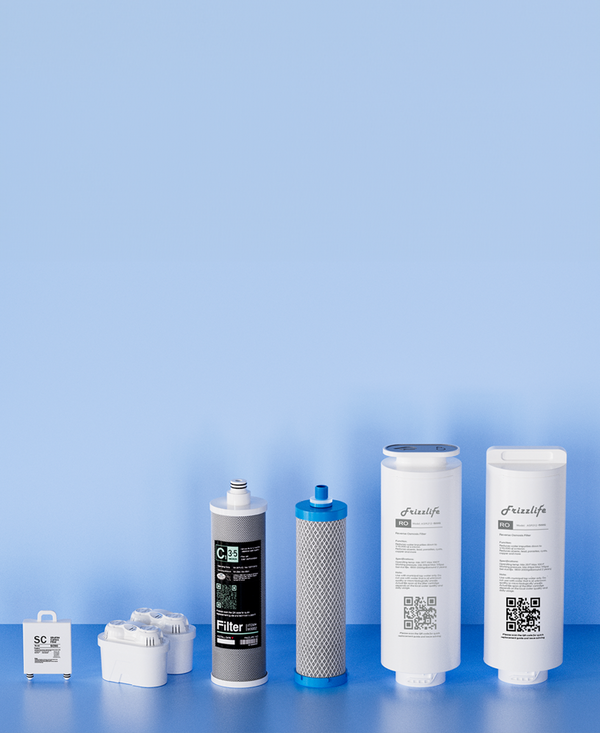
Find the Right Frizzlife Replacement Filter
When replacement is actually needed, choose a filter that matches your specific Frizzlife system and filtration stage. Check compatibility before replacing the cartridge.
Shop Replacement FiltersHow long should a whole-house sediment filter normally last?
There is no universal replacement interval for every whole-house sediment filter. Service life varies with:
-
Incoming sediment concentration
-
Particle size and type
-
Household water consumption
-
Cartridge surface area and design
-
Micron rating
-
System sizing
-
Seasonal or temporary water changes
-
The presence and maintenance of upstream pre-filtration
A filter exposed to heavy silt or sand may need service far sooner than the same cartridge used with relatively low-sediment water. For that reason, broad calendar estimates should not override actual pressure, flow, and system guidance.
A practical maintenance record is more useful than assuming a fixed lifespan. For each cartridge, record:
-
Installation date
-
Initial pressure readings, if available
-
Typical household flow
-
Date when noticeable pressure loss begins
-
Appearance and texture of captured debris
-
Recent source-water or plumbing events
-
Whether replacing the filter restored normal performance
After several cycles, the record establishes a realistic baseline for that home. If replacement frequency suddenly changes, investigate what changed rather than accepting the new pattern as normal.
When replacement is necessary, use a compatible cartridge intended for the specific housing and treatment purpose. Frizzlife maintains a collection of replacement filter options, but compatibility, startup, and replacement instructions should always be confirmed for the exact system.
How can I reduce how often my whole-house filter needs changing?
Reducing replacement frequency requires lowering the debris burden on the main cartridge without sacrificing the filtration job it is meant to perform.
Use an appropriate coarse-to-fine sequence
When conditions support staged filtration, a coarser first stage can intercept larger sand, rust, and debris before water reaches a finer cartridge. The downstream stage can then focus on smaller particles instead of filling with material that could have been removed earlier.
The exact micron sequence is water- and system-dependent. Avoid copying a generic set of micron ratings without testing or confirming compatibility.
Maintain the pre-filter
A pre-filter only protects the main cartridge when it remains operational. For a flushable or spin-down design, inspect the sump and flush accumulated debris according to the product instructions. Clean reusable screens only by the approved method.
A clogged pre-filter can cause the same household pressure symptoms as a clogged main cartridge, so check both stages when flow falls.
Size the system for household demand
Evaluate normal and peak water use, not just the number of people in the home. Simultaneous showers, laundry, irrigation, and other high-demand activities can expose an undersized system.
A properly selected system must balance sediment-holding capacity with the flow expected through the home. If the current arrangement cannot do that, review compatible whole-house filtration options rather than continuing to install the same cartridge without addressing the mismatch.
Test the source water
Testing is especially useful when:
-
Sediment returns immediately after replacement.
-
The appearance of the captured material changes.
-
Well water becomes cloudy or gritty after weather events.
-
Rust-like debris persists without nearby municipal work.
-
Slime or unusual deposits recur.
-
A different micron rating or treatment sequence is being considered.
Testing helps distinguish a filtration-capacity problem from an upstream water or plumbing condition. Visual inspection alone cannot provide that certainty.
Repair persistent well or plumbing issues
Pre-filtration can manage normal sediment, but it should not be used as a substitute for repairing a failing well component, severe source disturbance, or deteriorating plumbing.
If the filter repeatedly captures large amounts of sand, rust flakes, or other debris, investigate why that material is entering the water. Correcting the upstream cause may be more effective than increasing the number of filtration stages.
Follow correct replacement and startup procedures

When changing the cartridge:
-
Follow the model-specific shutdown, bypass, and depressurization procedure.
-
Open the housing using the approved method.
-
Keep the interior and replacement component clean.
-
Inspect the housing and seal for damage or trapped debris.
-
Position the O-ring and cartridge as instructed.
-
Reassemble without applying unsupported force.
-
Return valves to their proper operating positions.
-
Flush according to the system’s instructions.
-
Check for leaks and confirm that normal flow returns.
If the filter becomes dirty again almost immediately, do not assume that another replacement will solve the problem. Recheck the source conditions, filtration sequence, micron selection, and installation.
A whole-house filter getting dirty is evidence that it is capturing material. The warning sign is unusually rapid, recurring pressure or flow loss. By comparing current performance with a clean-filter baseline, inspecting the captured debris, and addressing sediment before it reaches a fine cartridge, you can distinguish routine maintenance from a source-water, sizing, or installation problem.
References
https://www.epa.gov/sdwa/drinking-water-regulations-and-contaminants