


Every reverse osmosis system separates incoming water into two streams: purified water and reject water. Where that countertop RO wastewater goes depends on the system’s design. Drain-connected models route it to the sink or household drain, while self-contained countertop units collect it in an internal compartment that must be emptied.
That wastewater stream is not evidence of a defective filter. It carries away dissolved solids and other substances rejected by the RO membrane. However, the amount produced can vary considerably by model, feed-water quality, temperature, pressure, membrane condition, and operating cycle.
Understanding the wastewater path and the advertised ratio can help you compare countertop RO systems, operate one correctly, and decide whether limited non-potable reuse makes sense.
Key Takeaway: Countertop RO Wastewater Goes to a Drain or a Collection Tank
Countertop RO systems generally handle reject water in one of two ways:
-
Drain-connected systems discharge reject water through a dedicated tube or outlet directed into the sink or connected drain.
-
Batch-style systems collect reject water in an internal tank, reservoir section, or removable wastewater compartment.
A system without permanent plumbing still produces reject water. “No drain connection” usually means the user empties the collected water manually rather than having it discharged automatically.
What Is Countertop RO Wastewater?
Countertop RO wastewater is the portion of feed water that does not become purified product water. It contains a higher concentration of the dissolved solids and other substances rejected by the membrane.
The process can be summarized as:
Feed water → RO membrane → purified water + concentrated reject water

The purified stream is often called permeate or product water. The concentrated stream may be called:
-
Reject water
-
Drain water
-
Wastewater
-
Concentrate
-
Brine
In residential RO discussions, these terms generally refer to the same non-product stream. “Brine” does not necessarily mean the water resembles seawater; it indicates that dissolved material has become more concentrated relative to the incoming water.
Purified water and reject water have different roles
Purified water is the stream intended for dispensing after it passes through the system’s treatment stages. Reject water is the transport stream that moves concentrated dissolved material away from the membrane.
Reject water may look and smell like ordinary tap water. Appearance, however, does not establish drinking-water suitability. It has not followed the purified-water path and may contain elevated concentrations of minerals or contaminants present in the source water.
For that reason, countertop RO reject water should not be used for drinking, preparing beverages, making ice, or cooking.
Why the membrane needs reject flow
RO performance depends on maintaining an appropriate balance between water passing through the membrane and water flowing across it. The crossflow on the feed side helps sweep concentrated material toward the reject outlet.
If that flow is reduced below the system’s design requirements:
-
Dissolved solids may accumulate near the membrane
-
Scale formation may accelerate
-
Purified-water output may decline
-
Contaminant-reduction performance may be affected
-
Membrane service life may be shortened
-
Internal pressure or leak problems may develop
This is why blocking a drain line or modifying a flow restrictor is not a safe way to improve water efficiency.
Why reject water should not be recirculated into the feed tank
Pouring wastewater back into a countertop RO feed reservoir may appear to conserve water, but it increases the concentration entering the next filtration cycle. The membrane must then process water with a higher dissolved load, which can reduce productivity and increase the likelihood of scaling.
Some systems may use controlled internal circulation as part of their engineered operating logic. That is different from manually pouring collected reject water back into the source tank. Unless the product manual explicitly instructs otherwise, use fresh source water for each fill cycle.
Where Does Countertop RO Wastewater Go?
There is no single wastewater route shared by every countertop RO system. The physical destination depends on whether the unit is faucet-connected, line-fed, or self-contained.
Faucet-connected systems
A faucet-connected countertop system commonly uses a diverter to redirect cold tap water into the filtration unit. It may have separate paths for:
-
Incoming feed water
-
Purified product water
-
Reject water returning to the sink
The countertop reverse osmosis drain water may exit through a dedicated tube placed in the sink or through an outlet incorporated into the diverter assembly. Drain flow is normally visible while the system is producing purified water or performing a flush cycle.
Secure any loose tubing so water cannot spray onto the counter or floor. The outlet should remain above or correctly connected to the designated drain location as instructed, without being submerged in standing sink water.
Line-fed countertop systems
Some countertop units receive water through a dedicated supply line rather than a temporary faucet diverter. Their wastewater may be routed through a separate tube to a sink, drainpipe, or another approved drain connection.
These systems can offer automatic wastewater disposal, but they may require more installation work than a fill-tank appliance. Drain routing and backflow protection must follow the manufacturer’s instructions and applicable plumbing requirements.
Do not assume that installation methods for an under-sink RO system apply to a countertop model. The correct connection depends on the equipment design.
Self-contained batch systems
A batch-style countertop unit typically has a removable source reservoir and does not require a permanent drain connection. During treatment, the system separates purified water from concentrate and directs the concentrate to a designated wastewater area.
At the end of a cycle, the user generally removes or empties that water before refilling the unit. Some models may prevent another cycle from starting until the reservoir or wastewater compartment has been handled.
The remaining water should not be mistaken for unused tap water. Once it has participated in an RO cycle, it may contain a higher concentration of the substances rejected from the purified stream.
How to identify the wastewater path before setup or purchase
Check the product manual and specification page for terms such as:
-
Drain line
-
Reject outlet
-
Brine outlet
-
Wastewater tank
-
Concentrate compartment
-
Source-water reservoir
-
Manual tank emptying
-
Drain connection required
Product photos alone may not reveal how wastewater is handled. A system can be marketed as installation-friendly or plumbing-free while still requiring regular manual disposal of reject water.
If you are comparing countertop reverse osmosis systems from Frizzlife, verify the wastewater route and ratio for the specific model rather than assuming every unit uses the same design.
Explore Frizzlife RO Options
Comparing reverse osmosis setups? Explore a countertop RO system, an under-sink option, or find replacement filters for an existing Frizzlife system.

Frizzlife WB99 Countertop RO
Prefer a countertop setup? Explore the WB99 countertop reverse osmosis system and review its current wastewater handling, filtration, and operating specifications.
View WB99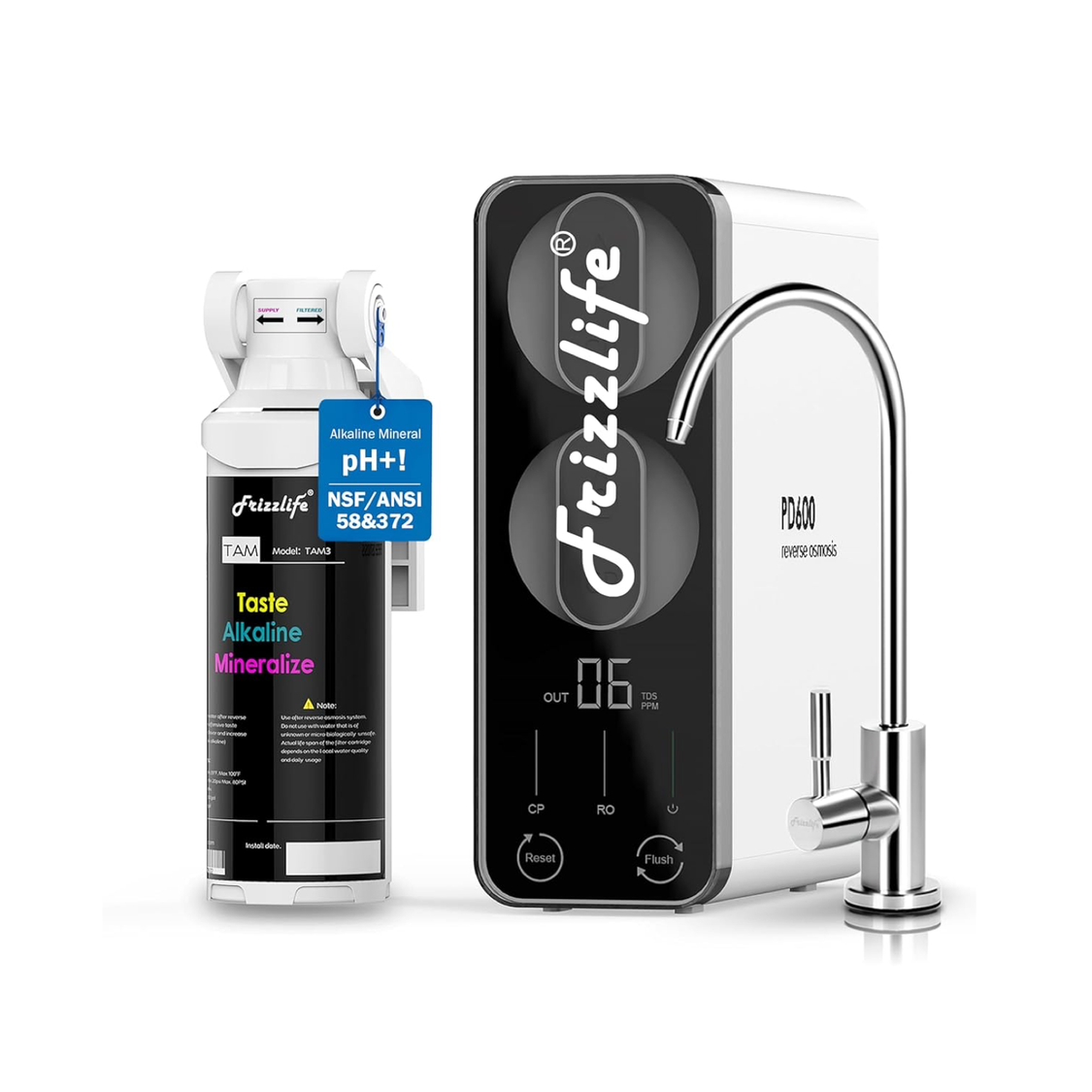
Frizzlife PD600-TAM3
Want a permanent kitchen setup instead? Explore the PD600-TAM3 as an under-sink reverse osmosis alternative.
View PD600-TAM3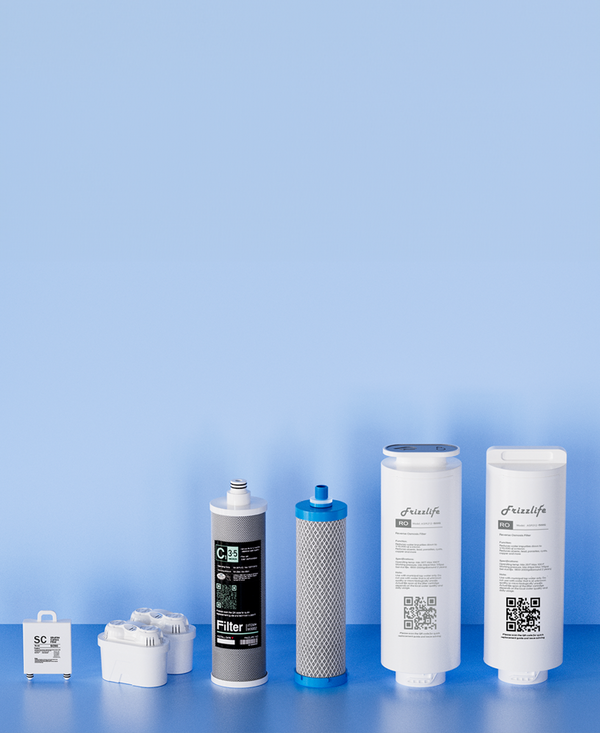
Frizzlife Replacement Filters
Already own a Frizzlife system? Find replacement filters and confirm compatibility with your specific model before ordering.
Find Replacement FiltersDo Countertop RO Systems Waste Water?
Yes. All reverse osmosis systems produce reject water as part of membrane separation. The more useful question is how much reject water a particular system creates under defined operating conditions.
That is described by the countertop RO water ratio, but ratio claims can be confusing because manufacturers do not always write them in the same direction.
Waste-to-pure versus pure-to-waste ratios
A waste-to-pure ratio lists reject water first.
For example:
-
3:1 waste-to-pure means three gallons of reject water are produced for each gallon of purified water.
-
1:1 waste-to-pure means one gallon of reject water is produced for each gallon purified.
A pure-to-waste ratio lists purified water first.
For example:
-
2:1 pure-to-waste means two gallons are purified for each gallon rejected.
-
4:1 pure-to-waste means four gallons are purified for each gallon rejected.
A ratio written only as “2:1” is incomplete unless the seller clearly identifies which stream comes first.

Wastewater-ratio conversion table
The table below compares common formats using one gallon of purified water as the reference.
|
Advertised format |
Equivalent opposite format |
Reject water per 1 gallon purified |
|
5:1 waste-to-pure |
1:5 pure-to-waste |
5 gallons |
|
3:1 waste-to-pure |
1:3 pure-to-waste |
3 gallons |
|
2.3:1 waste-to-pure |
About 1:2.3 pure-to-waste |
2.3 gallons |
|
1:1 waste-to-pure |
1:1 pure-to-waste |
1 gallon |
|
2:1 pure-to-waste |
1:2 waste-to-pure |
0.5 gallon |
|
4:1 pure-to-waste |
1:4 waste-to-pure |
0.25 gallon |
These examples explain the math; they are not promises for a particular countertop model.
Typical point-of-use RO efficiency and the WaterSense benchmark
The U.S. Environmental Protection Agency reports that a typical point-of-use RO system may generate five gallons or more of reject water per gallon of treated water. Some inefficient units may send as much as 10 gallons to the drain for each gallon treated.
For point-of-use RO systems carrying the EPA WaterSense label, the applicable efficiency requirement limits drain water to 2.3 gallons or less per gallon of treated water. That is a maximum waste-to-pure ratio of 2.3:1 under the program’s test requirements.
This benchmark provides useful context, but it should not be treated as proof that any countertop system is WaterSense labeled. Certification or labeling must be confirmed for the exact product.
What is a good pure-to-drain ratio for RO?
A good ratio produces more purified water with less reject water while still maintaining the reject flow needed for reliable membrane performance.
When ratios are written pure-to-waste, a higher first number indicates greater water efficiency:
-
1:1 means equal volumes of pure and reject water.
-
2:1 means two volumes purified for one volume rejected.
-
4:1 means four volumes purified for one volume rejected.
When written waste-to-pure, a lower first number indicates greater efficiency.
The EPA WaterSense limit of no more than 2.3 gallons sent to drain per gallon treated is a useful point-of-use benchmark. However, there is no single ratio that defines a “good” countertop RO system in every situation. Compare the published ratio with its test conditions, membrane performance, source-water limitations, flushing behavior, capacity, and maintenance requirements.
An extremely low wastewater claim should not be evaluated in isolation. Sufficient concentrate flow is necessary to protect the membrane and maintain treatment performance.
Why there is no universal countertop RO wastewater ratio
Countertop systems use different pumps, membranes, flow controls, tank arrangements, and flush programs. A faucet-connected unit operating continuously may manage concentrate differently from a batch system processing one reservoir at a time.
Published ratios may also be based on controlled test water and defined operating conditions. Real household conditions can produce a different result. For that reason, broad claims that all countertop systems are more or less efficient than all under-sink systems are not reliable. Efficiency is model-specific.
What Changes a Countertop RO Wastewater Ratio?
An advertised ratio is usually a performance value obtained under specified conditions, not an unchanging law. Several variables can alter the balance between product water and reject water.
Feed-water TDS, hardness, and contaminant concentration
Water with higher total dissolved solids places a greater separation load on the membrane. Hardness minerals can also contribute to scaling.
Depending on the design, the system may compensate through reject flow, flushing, cycle timing, or other controls. Harder or more concentrated feed water can therefore produce results different from testing performed with lower-TDS water.
A TDS meter can show changes in the overall concentration of dissolved ionic substances, but it does not identify individual contaminants or establish that water is safe for a particular use.
Water pressure and booster pumps
Pressure drives water through an RO membrane. If a system relies on supply-line pressure, low inlet pressure can reduce purified-water production and worsen the effective waste-to-pure ratio.
Many self-contained countertop units use an internal pump to control membrane pressure. That can make operation less dependent on faucet pressure, but it does not eliminate the effects of feed-water quality, temperature, pump condition, or system logic.
Never add or adjust pressure equipment unless the product documentation specifically allows it.
Cold water
RO membranes generally produce purified water more slowly when feed water is cold. Reject flow may not decline in the same proportion, so the measured ratio can look less efficient.
A ratio measured during cold winter conditions may differ from one measured under the warmer test conditions used for a published specification. Do not use hot water to compensate unless the system is specifically designed for it; residential drinking-water RO units are commonly intended for cold-water treatment.
Tank fullness and batch-cycle logic
In batch systems, results can change during the filtration cycle. As purified water is removed from the feed, the remaining water becomes more concentrated. The system may stop at a preset point to avoid processing excessively concentrated water.
Tank levels, partial cycles, automatic flushing, and the amount dispensed can all affect a short-term measurement. Measuring only one small serving may capture startup or flushing water and fail to represent a complete cycle.
Membrane condition, filter age, and scale
A fouled or scaled membrane may produce purified water more slowly. Clogged prefilters can restrict feed flow, while an aging pump or malfunctioning control component can also alter performance.
A worsening ratio does not automatically mean the membrane needs replacement, but it is a reason to check:
-
Filter and membrane maintenance status
-
Feed-water temperature
-
Correct tank filling
-
Drain-tube condition
-
Error indicators
-
Changes in source-water quality
-
The troubleshooting steps in the manual
How to measure the actual pure-to-reject ratio
For a drain-connected system:
-
Confirm that the unit is operating normally and maintenance is current.
-
Collect purified water in one measured container.
-
Collect drain water in a separate measured container during the same complete production period.
-
Include automatic flush water if it is part of normal operation.
-
Divide the purified volume by the reject volume for a pure-to-waste ratio—or reverse the calculation for waste-to-pure.
For a batch unit, begin with the correctly filled source tank and complete a normal cycle. Measure the purified output and the wastewater remaining in its designated compartment. Follow the manual because residual water may be distributed differently among models.
For a representative result, repeat the measurement over several complete cycles rather than relying on one short run. Record feed-water temperature and TDS if you want to compare results over time.
Can Countertop RO Wastewater Be Reused?
Countertop RO reject water can sometimes be collected for limited non-potable household tasks. Whether reuse is appropriate depends heavily on the source water and what the RO system is removing.
Reject water is not simply “extra tap water.” It contains a higher concentration of dissolved material from the feed stream. If the source contains elevated salinity, hardness, nitrate, arsenic, heavy metals, or another concerning substance, the reject stream may have a higher concentration of that substance.
Do not use reject water for drinking or cooking
Countertop RO reject water should not be used for:
-
Drinking
-
Cooking
-
Making coffee, tea, or other beverages
-
Washing produce immediately before eating
-
Making ice
-
Filling pet water bowls
It has not passed through the purified-water outlet and should be treated as non-potable.
Possible non-potable uses
Where source-water conditions are understood and the intended surface or task is suitable, possible uses may include:
-
Flushing a toilet
-
Mopping floors
-
Rinsing outdoor tools
-
Washing exterior pavement
-
Initial cleaning of non-food-contact outdoor items

These are practical possibilities, not a universal safety guarantee. If the source water has a known contamination issue, local restrictions apply, or the reject water could create residue or damage, send it to the drain instead.
Avoid using reject water where people or pets may ingest it, where aerosols could be created, or where concentrated minerals could leave unwanted deposits.
Using reject water for plants requires caution
Plant tolerance varies considerably. Some plants are sensitive to salinity, sodium, chloride, hardness, or particular source-water contaminants. Repeated use can also allow salts to accumulate in container soil.
Before using reject water on plants, consider:
-
The quality and salinity of the original feed water
-
Known contaminants in a private well or municipal supply
-
Whether a water softener adds sodium before the RO system
-
The sensitivity of the plant
-
Signs of mineral buildup in the soil or container
-
Whether the water will contact edible portions of a food plant
When these factors are unknown, using ordinary source water or sending the reject stream to the drain is the more conservative choice. A general TDS reading alone cannot determine whether the water is suitable for a specific plant.
When wastewater should go directly to the drain
Drain disposal is appropriate when:
-
The source has a known contaminant problem
-
The reject water has unusually high salinity or hardness
-
The intended reuse could involve ingestion or food contact
-
Local guidance limits reuse
-
The water has been stored and is no longer fresh
-
You cannot keep collection containers clean
-
Reuse would create staining, residue, or surface damage
-
The product instructions direct the wastewater to a drain
Sending reject water to an approved drain is the normal operating method for many systems.
Safe collection practices
If you collect countertop RO reject water for a suitable non-potable task:
-
Use a dedicated container
-
Label it clearly as non-potable
-
Keep it away from drinking-water containers
-
Use it promptly rather than allowing it to stagnate
-
Clean and dry the container regularly
-
Prevent access by children and pets
-
Do not pour it back into the RO feed tank
Manual collection should not interfere with the required reject flow. Never clamp a drain tube or elevate it in a way that creates backpressure unless the manual specifically permits that arrangement.
Everyday Wastewater Handling and Troubleshooting
Normal reject flow may occur while the system produces purified water and during automatic membrane flushing. The timing and volume depend on the model.
Keep drain tubing open and secure

For systems with a visible drain tube:
-
Check that the tube is not kinked, pinched, or crushed
-
Position it so it cannot jump out of the sink
-
Prevent the outlet from sitting in standing water
-
Keep the drain path free of clogs
-
Inspect fittings if water appears on the counter
-
Follow the specified tubing length and routing
Do not plug the tube because the flow appears excessive. Investigate the cause instead.
For batch systems, empty and rinse the wastewater section as directed. Do not allow concentrated residual water to remain in the tank between repeated fills unless that is part of the system’s documented operation.
What unusually high reject-water output may indicate
Higher-than-expected wastewater production can result from:
-
Cold feed water
-
Low pressure in a supply-fed system
-
High feed-water TDS or hardness
-
A startup or automatic flush cycle
-
A partially filled or interrupted batch
-
Restricted prefilters
-
Membrane fouling or scaling
-
A malfunctioning pump, valve, sensor, or control component
-
Measurement that excludes some purified output or captures only flush water
Compare complete operating cycles before concluding that the unit is malfunctioning. If the ratio changes sharply without an obvious change in temperature or source water, consult the troubleshooting instructions.
What reduced or stopped drain flow may indicate
Little or no reject flow is not necessarily an efficiency improvement. It may indicate:
-
A kinked or blocked drain tube
-
Incorrect installation
-
A clogged flow-control component
-
Insufficient feed-water supply
-
A pump or valve problem
-
A completed cycle or full purified-water tank
-
A system fault that has stopped production
If purified water is being produced but the expected reject stream has stopped, discontinue use and check the manual or contact technical support. Operating without the required reject flow can compromise membrane performance.
Do not modify the flow restrictor as a DIY efficiency fix
The flow restrictor helps establish the intended balance between permeate and concentrate. Replacing it with an unapproved part, tightening the drain line, or altering the plumbing may increase pressure on the membrane and reduce flushing.
Even if a modification appears to reduce wastewater temporarily, it may also increase scaling, lower purified-water quality, shorten membrane life, or create leaks. Use only approved parts and configurations.
How to Compare Countertop RO Systems by Wastewater Performance
Wastewater efficiency matters, but it should be evaluated alongside treatment performance, usability, capacity, and maintenance.
Confirm how wastewater is handled
Before buying, determine whether the system:
-
Drains automatically to the sink
-
Uses a visible countertop drain tube
-
Requires a dedicated drain connection
-
Stores reject water in a removable compartment
-
Requires manual emptying after each cycle
-
Stops automatically when the wastewater section is full
Automatic drainage may be more convenient for frequent use. A collection tank makes reuse possible but adds a manual handling step.
Look for defined test conditions
A useful efficiency claim should explain, where available:
-
Whether the ratio is pure-to-waste or waste-to-pure
-
Feed-water quality
-
Water temperature
-
Supply pressure or pump conditions
-
Whether flushing water is included
-
Whether the result represents a full cycle
-
Whether the value is independently verified or manufacturer-reported
Real-world results may differ even when a published claim is accurate under its stated test conditions.
Distinguish NSF/ANSI 58 certification from efficiency claims
NSF/ANSI 58 addresses point-of-use RO drinking-water treatment systems, including requirements related to materials, construction, structural integrity, TDS reduction, and applicable contaminant-reduction claims.
Certification to NSF/ANSI 58 does not, by itself, establish a particular wastewater ratio. Likewise, a low-waste ratio does not prove contaminant-reduction performance or certification.
Check the exact scope of a product’s certification and verify which claims are included. “Certified,” “tested to,” and “designed to meet” are not interchangeable statements.
Compare the complete system, not just one ratio
Evaluate wastewater performance alongside:
-
Documented contaminant-reduction claims
-
Certification status and scope
-
Purified-water capacity
-
Dispensing workflow
-
Drain or tank-emptying requirements
-
Filter and membrane maintenance
-
Availability of replacement components
-
Source-water limitations
-
Space and installation needs
A low reject ratio has limited value if the system is unsuitable for the source water, inconvenient to maintain, or unable to support the household’s normal demand.
When reviewing Frizzlife countertop RO options, use each model’s current specifications and documentation to confirm its wastewater route, advertised ratio, operating requirements, and verified treatment claims.
The Bottom Line
Countertop RO wastewater goes either to a sink or drain through a dedicated outlet, or into an internal collection compartment that must be emptied. It is a necessary concentrate stream that protects the membrane by carrying rejected dissolved material away.
To evaluate efficiency, identify whether a ratio is written waste-to-pure or pure-to-waste, then check the conditions behind the claim. Limited non-potable reuse may be practical in some situations, but reject water should not be consumed, returned to the RO feed tank, or reused without considering source-water quality. Above all, keep the wastewater path open and operate the system according to its model-specific instructions.
References
https://www.epa.gov/watersense/point-use-reverse-osmosis-systems