

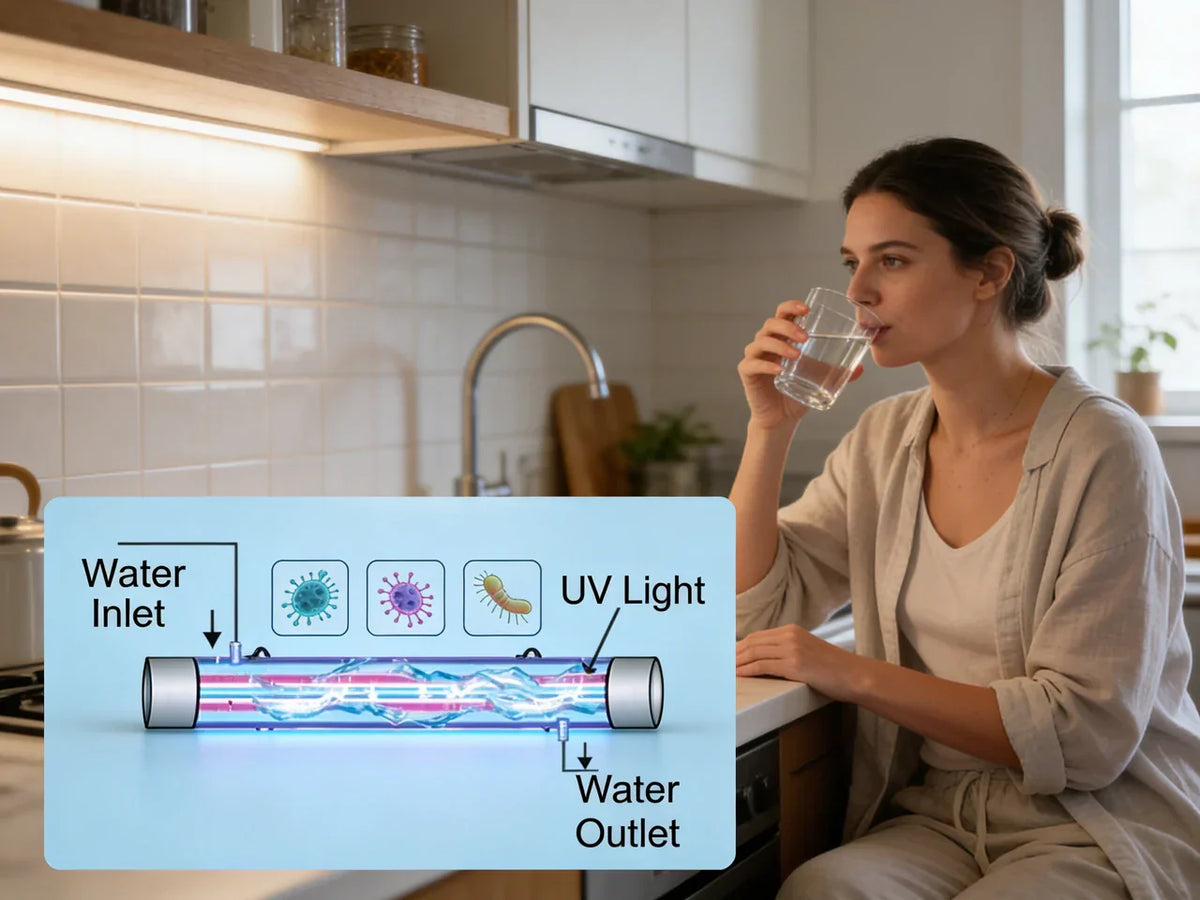
UV water treatment is a fast, chemical-free way to disinfect water using UV‑C light (often around 254 nm) that inactivates bacteria, viruses, and protozoa. People like it because it can help reduce chlorine use and meet tighter germ (microbial) goals—without changing taste or smell and without making many common disinfection byproducts. This guide clears up what UV systems do, what they don’t do, and how to choose the right unit for your home, business, or a larger facility. You’ll get the quick essentials first (performance, sizing, and placement), then deeper help on parts, real-world results, costs, rules, and maintenance—ending with a practical checklist so your UV setup works day after day.
UV water treatment basics
To maximize the benefits of UV water treatment, many homeowners install a water softener or filtration system before the UV lamp, ensuring that all water entering your home receives direct exposure to ultraviolet light, which disrupts the DNA of harmful microorganisms.
What UV‑C (254 nm) does to microbes (DNA/RNA inactivation)
If you’ve ever wondered what does a UV light do for water, the simple answer is this: UV‑C light damages a microbe’s DNA or RNA so it can’t copy itself. When it can’t reproduce, it can’t infect you.
This is why ultraviolet light water purification is called “disinfection,” not “filtration.” The water does not need chemicals added. Instead, the UV system exposes flowing water to a controlled amount of UV light inside a chamber. The key is the right dose delivered at the right flow rate with water that is clear enough for UV to pass through.
UV is widely used for drinking water safety because it works quickly. There’s no waiting for a chemical contact time in a tank. Water passes the lamp and gets treated in seconds.
What UV does not remove: sediment, metals, PFAS, chlorine residual
A UV unit is not a “catch‑all” purifier. UV water treatment is strong against living microorganisms in water, but it does not remove many non-living contaminants. That matters because many people install UV and expect it to fix everything.
Here’s what UV does not remove from your water:
-
Sediment (dirt, silt, rust)
-
Heavy metals (like lead or arsenic)
-
PFAS (“forever chemicals”)
-
Dissolved salts (what a reverse osmosis or ro filter targets)
-
Pesticides and many industrial chemicals
-
A chlorine residual already in the water (UV can reduce some chlorine in certain conditions, but you should not count on it as a dechlorination method)
-
Bad taste and odor causes (unless paired with other filtration methods)
So think of UV as one layer in a full water treatment system. Many homes use “filter + UV,” and some use “sediment + carbon + UV,” and some use “RO + UV” at a kitchen sink.
Key performance terms: UV dose (mJ/cm²), UVT, log reduction
Shopping for uv water systems can feel confusing because the marketing words are not the same as the engineering words. These three terms come up the most, and they explain most real-world success or failure.
UV dose (mJ/cm²) is the amount of UV energy delivered to the water. More dose usually means more germ inactivation, up to practical limits.
UVT (UV transmittance) is how much UV light can pass through the water. Clear water has high UVT. Water with color, iron, tannins, or fine particles can have low UVT, which blocks UV light.
Log reduction is how disinfection is reported. A 1‑log reduction means 90% inactivated. A 2‑log reduction means 99%. A 3‑log reduction means 99.9%, and so on.
“Dose vs. log reduction” mini‑chart (typical concept)
These are common reference points used in UV guidance. Exact results depend on the organism, the reactor design, and water quality.
| Log reduction | Percent inactivated | What it means in plain language |
| 1‑log | 90% | Big drop, not “safe” by itself for high-risk water |
| 2‑log | 99% | Strong improvement |
| 3‑log | 99.90% | Often targeted for many microbes |
| 4‑log | 99.99% | Very high, common “whole-home UV” claim when properly sized |
Glossary callout (quick):
UVT = how clear the water is to UV light.
Dose = UV energy delivered.
Flow rate = how fast water moves; faster flow lowers dose if the lamp power stays the same.
How UV systems work: components, specs & sizing
Before diving into the core components, it’s important to understand that UV light systems in a home water treatment setup typically treat all water entering through the main line, using ultraviolet light to neutralize harmful microorganisms; pairing them with a water softener or water filtration system ensures the water is clear enough for the UV lamp to emit effective UV rays throughout the treatment process.
Core parts: lamp/LED, reactor chamber, quartz sleeve, ballast/driver
A typical uv water treatment system is simple on the outside, but each inner part has a job.
The lamp (or LED module) makes the UV light. Most whole‑house systems still use UV lamps. Some smaller point‑of‑use units use UV‑C LEDs.
The reactor chamber is the metal body the water flows through. Inside, the water is guided so it gets enough exposure time and enough mixing.
The quartz sleeve is a clear tube that separates the lamp from the water. Quartz is used because it lets UV light pass while protecting the lamp and keeping the electrical parts dry.
The ballast/driver powers the lamp (or drives the LED). If this fails, the lamp may go out or run weak, which can silently lower disinfection.
Exploded schematic (text diagram):
Lamp/LED → (inside) Quartz sleeve → (inside) Reactor chamber → Outlet
Optional add-ons: UV sensor + controller + alarm + automatic wiper
If you’ve ever had a UV unit and the water “seems fine,” that can be misleading. UV problems often don’t change taste, smell, or color. That’s why sensors and alarms matter more than people expect.
Sensors & controls: UV intensity monitoring, UVT sensors, alarms, auto-wipers
Many modern systems include a UV intensity sensor. This measures UV light inside the chamber and can trigger an alarm if the level drops. Some setups add a flow switch so the lamp is only “counted” as working when water is flowing, and some add data logging.
Automatic wipers clean the quartz sleeve while the unit runs. This can help in water with hardness or iron, where scaling and fouling are common. In industrial settings, performance losses from sleeve fouling are often reported, and even a moderate drop in UV intensity can shrink your safety margin.
A practical way to think about it is like headlights in fog. The headlights still shine, but less light reaches the road. With UV, less light reaches microorganisms in the water.
How to size a UV system by flow rate + UVT (step-by-step)
Sizing is where many installs go wrong. People buy a unit based on pipe size, not flow. Or they size for average flow, not peak flow (like showers plus laundry plus a dishwasher). UV disinfection depends on time and intensity, so flow rate is central.
Below is a simple, real-world sizing method you can use before you ask for quotes.

Step-by-step sizing method (DIY calculator style)
-
Measure your peak flow rate. For a home, you can estimate by counting fixtures that may run at once, but the best method is a real flow test at a hose bib or a meter reading during peak use. Peak flow matters because water flow that exceeds the UV rating lowers dose.
-
Get your water tested for UVT drivers. If you’re on well water, test for turbidity, iron, manganese, color/tannins, and hardness. If you’re on city water, UVT is often higher, but you still want to know if you have old pipes shedding rust or sediment.
-
Pick your target UV dose. Many drinking water designs use common benchmark doses such as 30–40 mJ/cm² for strong microbial control, with higher targets used for added safety margins depending on goals and rules.
-
Select a UV unit that is validated at your flow and UVT. Validation matters because a reactor’s shape changes how well UV reaches the full flow. Ask what UVT the rating assumes. A unit rated at high UVT may deliver less dose in darker water.
-
Confirm pressure drop and electrical needs. Make sure your pump or municipal pressure can handle the added equipment.
Flow categories and typical use cases
| Flow rate category | Typical use cases | Common notes |
| < 20 GPM | Homes, small offices, small farms | Often point-of-entry “whole-house systems” |
| 20–100 GPM | Larger homes, multi-unit buildings, small industry | Usually needs monitoring and better pretreatment |
| > 100 GPM | Municipal loops, large industrial process | Often uses multiple reactors, redundancy, and full validation |
What UV dose is needed to disinfect drinking water?
People ask this because they want one number. In real life, the “needed” UV dose depends on the microorganism, water clarity (UVT), and local rules. Many drinking-water UV designs target benchmark ranges such as 30–40 mJ/cm² for strong inactivation of common pathogens, and higher where rules or risk call for it. The safest approach is to choose a system with third‑party validation or design guidance that matches your water quality and peak flow, not just a “watts” rating.
Types of UV disinfection systems by application
Understanding the different system types is key when selecting a UV water treatment solution, as these systems typically treat all water entering the home or facility, with the UV lamp emitting ultraviolet radiation to neutralize harmful microorganisms and ensure water treated at outlets is safe; while the cost of a UV water system varies, the benefits of direct exposure to UV and consistent water usage protection make these systems highly effective.
Residential: point-of-entry (POE) vs point-of-use (POU) for well water & city water
In homes, uv water treatment usually shows up in two places.
A point-of-entry unit treats water entering the home on the main line. People often call this a whole-house UV system. It protects all taps, showers, and appliances. If you have homes with well water, this is common because wells can be vulnerable after storms, flooding, or equipment work.
A point-of-use unit treats one tap, often the kitchen sink. This is where a UV unit may be paired with an ro filter or other water filtration system. If your main goal is safe drinking and cooking water, POU can be cost-effective.
So which is better? If your concern is whole‑home exposure (showers, brushing teeth, ice maker), point‑of‑entry makes sense. If your concern is only drinking and cooking, point‑of‑use may be enough. Many families start with POU and later upgrade when they see how often guests drink from bathroom taps or how often kids fill cups from any sink.
Municipal drinking water & wastewater reuse (tertiary treatment)
Municipal systems use UV for primary disinfection in some cases, and also as a barrier step where chlorine byproducts are a concern. In wastewater reuse, UV is often a tertiary step after solids removal and filtration. The clearer the water is before UV, the more reliable disinfection becomes.
A common treatment train looks like:
Filtration → UV disinfection → Distribution (sometimes with a small disinfectant residual added)
In municipal distribution, the “residual” topic matters. UV works in the reactor, but it does not keep working in the pipes after. That’s why many municipalities still maintain a disinfectant residual in the distribution network, even if UV is part of the plant process.
Industrial uses: food & beverage, pharma, microelectronics, process water
Industrial sites choose UV because it gives fast microbial control without adding chemicals that could affect taste, product quality, or process chemistry.
A few common uses include clean-in-place hygiene support, microbial control for rinse water, and reducing how much chemical disinfectant is needed to hit internal targets. Some facilities also use UV as a barrier step to protect membranes and equipment from biofouling.
If you’ve ever worked in a plant where one contamination event stopped a line, you already understand the business case. A UV reactor can be a relatively small part of a process, yet prevent a very expensive downtime event.
Emerging tech: UV‑C LEDs vs LPHO/MP lamps (energy, mercury-free, PoU niche)
UV‑C LED systems are gaining attention because they can be compact and mercury‑free. They also switch on instantly. That makes them attractive for point‑of‑use devices and specialty applications.
Traditional UV lamps are still common in higher-flow systems because they can deliver strong output at a cost that’s hard to beat for large volumes. Industry market research often reports that UV‑C LEDs are a growing share of new models and that point‑of‑use installs are a major early fit, but lamp-based systems remain the main choice for high-flow disinfection.
Efficacy, benefits & limitations (science + proof)
It’s worth noting that ultraviolet water treatment systems are highly effective when properly sized, as these systems typically treat all water entering the main water line, with UV radiation from the lamp providing direct exposure to neutralize harmful microorganisms at water outlets; while the cost of a UV water system varies, these systems provide a chemical-free water treatment solution that many homes and facilities rely on daily.
What pathogens UV targets well (E. coli, viruses, Cryptosporidium) + expected reductions
So, how effective is UV water treatment? When correctly sized and installed, it is one of the most effective ways to inactivate many harmful microorganisms.
UV is well known for inactivating E. coli, many viruses, and chlorine-resistant protozoa like Cryptosporidium. In real facilities with good pretreatment and good operations, large drops in pathogen levels are reported. In controlled residential demonstrations, very high kill rates for indicator bacteria are often achievable when the dose and flow match the design.
It’s still important to say this plainly: UV performance is not magic. It’s math plus maintenance. If the water is cloudy, if flow is too high, or if the sleeve is scaled, UV results drop.
Pathogen susceptibility and typical performance ranges
| Pathogen (example) | UV susceptibility (general) | Typical log reduction range when properly dosed |
| E. coli | High | 3–4+ log common in validated systems |
| Many enteric viruses | Medium to high | Often 2–4 log depending on dose and virus type |
| Cryptosporidium | High | Strong inactivation at common drinking-water UV doses |
| Giardia | High | Strong inactivation at common drinking-water UV doses |
The key point is not the exact number in a table. The key point is that your real system must deliver the dose at your worst-case flow and water clarity, not your best day.
Benefits vs chlorination/ozone: no chemical taste/odor, fewer DBPs, rapid contact time
UV has a few advantages that people notice right away. First, it does not add a chemical taste or smell. That’s why some families who dislike chlorine taste still feel comfortable with UV as part of a plan for safe drinking water.
Second, UV can reduce reliance on chemicals that form some disinfection byproducts. If you’ve heard concerns about certain byproducts linked to chlorination, UV is often part of the conversation because it disinfects without adding those chemicals.
Third, UV is fast. There’s no large contact tank needed in many designs. Water is treated as it flows.
This is why UV shows up in conversations about chemical-free disinfection. It’s not that chemistry disappears from all treatment. It’s that disinfection can be achieved without adding a disinfectant chemical at that step.
Limitations: no residual protection, turbidity/UVT sensitivity, sleeve scaling/fouling
Now for the honest part: what are the disadvantages of UV water purification?
The biggest limitation is that UV leaves no disinfectant residual. Once the water leaves the reactor, the UV light is gone. If germs enter later in the plumbing (a cross-connection, a broken pipe, a contaminated storage tank), UV won’t protect you downstream.
UV also depends on water clarity. High turbidity, color, or certain dissolved substances can block UV light. That’s why pretreatment matters. A good filtration system before UV can be the difference between “works great” and “why did I even buy this?”
Sleeve scaling and fouling is another real issue. Hardness minerals can form scale on the quartz sleeve. Iron can stain it. Biofilm can grow. Any of these can cut UV transmission.
Here is a simple way to think about UVT and “performance margin.” This is not a promise, just a way to visualize risk.
| UVT (%) | What it often means for real installs |
| 95–99% | Wide safety margin if flow stays in range |
| 85–95% | Usually workable with good pretreatment and sizing |
| 75–85% | Often needs better filtration and careful validation |
| < 75% | Higher risk; UV may still work with design changes, but don’t guess |
Does UV kill bacteria and viruses in well water?
Yes—UV light can effectively inactivate bacteria and many viruses in well water, as long as the system is sized for your peak flow and your well water is clear enough (good UVT) after pretreatment. If your well has sediment, iron, tannins, or high turbidity, add the right filters first. UV can only disinfect what the light can reach.

Installation best practices (avoid common failures)
With the right system type and sizing in place, UV light water treatment can effectively disinfect water, but proper installation is key: systems may fail if placed incorrectly, so understanding where the UV bulb and UV filtration fit in the treatment train ensures that all water entering the home is treated, and that the benefits these systems offer are fully realized despite the usually cost of the equipment.
Where to install UV in the treatment train (after filters; after softener)
Most UV failures I see in the real world are not “bad UV.” They are bad placement.
UV should usually be installed after sediment filtration. If you put UV first, you can shadow microorganisms behind particles, and you can foul the sleeve faster.
In many homes, UV also belongs after a water softener when one is used. A water softener reduces hardness minerals that can scale the quartz sleeve. Less scale usually means better UV transmission and fewer cleanings. This is especially important for well water or any supply with high hardness.
A practical “main line” order that often works well is:
Sediment filter → (optional carbon) → water softener → uv water treatment → house
If you use an ro filter at a sink, it is often separate: it treats drinking water at that one tap, sometimes paired with UV depending on the design.
Pretreatment checklist: sediment filtration, iron/manganese, hardness, turbidity targets
Pretreatment is not about buying extra gear. It is about making sure UV can do its job.
If your water has visible particles, start with sediment filtration. If your water stains sinks orange or black, iron and manganese may be present and can foul sleeves and reduce UVT. If your hardness is high, scaling risk rises. If your water is colored like tea, tannins can cut UVT.
I learned this lesson early on helping a friend with a rural cabin. The UV unit was new, but the sleeve turned cloudy fast. The lamp was fine. The problem was hard water scale. Once a softener was added upstream and the sleeve was cleaned, the UV alarm stopped triggering and the system stayed stable.
Commissioning & validation: verifying flow, alarms, UV intensity, and UVT assumptions
Commissioning is the “start-up day,” but it shouldn’t be rushed. This is where you confirm the system you bought is actually delivering what you think it is.
Use this pass/fail checklist to reduce guesswork.
| Commissioning check | Pass criteria (examples) | Pass/Fail |
| Peak flow verified | Measured peak flow ≤ UV rated flow | |
| Pretreatment installed | Filters/softener in place and working | |
| UV intensity reading | Sensor shows normal operating range | |
| Alarm test | Alarm triggers when lamp off or intensity low | |
| Leak and pressure check | No leaks; acceptable pressure drop | |
| Water clarity assumptions | UVT/turbidity matches design assumptions |
Should UV be installed before or after a water softener?
In most home setups, UV is best installed after a softener and after sediment filtration. The softener helps prevent mineral scale on the quartz sleeve, which helps keep UV transmission high. The filters reduce particles that can block UV light. There are exceptions, but “post-softener, post-filter” is a common best practice.
Maintenance, troubleshooting & lifecycle reliability
Once a UV system is correctly installed and sized for your types of water, and the UV treatment is effectively delivering disinfected water throughout the home, ongoing maintenance becomes essential—regular checks, lamp replacement, and monitoring ensure that systems continue to treat all water entering your home as intended.
Lamp replacement intervals, cleaning schedules, and spare parts planning
UV lamps do not last forever. Even if the lamp still glows, UV output drops over time. Many home systems plan lamp replacement around every 12 months. In residential sizes, lamp costs are often in the USD 100–300 range, depending on type and size, plus any service cost if you don’t do it yourself.
Cleaning the quartz sleeve matters just as much. If your water is hard or has iron, you may need more frequent cleaning. Some people put it off because water still “runs fine.” But again, UV problems are invisible.
A simple way to stay on track is to tie UV checks to something you already do, like changing furnace filters or testing smoke alarms. Put it on a calendar and keep one spare lamp if your water safety depends on it.
Common problems: sleeve fouling, sensor drift, ballast failures, flow changes
If a UV unit is not performing, it’s usually one of a few patterns: the sleeve got dirty, the sensor is reading wrong, the ballast is failing, or the flow rate changed.
Troubleshooting is easier if you treat UV like a safety device, not like a passive pipe fitting. When an alarm sounds, take it seriously and fix it fast.
Troubleshooting table (quick diagnosis)
| Symptom | Likely cause | Practical fix |
| UV alarm, lamp is on | Sleeve fouling or sensor drift | Clean sleeve; check sensor; confirm UVT/filters |
| No light / unit dead | Ballast/driver failure or power issue | Check outlet/breaker; replace driver if needed |
| Frequent alarms after rain | Well water turbidity spike | Improve pretreatment; pause high-risk use until stable |
| Water pressure drops | Filters plugged or scaling | Change filters; inspect plumbing and chamber |
| Works until multiple showers run | Peak flow exceeds rating | Resize system or add flow control |
Smart monitoring & predictive maintenance (remote alerts, dose assurance)
Some systems add remote alerts and data logging. This can be a big deal for landlords, schools, small towns, or anyone who can’t “just check the light” every day.
Smart monitoring helps you catch slow problems like sleeve fouling or gradual UV output loss. It also helps prove to yourself (or an inspector) that the unit stayed in its safe range. In operations studies of UV systems, better monitoring is often linked with better uptime because problems are found sooner, not after complaints or test failures.
How often do you need to replace a UV lamp?
Many UV lamp systems plan replacement about once per year because UV output drops with use. Some lamps are designed for longer, but annual replacement is a common, simple schedule for home and light commercial setups. Always follow the system manual and use intensity readings (if you have them) as your reality check.
Costs, ROI & buying criteria (residential to municipal)
Once you understand how UV systems treat all water entering your home or facility, and what maintenance, reliability, and performance to expect, the next step is evaluating the cost, potential ROI, and criteria for choosing the right system for your specific needs.
Total cost breakdown: CAPEX vs OPEX (lamp/energy/parts/service)
People often ask, how much is an UV water treatment system? The price range is wide because it depends on flow rate, sensors, validation level, and installation needs.
A simple way to think about cost is two buckets:
CAPEX (upfront): UV reactor, controller, installation labor, plumbing changes, pretreatment filters/softener if needed.
OPEX (ongoing): electricity, lamp replacements, sleeve cleaning supplies, filter changes upstream, and service calls.
Residential point-of-entry setups are often far less than large facilities, while large-scale units can exceed USD 50,000 when you include the reactor, controls, validation, and installation. For smaller municipalities, upfront cost can be a real barrier, even if operating costs are reasonable later.
How to compare quotes: flow, validated dose, UVT assumptions, redundancy, sensors
When you compare quotes, don’t get stuck on watts or pipe size. Push for the numbers that match real performance.
Ask what flow rate the system is rated for at your expected UVT. Ask what alarms are included. Ask what happens if the lamp fails—does water still flow with no warning, or does the system alert you loudly?
Must-have vs nice-to-have features (by use case)
| Feature | Home POE | Small business | Municipal/industrial |
| Validated performance rating | Must-have | Must-have | Must-have |
| Audible/visible alarm | Must-have | Must-have | Must-have |
| UV intensity sensor | Nice-to-have | Must-have | Must-have |
| Auto-wiper | Nice-to-have | Nice-to-have | Often must-have |
| UVT monitoring | Rare | Nice-to-have | Must-have in many designs |
| Redundancy (2+ reactors) | Rare | Rare | Common/needed |
UV vs RO vs chlorine vs ozone: when each wins
People often compare uv water treatment to other water treatment options, but they solve different problems.
UV is best when your main concern is microorganisms and you want a fast disinfecting step without adding chemicals.
A reverse osmosis (ro) system is best when you need to remove dissolved contaminants such as salts, many metals, and some chemical contaminants. RO is not mainly a disinfectant; it’s a separation process.
Chlorine is best when you need a lasting residual in pipes and storage. It can also handle some contamination events well, but it can affect taste and can form disinfection byproducts.
Ozone is a powerful oxidant and disinfectant used in some plants and industries, but it needs careful design and off-gas control.
Simple comparison matrix
| Technology | Best at | Main limits | Common placement |
| UV | Inactivating microbes fast | No residual; needs clear water | After filtration/softening |
| RO | Removing dissolved solids/chemicals | Wastewater stream; slower flow | Point-of-use or dedicated line |
| Chlorine | Residual protection in pipes | Taste/odor; byproducts | Plant + distribution |
| Ozone | Strong oxidation + disinfection | Complex equipment; no lasting residual | Treatment plant/process |

Financing & ROI: chemical reduction, compliance risk reduction, downtime costs
UV ROI is often not just “saving money on chemicals.” It can be about lowering risk.
For a home, the value is peace of mind and fewer illness worries, especially for well water users.
For a business, the value can be fewer product losses, fewer shutdowns, and easier compliance.
For a municipality, UV can reduce certain byproducts and help meet microbial goals, but budgeting is real. Many towns weigh UV against pipe upgrades, staffing, and other urgent needs. The right answer depends on local water quality, rules, and public health priorities.
Market trends, regulations & real-world deployments
With a clear understanding of system costs, ROI, and key performance factors, it’s also important to consider market trends, regulatory standards, and real-world deployments to see how UV water treatment is being adopted and implemented across different regions and applications.
Market size & growth snapshots (2025–2035) + what’s driving adoption
Market research groups project continued growth for UV disinfection systems through the next decade. Estimates vary by what is counted (drinking water only vs. wastewater reuse vs. advanced oxidation), but many projections cluster around mid‑single to high‑single digit annual growth.
The big adoption drivers are easy to understand. People want clean water with fewer chemicals, and regulators want strong microbial barriers. UV fits that need because it can inactivate chlorine‑resistant protozoa and can support safer treatment trains.
At the same time, cost is still a restraint in many small communities and small businesses, especially when pretreatment upgrades are needed.
Regional adoption patterns: North America vs Europe and industrial installs
UV has been widely adopted in North America and Europe for both municipal and industrial use. Adoption patterns often reflect local rules, infrastructure age, and industrial needs. In regions with strong reuse programs, UV is a common tertiary step. In regions with aging distribution systems, some operators value UV as one barrier while still relying on a residual disinfectant downstream.
Compliance & standards to reference: EPA guidance, NSF/ANSI 55 (Class A/B), local health rules
If you are buying a residential system, one standard you will see often is NSF/ANSI 55. It covers UV microbiological water treatment systems and includes different classes for different use cases. Understanding the class helps you match expectations to reality.
For larger designs, engineering guidance like the U.S. EPA UV disinfection guidance is often referenced. Local and national health rules still matter, so always check what your area requires for public systems or regulated facilities.
Case studies (what “good” looks like in real life)
In the real world, strong UV outcomes usually come from the same basics: good pretreatment, correct sizing, and consistent maintenance.
In municipal settings, UV is often used to strengthen microbial control while managing disinfection byproducts. In industrial settings, UV is often used to cut chemical use and help keep process water stable.
The pattern is simple: UV performs best when it is treated as a critical control point, with alarms that people respond to, not as a “set it and forget it” tube on a wall.
Action plan & checklist (choose, size, install, maintain)
It helps to have a structured action plan and checklist to guide your decisions from selecting the right UV unit to ensuring it continues to protect all water entering your home or facility.
Decision tree: pick UV type (POU/POE/municipal) based on water source + risk
If you feel stuck, ask yourself one question: where is your real risk?
If your risk is the whole building (showers, faucets, appliances), you lean toward point‑of‑entry. If your risk is only drinking and cooking, point‑of‑use may be enough, often paired with an RO unit.
If your risk is public compliance and distribution safety, UV may be one barrier in a multi‑step train, often combined with filtration and a residual disinfectant.
Sizing & spec checklist: minimum UVT, target dose, validated flow, alarms, monitoring
Before you buy, make sure you can answer these in plain language:
-
What is my peak flow rate?
-
What water source am I on (well, surface water, municipal water supplies)?
-
What pretreatment do I have (sediment filtration, carbon, water softener)?
-
What UVT or turbidity does the UV unit assume?
-
What dose is the system designed to deliver at my flow?
-
What alarms or monitoring prove the UV is still working?
If you can’t answer these yet, that’s okay. That just means you’re still in the “site survey” stage, not the buying stage.
Implementation timeline: site test → install → commissioning → monthly/annual tasks
A realistic timeline looks like this:
| Time | What you do | Why it matters |
| Week 1 | Water test + flow estimate | Prevents wrong sizing |
| Week 2–3 | Select pretreatment + UV unit | Protects UV and improves UVT |
| Install day | Plumb in, power, verify bypass | Avoids leaks and unsafe bypass use |
| Commission day | Confirm flow, alarms, sensor readings | Proves performance |
| Monthly | Quick visual/alarm check | Catches silent failures |
| Every 6–12 months | Clean sleeve (as needed) + replace lamp (often annual) | Restores UV output |
Key takeaways (next steps)
UV water treatment is highly effective at inactivating microorganisms when it’s correctly sized, installed in the right place in your water treatment work (usually after filtration and often post-softener), and maintained on schedule. It is a strong chemical-free disinfection layer, but it is not a complete contaminant-removal solution. If you also worry about metals, PFAS, or dissolved chemicals, pair UV with the right water filtration system or reverse osmosis systems based on lab results.

Short FAQs
1. How effective is UV water treatment?
UV water treatment can be extremely effective at inactivating bacteria, viruses, and protozoa, as long as the system is set up and maintained correctly. The key is water clarity—UV light can only disinfect what it actually reaches. That means water should have low turbidity, minimal color, and little iron or other particles that can block UV rays. Flow rate also matters: if water moves too fast, it may not get the full UV dose. When these factors are managed, UV systems provide a chemical-free, instant disinfection layer that protects every tap in your home or facility.
2. What are the disadvantages of UV water purification?
While UV is great at killing microbes, it doesn’t solve every water problem. It provides no residual protection, so germs that enter the plumbing after the UV reactor aren’t neutralized. Performance drops if the water is cloudy or heavily colored, and the quartz sleeve can get scaled or fouled from hardness, iron, or biofilm, which reduces effectiveness. UV also does nothing for metals, chemicals, or PFAS—you’ll still need filtration or other treatment for those. Essentially, UV is a strong, chemical-free microbe barrier, but it’s not a complete water purification solution on its own.
3. Is it good to drink UV-treated water?
Yes, UV-treated water is generally safe and clean to drink. The UV process kills microorganisms without adding chemicals, so the taste and odor remain unchanged. That makes it especially appealing for households sensitive to chlorine or other chemical disinfectants. However, UV only targets living organisms—it doesn’t remove metals, sediment, or chemical contaminants. So if your water has high hardness, heavy metals, or PFAS, UV alone isn’t enough. Pairing it with the right filtration or softening system ensures the water is safe, clear, and pleasant to drink, while still maintaining the fast, chemical-free disinfection that UV provides.
4. Which is better, a water softener or a water filter?
It depends on the problem you’re trying to solve. A water softener mainly removes hardness minerals like calcium and magnesium, preventing scale buildup in pipes, appliances, and on UV sleeves. A water filter, on the other hand, removes particles, sediment, chlorine, or certain chemicals depending on the filter type. Many homes benefit from using both: the filter protects your health and improves water clarity for UV systems, while the softener protects plumbing and extends the life of appliances. Choosing the right combination depends on your water test results and your household needs.
5. How much is a UV water treatment system?
The cost of a UV system can vary a lot depending on flow rate, monitoring features, and pretreatment requirements. Small point-of-use units for a single tap can be a few hundred dollars, while whole-house systems for well water or municipal use can run several thousand dollars. Large commercial or municipal setups, with validated reactors, sensors, and control systems, can exceed $50,000 including installation. Ongoing costs are modest but include lamp replacement, sleeve cleaning, and occasional service. Ultimately, your final price depends on how much water you need treated, the type of UV unit, and what pretreatment or monitoring features you choose.
References