


Municipal water is regulated and monitored before it reaches your home, while the treatment processes used can vary by water source and utility. Chlorine or chloramine may affect taste and odor. Dissolved minerals can give water a noticeable mineral character. Aging service lines or household plumbing may also create concerns that a citywide water report cannot fully describe.
A reverse osmosis system for city water can provide an additional point-of-use treatment barrier and substantially lower total dissolved solids. However, RO is not automatically necessary for every municipal supply. If your only complaint is a mild chlorine taste, carbon filtration may be the simpler answer. If you want lower-TDS water for drinking and cooking, broader model-specific contaminant reduction, or an alternative to bottled water, under-sink RO may make more sense.
The right choice depends on four questions:
-
Does your utility use chlorine or chloramine?
-
What does your water report—and, when appropriate, a tap-water test—show?
-
Are you trying to improve taste only, or reduce dissolved substances?
-
Do you need treated water at one faucet or throughout the house?
Decision Snapshot: Do I Need Reverse Osmosis for City Water?
You do not necessarily need reverse osmosis simply because you receive city water. U.S. public water systems must comply with applicable drinking-water standards and monitoring requirements, while the treatment processes used vary by system and water source. An RO system is usually an additional household treatment choice rather than a replacement for municipal treatment.
Choose carbon filtration when taste and chlorine odor are the main problems
Carbon filtration is often sufficient when:
-
Your utility report does not identify a specific issue you want to address.
-
The main complaint is chlorine taste or odor.
-
Lowering city water TDS is not a priority.
-
You want a simpler system without an RO concentrate stream.
-
You are satisfied with the mineral content of your tap water.
The filter still needs to match the disinfectant. Free chlorine is generally easier for activated carbon to reduce than chloramine. If the utility uses chloramine, look for media and performance information specifically addressing chloramine rather than assuming any basic carbon cartridge will be suitable.
Choose under-sink RO when you want lower TDS and a broader contaminant barrier
An under-sink municipal water RO system is a strong fit when:
-
You want substantially lower dissolved-solids content.
-
Mineral taste, salinity, or a persistent tap-water flavor bothers you.
-
You want treated water for drinking, coffee, tea, ice, and cooking.
-
You are trying to reduce reliance on bottled water.
-
Testing identifies a dissolved contaminant that a specific RO model is tested or certified to reduce.
-
You want an added point-of-use barrier beyond municipal treatment.
RO performance is model-specific. A membrane’s general capabilities do not prove that a complete system has been certified for every contaminant sometimes associated with RO technology.
Consider whole-house RO only for specific, documented water problems
Whole-house RO treats water before it reaches most or all fixtures. On city water, that is usually more treatment than a household needs.
It may be justified when testing documents a widespread dissolved-water problem affecting all household uses and a qualified water-treatment professional determines that point-of-entry RO is appropriate. Unlike an under-sink unit, whole-house RO commonly requires substantial treatment capacity, storage, drainage, repressurization, and plumbing integration.
For most municipal homes, point-of-use RO at the kitchen is more practical.
RO vs. carbon filtration for municipal water
|
Decision factor |
Carbon filtration |
Under-sink RO |
Whole-house RO |
|
Primary purpose |
Improve disinfectant-related taste and odor |
Lower TDS and provide broader point-of-use treatment |
Treat dissolved substances throughout the home |
|
TDS reduction |
Generally not the main function |
Yes |
Yes |
|
Chlorine treatment |
Carbon media performs the main work |
Carbon prefilter performs the main work before the membrane |
Requires properly designed pretreatment |
|
Chloramine treatment |
Requires appropriately selected and sized media |
Requires chloramine-capable prefiltration; do not rely on the membrane alone |
Requires engineered pretreatment |
|
Treatment location |
One faucet or the whole home, depending on system type |
Drinking-water faucet |
Main water supply |
|
Complexity |
Low to moderate |
Moderate |
High |
|
Best fit |
Taste and odor are the main concerns |
Drinking, cooking, lower TDS, and bottled-water replacement |
Specific, documented whole-home water problems |
Is City Tap Water Already Filtered Enough?
City tap water may already be treated adequately for regulatory compliance, yet still fall short of an individual household’s taste or treatment preferences. “Filtered enough” therefore depends on what outcome you expect.
What municipal water treatment does before water reaches your home
Municipal treatment varies by water source and utility. It may include processes that remove particles, control microorganisms, adjust water chemistry, and maintain a disinfectant residual through the distribution system.
That residual is important because water must travel through storage facilities and miles of piping before it reaches your faucet. Utilities may use free chlorine or chloramine for this purpose. Chloramine is commonly formed by adding ammonia to chlorine and is more persistent in distribution than free chlorine.
EPA and CDC state that chlorine or chloramine levels up to 4 milligrams per liter are considered safe in drinking water. EPA lists the maximum residual disinfectant level, or MRDL, for both chlorine and chloramine as 4.0 mg/L as Cl₂. That regulatory limit should not be interpreted as evidence that every compliant home needs additional filtration.
Meeting drinking-water standards vs. meeting your household goals
A utility’s job is to provide water that complies with applicable drinking-water requirements. Your goals may go further and include:
-
Removing an objectionable disinfectant taste
-
Lowering dissolved minerals
-
Producing consistent water for beverages and cooking
-
Reducing a specific substance identified by testing
-
Avoiding bottled-water purchases
-
Adding treatment at the point where water is consumed
These are legitimate reasons to consider RO for tap water, but they are different from claiming that municipal water is broadly unsafe. EPA notes that chloraminated water within applicable standards is safe for drinking and cooking.
How to read your utility’s Consumer Confidence Report
Community water systems generally provide an annual Consumer Confidence Report. Search your utility’s website or contact the utility directly, then look for:
-
Water source: Surface water, groundwater, or a combination
-
Disinfectant: Free chlorine, chloramine, or seasonal changes between them
-
Reported contaminant results: Including detected levels and regulatory limits
-
Violations or notices: If any occurred during the reporting period
-
Hardness or mineral information: Sometimes published separately
-
Distribution-system notes: Such as corrosion-control information
-
Utility contact details: Useful when the disinfectant type is unclear
Do not rely only on the word “chlorine.” Ask whether the system uses free chlorine or chloramine, because that distinction affects the prefilter design of a reverse osmosis system for city water.
What a water report may not reveal about your individual plumbing
A Consumer Confidence Report describes the public water system’s monitoring results. It does not necessarily describe the exact water chemistry at every faucet at every moment.
Conditions can change after water enters a neighborhood or building. Relevant variables include:
-
The material and age of the service line
-
Building plumbing and fixtures
-
Stagnation time
-
Sediment from local plumbing work
-
Water heaters and internal storage
-
Treatment equipment already installed in the building
This is why a citywide report and a household tap test serve different purposes. The report helps you understand the public supply; a properly selected test can investigate your specific faucet or building.
When targeted tap-water testing is worth considering
Testing can be useful when:
-
The water has an unusual color, odor, or taste that persists after flushing.
-
The property has older plumbing or an uncertain service-line material.
-
A utility notice identifies a local concern.
-
You are selecting treatment for a specific contaminant.
-
You want reliable hardness, TDS, or other baseline data before buying equipment.
-
Someone is making a major treatment recommendation without water data.
A handheld TDS meter can provide a quick dissolved-solids reading, but it cannot identify which substances are present. Specific concerns require an appropriate laboratory method.
How a Municipal Water RO System Works
Most residential RO systems use several treatment stages. The exact sequence varies, but each stage has a different job.

Sediment prefilter
The sediment stage captures particulate matter that could load the carbon media or interfere with downstream components. Even clear municipal water may occasionally carry fine particles from distribution-system work or household plumbing.
A sediment prefilter does not meaningfully lower dissolved solids or replace carbon treatment. Its primary role is protection.
Carbon prefilter
The carbon stage reduces disinfectants before water reaches the RO membrane. It may also improve taste and odor and reduce certain organic compounds, depending on the media and system design.
This stage is especially important because the RO membrane should not be treated as the primary chlorine or chloramine filter. The correct media depends on the utility’s disinfectant:
-
A properly designed carbon block may be suitable for free chlorine.
-
Chloramine may require catalytic carbon or another chloramine-specific configuration.
-
Actual performance depends on media type, cartridge size, contact time, flow, water chemistry, and replacement condition.
RO membrane
Pressurized water moves across a semipermeable membrane. Part of the water becomes product water, while another stream carries rejected dissolved material to the drain.
The membrane is the main TDS-reduction stage. It may also reduce specific dissolved contaminants, but claims must be evaluated for the complete system and model. Do not assume that a system reduces a substance merely because generic RO technology can sometimes address it.
Post-carbon and optional remineralization stages
A post-carbon filter polishes water after the membrane and may help address tastes picked up during storage or delivery.
Some systems also include remineralization. This stage adds selected minerals back to the RO water to modify taste and, depending on its design, water chemistry. Remineralization is optional rather than universally necessary. Some people prefer the clean, low-mineral taste of standard RO water; others prefer more mineral character.
What RO for tap water does not do
A household RO system has important limitations:
-
It does not eliminate the need for timely filter replacement.
-
It should not be assumed to reduce every contaminant.
-
It is not a substitute for model-specific certification or test data.
-
It is not normally intended to make microbiologically unsafe source water safe without additional validated treatment.
-
It does not repair contaminated plumbing or a deteriorated service line.
-
It does not provide whole-home scale control when installed only at one faucet.
-
It creates a concentrate stream, so water efficiency should be compared by model.
Why RO is not a replacement for a water softener
Hardness and TDS overlap, but they are not the same.
A water softener is designed to manage hardness minerals through ion exchange, helping control scale across household plumbing and water-using appliances. An under-sink RO system treats a limited amount of water for drinking and cooking. It may reduce hardness constituents in its product water, but it does not protect the rest of the house.
In a hard-water home, a softener and kitchen RO can perform complementary jobs:
-
Softener: Whole-home hardness management
-
Under-sink RO: Lower-TDS drinking and cooking water
Pretreatment may also help protect an RO membrane from scale under challenging conditions. Equipment order and compatibility should be determined from the actual water chemistry and system instructions.
Why performance claims must be checked by model
Terms such as “RO system,” “carbon block,” and “chloramine filter” describe technologies, not guaranteed results.
Before buying, verify:
-
Whether the exact model has third-party certification
-
Which standard and reduction claims apply
-
Whether the certification covers the complete system
-
Whether chloramine performance is specifically documented
-
The tested operating conditions
-
Whether replacement filters are part of the certified configuration
“Tested to,” “certified to,” “designed for,” and “manufacturer claims” do not mean the same thing.
Chlorine vs. Chloramine: Why the Right Prefilter Matters
The most common design mistake with a municipal water RO system is focusing on the membrane while overlooking disinfectant prefiltration.

Chlorine and chloramine in city water
|
Characteristic |
Free chlorine |
Chloramine |
|
What it is |
A chlorine-based disinfectant residual |
A more stable disinfectant commonly formed by adding ammonia to chlorine |
|
Persistence |
Generally less persistent |
More persistent in distribution |
|
Carbon treatment |
Commonly addressed with properly designed activated carbon |
More difficult to reduce and may require catalytic carbon or specialized media |
|
Role of RO membrane |
Should not be the primary treatment stage |
Should not be relied on for removal |
|
Buying priority |
Confirm carbon capacity and replacement needs |
Confirm specific chloramine capability, sizing, and performance evidence |
Does RO remove chlorine from municipal water?
A complete RO system can reduce chlorine when it includes effective carbon prefiltration. The carbon stage—not the RO membrane—is expected to do most of that work.
This distinction matters because saying “RO removes chlorine” can hide the actual treatment mechanism. If the carbon prefilter is exhausted, incorrectly installed, or undersized, disinfectant may reach downstream components. The membrane should be protected by maintaining effective prefiltration and following the system’s service requirements.
Does reverse osmosis remove chloramine?
Do not assume the membrane alone will reliably remove chloramine. The Water Quality Association describes chloramines as difficult to remove by reverse osmosis, distillation, and ion-exchange resins.
A complete RO system may address chloramine when it has properly selected and sized pretreatment, but the outcome is configuration- and condition-dependent. For chloraminated city water, look for:
-
Catalytic carbon or other media intended for chloramine
-
A system-level chloramine claim where available
-
Adequate media volume
-
Flow conditions that allow sufficient contact time
-
Clear replacement guidance
-
Independent certification or test data for the exact model, when offered
A generic “multi-stage” description does not establish chloramine performance.
Standard carbon block vs. catalytic carbon
Standard activated carbon is widely used for free chlorine reduction. Catalytic carbon is modified or selected to improve the reaction involved in chloramine reduction.
That does not mean every catalytic carbon cartridge performs equally. Results still depend on:
-
Carbon quality and formulation
-
Media quantity
-
Cartridge construction
-
Water pH and chemistry
-
Disinfectant concentration
-
Flow rate
-
Contact time
-
Cartridge condition
The label alone is not enough. Check the system documentation and applicable performance data.
How contact time and flow affect chloramine reduction
Water must interact with the media long enough for treatment to occur. If flow is too high for the available media volume, contact time decreases. A small cartridge may therefore perform differently from a larger or multi-stage configuration, even when both use nominally similar carbon.
This is one reason chloramine treatment should be evaluated as a complete design rather than as a checklist item. Higher household demand, changing water chemistry, and an aging cartridge can all affect results.
Why disinfectant breakthrough requires troubleshooting
Carbon prefilters are intended to reduce chlorine or chloramine before water reaches downstream components. If disinfectant breakthrough occurs, the system may no longer be operating under its intended feed-water conditions. Changes in product-water quality or an unexplained rise in product-water TDS can indicate a system problem, but those symptoms do not identify the cause by themselves.
Before replacing the membrane, check the prefilter type, installation, condition, and service schedule, along with the exact model’s operating instructions. For chloraminated city water, confirm that the pretreatment configuration is specifically designed or documented for chloramine under the applicable flow conditions.
How to confirm which disinfectant your city uses
Use one or more of these sources:
-
Read the utility’s Consumer Confidence Report.
-
Search the utility website for “disinfection,” “chloramine,” or “free chlorine.”
-
Call the water-quality department and ask directly.
-
Ask whether the disinfectant changes seasonally.
-
Confirm whether reported residuals are expressed as chlorine or as Cl₂.
Do not try to identify chlorine versus chloramine based on smell alone.
City Water TDS, Hardness, and Taste: What the Numbers Really Mean
City water TDS is often treated as a simple score, but the number needs context.

What a TDS reading measures—and what it cannot tell you
Total dissolved solids is an estimate of dissolved ionic material in water. Depending on the supply, that may include calcium, magnesium, sodium, bicarbonate, chloride, sulfate, and other dissolved constituents.
A TDS meter does not:
-
Identify individual contaminants
-
Distinguish beneficial minerals from unwanted substances
-
Detect every uncharged compound
-
Establish that water is safe or unsafe
-
Replace contaminant-specific laboratory testing
TDS is useful for comparing feed water with RO product water and tracking changes in membrane performance. It is not a complete water-quality test.
Why there is no universal city-water TDS threshold for needing RO
There is no single TDS number at which every household suddenly needs reverse osmosis. Two water supplies with the same TDS may contain different dissolved substances and taste different.
The RO decision should consider:
-
Taste and mineral character
-
Specific test results
-
Utility information
-
Household treatment goals
-
Hardness and scale conditions
-
System efficiency and maintenance requirements
A high reading may strengthen the case for RO if you dislike the taste or want lower dissolved-solids content. A low reading does not prove the absence of a specific contaminant.
When lowering TDS can improve taste
RO often changes the mineral character of water substantially. People who dislike salty, bitter, metallic, or heavy mineral notes may prefer the taste after treatment. The result is subjective: some prefer low-TDS water, while others describe it as flat.
Coffee, tea, ice, and cooking water may also taste different after RO because mineral composition influences flavor extraction and perception. Whether that is an improvement depends on personal preference and how the water is used.
TDS vs. hardness
|
Measurement |
What it represents |
Common household concern |
Typical treatment approach |
|
TDS |
Overall dissolved ionic content |
Mineral taste and desire for lower-solids drinking water |
Point-of-use RO |
|
Hardness |
Primarily scale-forming calcium and magnesium |
Scale on fixtures and in appliances |
Water softener or other hardness treatment |
|
Disinfectant residual |
Chlorine or chloramine maintained in the distribution system |
Taste, odor, and RO membrane protection |
Properly selected carbon media |
Hard water can have elevated TDS, but not all TDS is hardness. A softener can reduce hardness without producing low-TDS water because it exchanges hardness ions rather than removing all dissolved material.
Should you add remineralization after RO?
Consider remineralization if you:
-
Prefer a more mineral-forward taste
-
Find standard RO water too flat
-
Want a system specifically designed to adjust post-RO water chemistry
Skip it if you prefer very low-mineral water or want the simplest treatment path. Because remineralization cartridges vary, review the exact model’s media, claims, and maintenance requirements rather than assuming all stages produce the same result.
RO vs. Simpler City-Water Filtration Options
The best treatment system is the least complicated option that reliably meets the household’s actual goal.
Carbon pitcher or faucet filter
This can be appropriate for limited taste-and-odor improvement at one faucet. Capacity, flow, and chloramine performance may be limited, so check the product’s exact claims.
Choose this route when the problem is modest and TDS reduction is not required.
Whole-house carbon plus kitchen RO
For some municipal homes, this combination provides a balanced approach:
-
Whole-house carbon addresses disinfectant-related taste and odor throughout the home.
-
Under-sink RO lowers TDS at the kitchen faucet.
-
Each technology is assigned a specific job.
The whole-house carbon stage must still be designed for the utility’s disinfectant and household flow. Adding more stages is not automatically beneficial if they are redundant or improperly sized.
Treatment decision matrix
|
Water problem or goal |
Most direct option |
When to consider an upgrade |
|
Chlorine taste or odor only |
Carbon filtration |
Add RO if you also want lower TDS |
|
Chloramine taste or odor |
Chloramine-capable carbon filtration |
Add RO for broader point-of-use treatment and TDS reduction |
|
Mineral-heavy taste |
Under-sink RO |
Add remineralization if standard RO tastes too flat |
|
Whole-home hardness scale |
Water softener |
Add kitchen RO for drinking-water TDS reduction |
|
Specific dissolved contaminant concern |
Treatment verified for that contaminant |
Use test results and model-specific certification to select equipment |
|
Bottled-water replacement |
Under-sink RO |
Compare tank-based and tankless formats for space and demand |
|
Documented whole-home dissolved-water problem |
Professionally designed point-of-entry treatment |
Consider whole-house RO only after testing and system planning |
Under-Sink vs. Whole-House Reverse Osmosis for City Water
Tank-based under-sink RO
A tank-based system produces water gradually and stores it for later use. The tank helps deliver water when the faucet opens, but it requires cabinet space and may affect how much treated water is immediately available.
When comparing systems, consider:
-
Available cabinet space
-
Expected drinking and cooking demand
-
Tank accessibility
-
Faucet placement
-
Drain and feed-water connections
-
Replacement-filter access
Tankless under-sink RO
Tankless systems reduce the need for a separate storage tank and can provide direct production at the faucet. They may use powered components, monitoring features, or pumps depending on the design.
Evaluate the exact model’s:
-
Rated output and delivery flow
-
Water-efficiency information
-
Electrical requirements
-
Inlet-water requirements
-
Installation clearances
-
Noise expectations
-
Replacement-filter availability and cost
“Tankless” describes the format, not contaminant performance. Certifications and reduction claims still need to be checked by model.
Why point-of-use RO usually fits municipal homes better
Most households consume only a fraction of their water as drinking and cooking water. Under-sink RO treats that smaller volume, avoiding the complexity of producing RO water for showers, laundry, toilets, and irrigation.
Point-of-use treatment is also easier to pair with other equipment. A home can use whole-house carbon for disinfectant control, a softener for hardness, and RO only where low-TDS water is wanted.
When whole-house RO may be justified
Whole-house RO may be considered when:
-
Testing confirms a significant dissolved-water issue at the point of entry.
-
The concern affects bathing, laundry, or other whole-home uses—not only drinking.
-
Other targeted treatments are unsuitable.
-
The household understands the storage, drainage, maintenance, and energy implications.
-
The system is designed for the property’s peak water demand.
This is an engineered treatment project, not simply a larger under-sink installation. It may require product-water storage, a repressurization pump, pretreatment, controls, a drain connection, and plumbing capable of distributing treated water appropriately.
Apartment, condo, and single-family home scenarios
Apartment: A countertop or under-sink point-of-use system may be the realistic option, subject to the lease and plumbing access. Whole-building concerns should be discussed with property management.
Condo: Confirm responsibility for supply lines and whether alterations require association approval. A compact under-sink system generally creates less disruption than point-of-entry equipment.
Single-family home: Under-sink RO remains the common fit for drinking water. Whole-house carbon or a softener can be added when there is a separate whole-home disinfectant or hardness goal.
Home with existing carbon filtration: Verify whether that equipment treats free chlorine or chloramine and whether an additional under-sink carbon stage remains required by the RO manufacturer.
Home with a softener: RO can still be useful at the kitchen because softened water is not the same as low-TDS water.
How to Choose and Maintain a Reverse Osmosis System for City Water
Pre-purchase water and household checklist
Before comparing systems, collect the following information:
-
Utility disinfectant: chlorine or chloramine
-
Consumer Confidence Report findings
-
Feed-water TDS
-
Hardness
-
Any contaminant-specific test results
-
Available water pressure or pressure concerns
-
Under-sink space
-
Access to a drain, feed line, and electrical outlet if required
-
Daily drinking and cooking demand
-
Preference for tank-based or tankless delivery
-
Desired water efficiency
-
Replacement-filter availability and ongoing cost
-
Existing whole-house carbon or softening equipment
These details help prevent both over-buying and under-treating.
Match the prefilter stack to the disinfectant
For free-chlorine city water, verify that the carbon stage has suitable chlorine-reduction capacity under the model’s rated conditions.
For chloraminated city water, prioritize:
-
Chloramine-specific media or performance documentation
-
Adequate carbon volume
-
Appropriate flow and contact time
-
Clear maintenance instructions
-
Evidence that applies to the complete system
Do not choose based only on the number of filtration stages. Five poorly matched stages are not necessarily more useful than a well-designed system with fewer stages.
Compare certifications and operating requirements
Review the documentation for the exact system, not just the product family. Important questions include:
-
Which contaminants is the model certified or tested to reduce?
-
Which organization performed the testing?
-
Does the claim apply to the complete system?
-
What feed-water conditions were used?
-
Is chloramine included, or only chlorine?
-
What is the rated water efficiency?
-
Does the system need electricity?
-
Are replacement cartridges proprietary to the model?
-
How much space is required for service access?
If documentation only says a system “may reduce” a substance, do not interpret that as an independently certified claim.
Common mistakes to avoid
Buying RO for a taste-only problem: If the sole issue is chlorine odor and TDS is acceptable, carbon may meet the goal with less complexity.
Assuming all carbon handles chloramine equally: Chloramine is more difficult to reduce than free chlorine. Media selection and contact time matter.
Treating TDS as a safety score: TDS cannot identify individual contaminants or prove that water is safe.
Expecting RO to soften the whole house: An under-sink system does not prevent scale at other fixtures.
Ignoring the concentrate stream: Compare model-specific efficiency and consider local water and sewer use.
Choosing whole-house RO without water data: Test first and evaluate simpler targeted options.
Looking only at purchase price: Include replacement filters, membrane service, water use, installation needs, and accessibility in the ownership decision.
Maintenance signs to watch
Follow the exact system’s maintenance instructions rather than using a universal replacement schedule. Service may be needed when you notice:
-
Reduced faucet flow
-
A change in taste or odor
-
Disinfectant breakthrough
-
An unusual rise in product-water TDS
-
Leaks or repeated cycling
-
Warning indicators on equipped systems
-
Visible sediment loading
-
A missed replacement interval specified for the model

Rising product-water TDS can indicate membrane wear, sealing problems, changing feed water, or another system issue. Taste changes may point to exhausted carbon. Diagnose the full prefilter and membrane sequence instead of automatically replacing only one component.
Once you know your disinfectant type, treatment goals, and installation constraints, you can compare Frizzlife reverse osmosis filter systems for municipal water. Check each model’s specifications, certifications, prefilter design, efficiency information, and operating requirements before selecting a system.
Explore Frizzlife RO Options for City Water
Looking for a point-of-use RO system for municipal water? Compare two Frizzlife tankless options, or find replacement filters for your existing system.
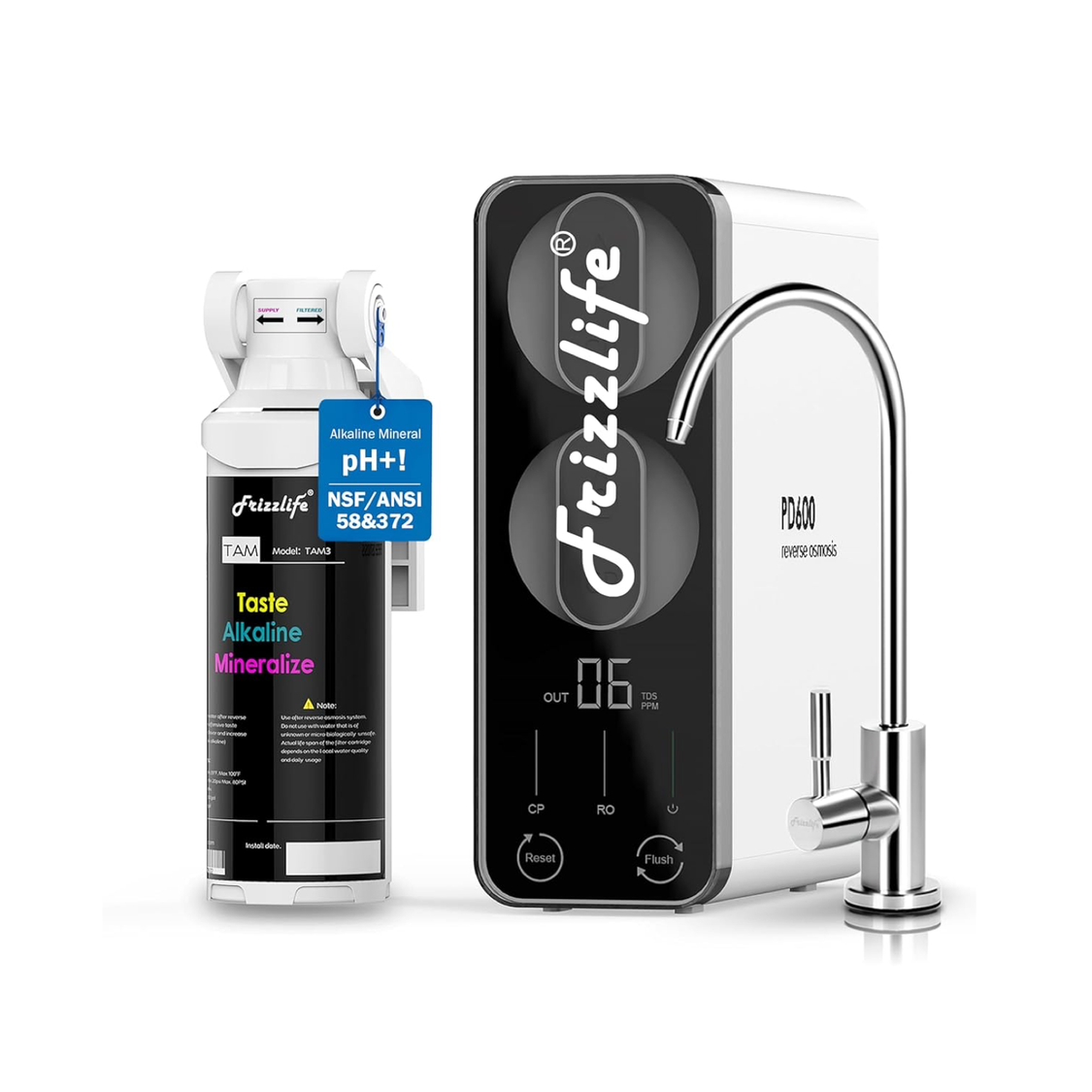
Tankless RO System
Frizzlife PD600-TAM3
A compact tankless reverse osmosis system with alkaline remineralization and smart TDS monitoring for under-sink drinking-water treatment.
View PD600-TAM3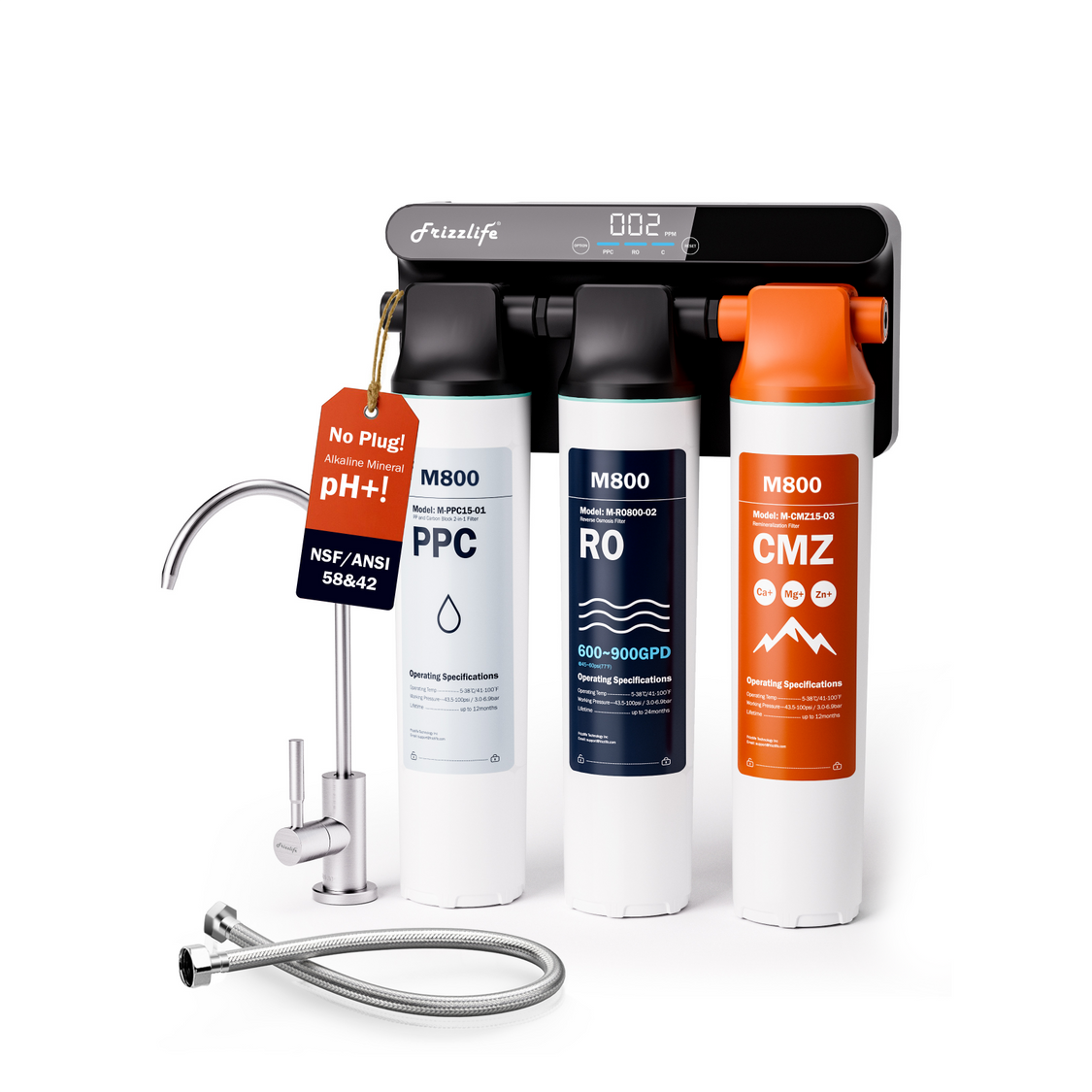
Non-Electric Tankless RO
Frizzlife M800
A non-electric tankless reverse osmosis system with alkaline remineralization, designed for users who want an under-sink RO setup without electrical power.
View M800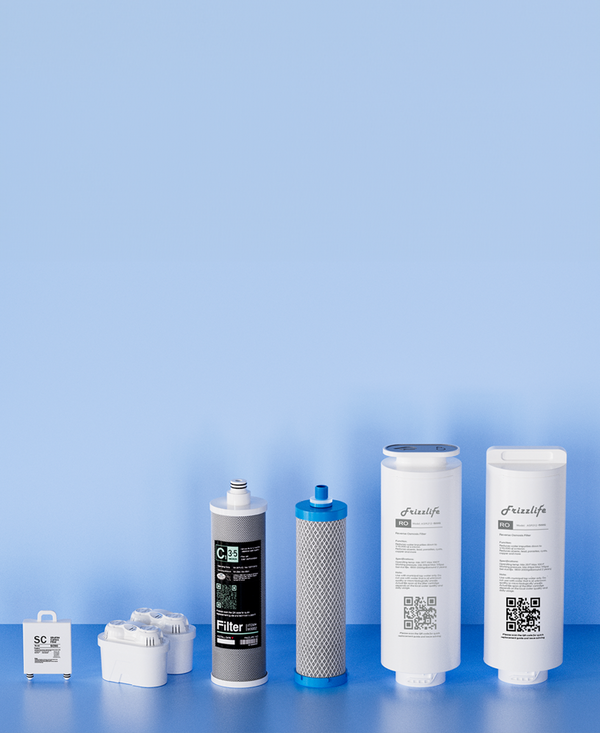
Maintenance
Frizzlife Replacement Filters
Already own a Frizzlife system? Find the replacement filters designed for your model and keep routine maintenance on schedule.
Find Replacement FiltersThe Bottom Line
A reverse osmosis system for city water makes the most sense when you want lower TDS, a broader point-of-use treatment barrier, or a practical replacement for bottled drinking water. If your only concern is chlorine taste or odor, an appropriately designed carbon filter may be enough.
The most important step is identifying whether your city uses free chlorine or chloramine. Free chlorine is commonly addressed by activated carbon, while chloramine requires more careful media selection, sizing, and contact time. In either case, the RO membrane should not be treated as the main disinfectant filter.
Start with the utility report, use targeted testing when needed, and choose equipment based on documented water conditions rather than assumptions. For most municipal households, a properly configured under-sink RO system offers a more practical balance than whole-house reverse osmosis.
References
-
U.S. Environmental Protection Agency, National Primary Drinking Water Regulations:
https://www.epa.gov/ground-water-and-drinking-water/national-primary-drinking-water-regulations -
U.S. Environmental Protection Agency, Chloramines in Drinking Water:
https://www.epa.gov/dwreginfo/chloramines-drinking-water -
U.S. Environmental Protection Agency, Basic Information About Chloramines and Drinking Water Disinfection:
https://www.epa.gov/dwreginfo/basic-information-about-chloramines-and-drinking-water-disinfection -
Centers for Disease Control and Prevention, Water Disinfection With Chlorine and Chloramine:
https://www.cdc.gov/drinking-water/about/about-water-disinfection-with-chlorine-and-chloramine.html -
Water Quality Association, Chloramine:
https://wqa.org/resources/chloramine/