


If you are wondering “is RO water hard or soft?”, the direct answer is that reverse osmosis water is typically very low in hardness and can be considered effectively soft at the treated faucet. An RO membrane rejects most of the dissolved calcium and magnesium that cause hard water.
However, that does not make an under-sink reverse osmosis system the same as a whole-house water softener. RO treats the water sent through its membrane—usually drinking and cooking water at one faucet. A traditional water softener treats the main household supply to control scale in pipes, water heaters, showers, dishwashers, and other appliances.
This distinction explains why answers to “does reverse osmosis soften water?” can sound contradictory. Chemically, RO substantially reduces hardness in the water it produces. Functionally, a typical under-sink RO system does not soften water throughout the home.
Key Takeaway: Is RO Water Hard or Soft?
The direct answer: RO water is typically very low in hardness and effectively soft at the treated tap
Hardness is primarily the amount of dissolved calcium and magnesium in water. Because a reverse osmosis membrane rejects most dissolved ions—including calcium and magnesium—the finished RO water normally has much less hardness than the incoming supply.
That means RO-treated water usually behaves like soft water at the RO faucet:
- It has a lower potential to form mineral scale.
- It leaves fewer calcium and magnesium deposits in kettles and cookware.
- It usually contains far fewer dissolved minerals than either untreated hard water or conventionally softened water.
- Its hardness may test within a soft or very low-hardness range.
RO does not necessarily produce water with absolutely zero calcium or magnesium. Real-world results depend on the membrane, incoming water chemistry, pressure, maintenance condition, and whether the system includes a remineralization stage. It is therefore more accurate to describe RO water as typically very low in hardness or effectively soft, rather than guaranteeing that it is mineral-free.
Why an under-sink RO system does not soften water throughout the home
Most residential reverse osmosis systems are point-of-use systems. They connect to a specific water line and deliver treated water through a dedicated faucet or selected fixture. The rest of the household plumbing continues to receive the original supply water.
For example, an under-sink RO system may provide low-hardness water for:
- Drinking
- Making coffee or tea
- Cooking
- Filling a kettle
- Washing produce
- Supplying a compatible refrigerator line
It does not normally change the water going to:
- Showers and bathtubs
- Bathroom faucets
- Washing machines
- Dishwashers
- Water heaters
- Outdoor faucets
- Most other household fixtures
If scale remains on shower glass after installing an under-sink RO system, the RO is not necessarily malfunctioning. The shower is simply receiving untreated hard water. Homeowners primarily concerned with drinking and cooking water can explore reverse osmosis filtration systems, while whole-home hardness problems generally require a different treatment approach.
What can affect the remaining hardness in RO water
Several factors determine whether an RO sample has no detectable hardness or a small residual amount:
- Incoming hardness: Extremely hard feed water can leave more residual hardness than moderately hard feed water, even when the membrane rejects a high proportion of it.
- Membrane condition: An aging, damaged, incorrectly installed, or fouled membrane may allow more dissolved ions into the product water.
- Feed-water pressure: RO separation depends on adequate operating pressure. Conditions outside the system’s intended range can affect production and rejection.
- Membrane and system design: Hardness reduction varies by membrane and configuration, so one percentage should not be treated as universal.
- Remineralization: A post-treatment cartridge may add calcium or other minerals back to the water for a different taste and mineral profile.
- Testing location: Water from the regular kitchen faucet is not necessarily RO water, even when an RO system is installed under the sink.
- Cross-connections or bypassing: Plumbing errors can allow untreated water to mix with the RO stream.
Published technical estimates often describe properly functioning RO systems as rejecting most hardness minerals, sometimes leaving roughly 1% to 5% of the original hardness. These are illustrative figures, not a guaranteed result for every system or water supply.
Decision Snapshot: Is RO Enough for Your Hard-Water Problem?
|
Your main concern |
Is under-sink RO enough? |
More appropriate approach
|
|---|---|---|
|
Better drinking and cooking water at one faucet |
Often, yes |
Point-of-use reverse osmosis |
|
Mineral deposits inside a kettle filled from the RO faucet |
Often, yes |
Check RO performance and remineralization if deposits continue |
|
Scale on showerheads and bathroom fixtures |
No |
Whole-home hardness treatment |
|
Scale in a water heater or household plumbing |
No |
Water softener or another suitable whole-home scale-control method |
|
Hard-water effects on laundry and soap performance |
No |
Whole-home water softener |
|
Very hard feed water causing frequent RO maintenance |
Not always |
Evaluate pretreatment, potentially including softening |
|
Broad drinking-water treatment plus whole-home scale control |
One system alone may not cover both goals |
Water softener followed by point-of-use RO |
|
Sediment, chlorine, or other whole-house filtration concerns without hardness problems |
RO may not be the right scope |
Whole-house filtration selected for the actual water conditions |
What Hard Water, Soft Water, and RO Water Actually Mean
Hardness comes primarily from dissolved calcium and magnesium
Hard water contains elevated concentrations of dissolved calcium and magnesium ions. These minerals enter water naturally as it moves through soil and mineral-bearing rock.
Hardness is not usually identified by looking at a glass of water. Instead, it becomes noticeable through effects such as:
- White or chalky scale on faucets and showerheads
- Mineral spots on glass and dishes
- Scale in kettles, water heaters, and plumbing
- Reduced soap lather
- Soap scum on tubs and shower surfaces
- Mineral buildup in appliances that heat or evaporate water
Soft water has a low concentration of calcium and magnesium. That can happen naturally, through ion-exchange softening, or because a purification process such as reverse osmosis has removed most dissolved minerals from a particular stream.
The route matters. Ion-exchange softened water and RO water can both have low hardness, but their overall mineral compositions are different.
How water hardness is measured in mg/L, ppm, and grains per gallon
Water hardness is commonly reported in:
- Milligrams per liter as calcium carbonate, written as mg/L as CaCO₃
- Parts per million, or ppm, which is approximately equivalent to mg/L for typical water testing
- Grains per gallon, abbreviated gpg
One grain per gallon is approximately 17.1 mg/L as CaCO₃.
Classification labels vary somewhat among water utilities, laboratories, and treatment professionals. One commonly used practical scale is:
|
Hardness classification |
Approximate hardness as CaCO₃ |
Approximate gpg
|
|---|---|---|
|
Soft or very soft |
Up to 17 mg/L |
Up to 1 gpg |
|
Slightly hard |
17–60 mg/L |
1–3.5 gpg |
|
Moderately hard |
60–120 mg/L |
3.5–7 gpg |
|
Hard |
120–180 mg/L |
7–10.5 gpg |
|
Very hard |
Over 180 mg/L |
Over 10.5 gpg |
These are guidance categories, not drinking-water contaminant limits. Some classification systems use a broader range for the word “soft,” so the measured number is more useful than the label alone.
Why low TDS and soft water are not the same thing
Total dissolved solids, or TDS, is a broad measurement related to the total concentration of dissolved material in water. Hardness is narrower: it mainly refers to calcium and magnesium.
Water can therefore be soft while still having a substantial TDS level. Ion-exchange softening illustrates this clearly. A softener removes calcium and magnesium by exchanging them for sodium or potassium ions. Hardness decreases, but the total amount of dissolved ions may remain similar.
RO water usually has both low hardness and reduced TDS because the membrane rejects a broad range of dissolved ions—not just calcium and magnesium.
This is why a handheld TDS meter cannot confirm hardness on its own:
- A low TDS reading suggests fewer dissolved substances overall, but it does not identify individual ions.
- A higher TDS reading does not prove the water is hard; sodium and other non-hardness ions can raise TDS.
- A hardness strip or laboratory test measures the question more directly.
If the goal is to determine whether RO water is hard or soft, test hardness rather than relying only on TDS.
Does Reverse Osmosis Soften Water? Technical vs Practical
Can an RO system remove the minerals that cause water hardness?
Yes. Reverse osmosis can remove a substantial portion of the calcium and magnesium in the water being treated.
RO should not be understood as a simple screen that catches particles only when they are larger than membrane openings. The separation process involves pressure, membrane properties, dissolved-ion behavior, and selective transport through a semipermeable membrane. Calcium and magnesium do not pass through as freely as water molecules, so most remain in the concentrated reject stream.
As a result, the product water contains much less hardness than the feed water. The exact reduction is condition- and system-dependent, but the technical answer to “does RO remove hardness?” is yes—it normally removes most hardness from the treated stream.
Why RO reduces hardness but is not a traditional water softener
A traditional water softener uses ion exchange. Hard water passes through resin that attracts calcium and magnesium. The resin exchanges those hardness ions for sodium or, in some systems, potassium. The resin is then regenerated so it can continue treating water.
Reverse osmosis uses a different process. It separates water from a broad range of dissolved substances through membrane filtration. It does not exchange calcium and magnesium for sodium or regenerate softening resin.
The distinction is both technical and practical:
- A softener specifically targets hardness at household flow rates.
- RO reduces hardness as part of broader dissolved-solids reduction.
- A softener is normally installed on the main water line.
- Residential RO is normally installed at a point of use.
Thus, RO water can be soft without the RO system being classified as a traditional water softener.
RO Water vs Soft Water
How RO changes the mineral profile of water
RO reduces calcium and magnesium along with many other dissolved ions. The result is generally lower-hardness, lower-TDS water.
Because much of the original mineral content has been reduced, some people describe plain RO water as clean-tasting, while others find it relatively flat. Taste is subjective and also depends on the source water, post-filters, storage, plumbing, and whether minerals are added after filtration.
RO is commonly selected for drinking and cooking because it addresses a broader dissolved-solids profile than a water softener. However, reduction claims vary by system and should be checked against the documentation for the specific model.
How ion-exchange softening changes the mineral profile of water
An ion-exchange softener primarily changes which dissolved ions are present. Calcium and magnesium are exchanged for sodium or potassium, depending on the system.
The finished water has low hardness and a much lower tendency to form traditional calcium and magnesium scale. However, it is not equivalent to low-TDS RO water because many dissolved substances remain.
In simplified terms:
- RO removes a broad portion of the dissolved mineral load from one treated stream.
- Softening exchanges hardness minerals for different ions in the household supply.
- RO usually reduces sodium as part of broader salt rejection.
- Sodium-based softening adds sodium in proportion to the hardness being exchanged.
People following sodium-related dietary guidance should seek advice appropriate to their circumstances rather than relying on generalized claims about softened water.
Differences in TDS, scale potential, taste, and household use
|
Characteristic |
RO water |
Ion-exchange softened water
|
|---|---|---|
|
Calcium and magnesium |
Usually greatly reduced |
Greatly reduced through ion exchange |
|
TDS |
Usually substantially reduced |
May remain relatively similar |
|
Sodium or potassium |
Usually reduced with other dissolved ions |
Added in exchange for hardness minerals |
|
Scale potential |
Low at the RO outlet |
Low throughout treated household plumbing |
|
Typical treatment scope |
One drinking-water location |
Main household water supply |
|
Primary purpose |
Drinking-water purification |
Hardness and scale control |
|
Taste |
May taste lighter or flatter |
Depends on source water and softening conditions |
|
Shower and laundry effects |
None unless those fixtures receive RO water |
Applies throughout the softened plumbing |
|
Appliance protection |
Only appliances supplied with RO water |
Appliances on the softened line |
Neither type of water is defined solely by taste. Testing is the reliable way to compare hardness and dissolved-solids levels.
What remineralization can mean for RO water hardness
Some RO configurations include a remineralization stage after the membrane. Depending on the media, this stage may add calcium or other minerals for taste and pH adjustment.
If calcium is added, finished water may show measurable hardness even though the membrane reduced the original hardness substantially. The final level depends on the cartridge, contact time, flow, source-water conditions, and system design.
Remineralized RO water may still fall within a soft or low-hardness range. The correct interpretation depends on the measured hardness—not simply on whether a mineral cartridge is present.
Reverse Osmosis vs Water Softener
Drinking-water treatment versus whole-home hardness control
Choose treatment based on the location of the problem.
If the concern is drinking-water taste, dissolved minerals, or the quality of water used for cooking, point-of-use RO may be appropriate. If the concern is scale throughout the plumbing system, a softener is usually the more relevant technology.
A drinking-water problem and a household hardness problem can exist at the same time. That is why comparing RO and softening as if only one can be installed may lead to the wrong decision. They perform different jobs and can complement each other.
Will an RO system stop scale in pipes, water heaters, showers, and appliances?
A standard under-sink RO system will not stop scale throughout the home. It only reduces scale potential in the water delivered through its treated outlet.
It can help protect a coffee maker, kettle, or other device filled exclusively with RO water. It cannot protect:
- The water heater
- Showerheads and shower doors
- Main plumbing lines
- The washing machine
- A dishwasher supplied by the untreated line
- Bathroom fixtures
- Outdoor irrigation plumbing
Whole-house RO exists as a specialized treatment approach, but it is more complex than a typical residential under-sink installation and should not be confused with ordinary point-of-use RO.
What each system does—and does not—treat
A softener controls calcium and magnesium hardness. It is not a general-purpose contaminant filter and should not be assumed to remove sediment, disinfectant residuals, or the broad range of dissolved substances associated with RO.
RO provides broad membrane separation at a selected outlet. It does not automatically improve shower water, laundry performance, or scale conditions elsewhere in the home.
Likewise, ordinary filtration does not necessarily soften water. Sediment and carbon filtration can address specific particles, tastes, odors, or chemicals, depending on the media, but dissolved calcium and magnesium can pass through filters that are not designed for hardness treatment.
Do You Need RO, a Water Softener, or Both?
Choose under-sink reverse osmosis when the priority is drinking and cooking water
RO is a logical choice when you want to treat water at the kitchen sink without changing the entire household supply.
Typical priorities include:
- Lower-hardness drinking water
- Reduced overall dissolved-solids content
- Better-tasting water, depending on the original water quality
- Low-mineral water for cooking or hot beverages
- Treatment at a specific faucet rather than every fixture
The specific substances reduced depend on the system and its documented performance. Choose a model based on an actual water-quality report and the product’s verified claims—not on the assumption that every RO unit has identical capabilities.
Explore Under-Sink Reverse Osmosis Systems
Looking for lower-hardness water at your drinking-water faucet? Explore two Frizzlife reverse osmosis systems designed for everyday drinking and cooking water.
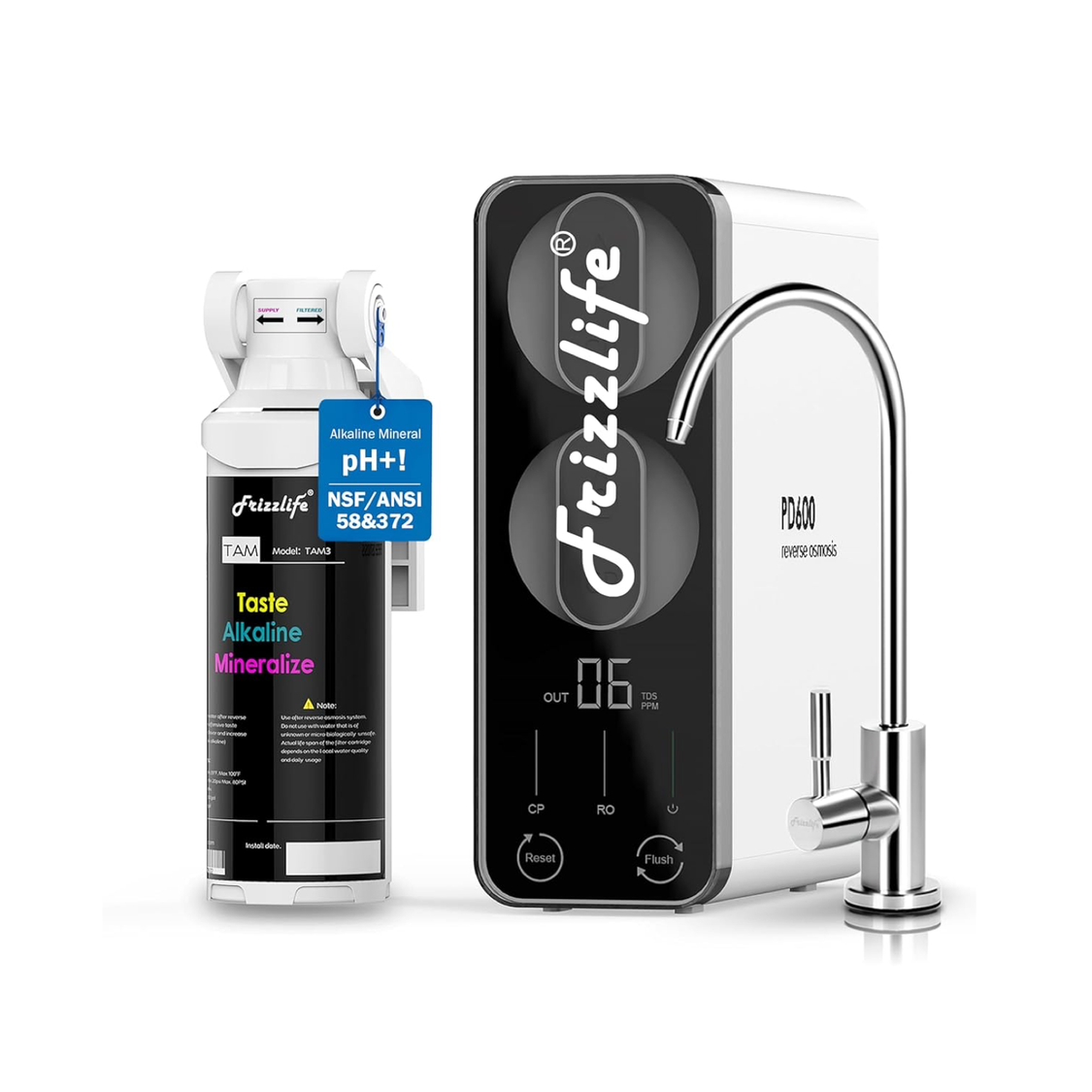
Frizzlife PD600-TAM3
A 600 GPD tankless reverse osmosis system with alkaline remineralization, designed for filtered drinking and cooking water at the kitchen sink.
Explore PD600-TAM3 →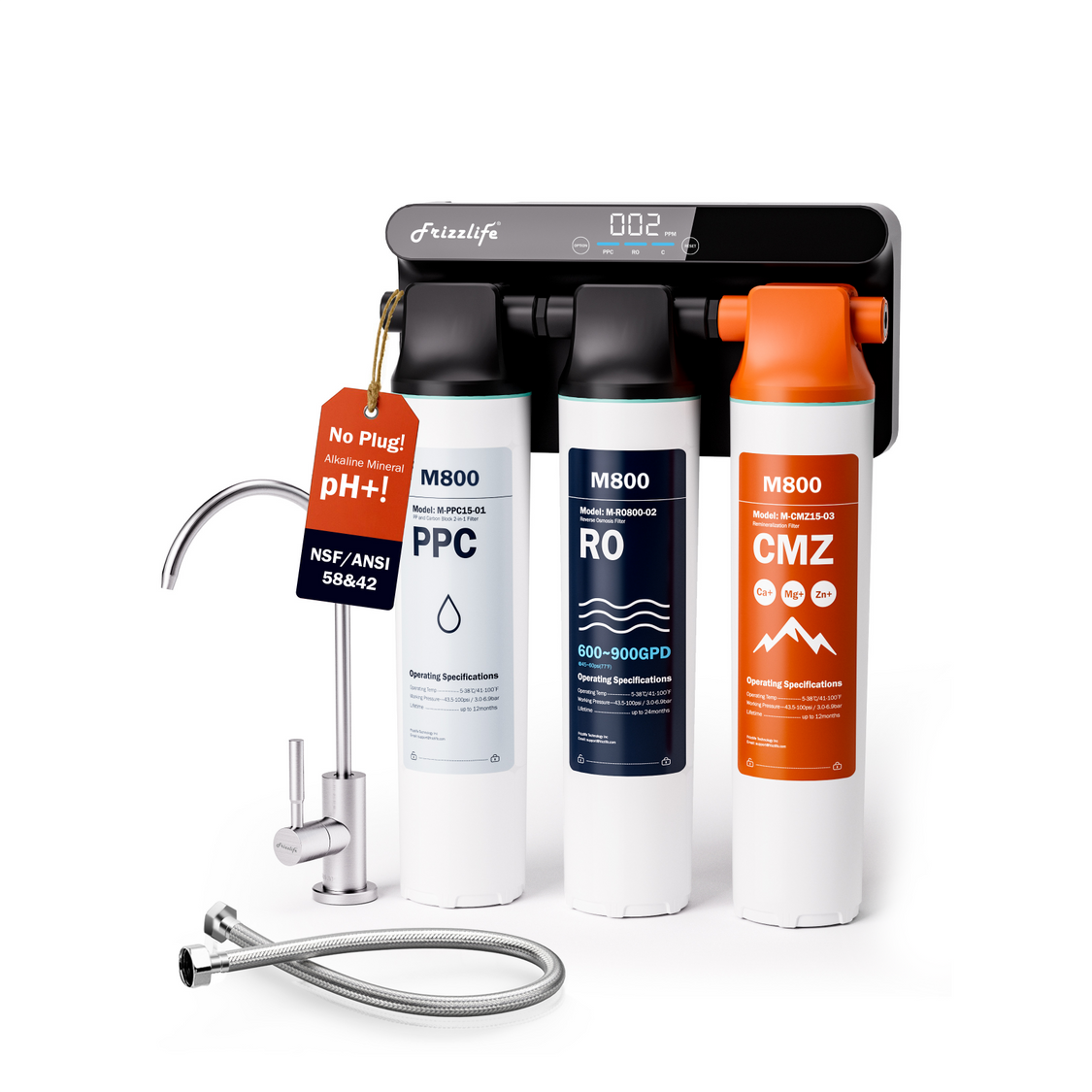
Frizzlife M800
A 900 GPD non-electric tankless RO system with remineralization, designed to provide filtered water through a dedicated drinking-water outlet without requiring electricity.
Explore M800 →Note: These are point-of-use RO systems, not whole-house water softeners. Remineralization can add minerals back after RO filtration, so final water hardness varies by system and water conditions.
Choose a water softener when the priority is whole-home scale control
A water softener is the more appropriate choice when hard-water symptoms occur throughout the home, including:
- Recurring scale on fixtures
- Mineral deposits in the water heater
- Soap scum in showers
- Reduced soap lather
- Scale-related appliance concerns
- Hardness spots on glassware and surfaces
- High hardness confirmed at multiple faucets
Softening the main supply allows showers, laundry equipment, water heaters, and other connected fixtures to receive low-hardness water. An under-sink RO system cannot provide that coverage.
When a combo—a water softener and reverse osmosis—is the best answer

Using both systems can make sense when a household wants whole-home scale control and separate drinking-water purification.
A common treatment sequence is:
- Incoming water enters the home.
- Pretreatment addresses sediment or other site-specific conditions where necessary.
- A water softener treats the main household supply.
- Softened cold water feeds an under-sink RO system.
- The RO system produces drinking and cooking water at a dedicated outlet.
This arrangement allows the softener to reduce hardness throughout the home while RO further reduces sodium and other dissolved ions in the drinking-water stream. Pre-softening can also reduce hardness-related scale stress on the RO membrane, which may be useful with very hard feed water.
A combined setup is worth considering when:
- Hardness is high and scale appears throughout the house.
- Drinking-water treatment is also a priority.
- RO membrane scaling or frequent maintenance is a concern.
- The household wants softened shower and laundry water but lower-TDS water for drinking.
- Water testing shows that one treatment process will not meet both goals.
Whether pretreatment is necessary depends on feed-water chemistry, the selected equipment, and manufacturer guidance. Avoid applying a universal hardness cutoff to every system.
Where whole-house filtration fits—and why filtration alone may not soften water
Whole-house filtration is a broad category rather than a single process. Depending on the media and design, a system may address sediment, chlorine, taste, odor, or other water-quality concerns.
Standard sediment or carbon filtration does not normally remove dissolved calcium and magnesium. As a result, filtered water can still be hard and continue forming scale.
If your concerns extend beyond drinking water, review whole-house water filtration options according to the substances identified in your water. Keep in mind that whole-house filtration and water softening are not automatically interchangeable. Confirm what a particular system is designed and documented to treat.
How to Test Water Hardness and Confirm Your Treatment Is Working
Test the incoming water and RO-treated water separately

Start with two clearly labeled samples:
- Untreated cold water from a faucet that does not receive RO water
- Finished water directly from the RO faucet
If the home also has a softener, a third sample from a softened but non-RO faucet can help distinguish softener performance from RO performance.
Comparing the samples answers three different questions:
- How hard is the source water?
- Is the softener reducing hardness throughout the home?
- Is the RO reducing the remaining hardness at the drinking-water outlet?
A single reading cannot provide all three answers.
Use hardness results rather than TDS alone
Use hardness test strips, a drop-count titration kit, or laboratory analysis that reports hardness as mg/L CaCO₃ or gpg. Follow the test instructions carefully, particularly for sample volume, timing, and color interpretation.
TDS readings can supplement the results:
- A large TDS reduction may indicate that the RO membrane is rejecting dissolved material.
- Little or no difference may suggest a sampling, plumbing, membrane, or operating issue.
- A higher post-RO TDS reading than expected may reflect remineralization.
But TDS still does not tell you exactly how much calcium and magnesium are present. Hardness-specific results are needed to classify the water as hard or soft.
Check the correct faucet and account for remineralization
Confirm the path the water takes before interpreting a surprising result. Some kitchen faucets provide separate untreated and filtered streams. Refrigerator water may come from the RO system, the regular cold-water line, or another filter.
If the system has a remineralization cartridge, finished water can show more hardness than water measured immediately after the RO membrane. That increase may be an intended result of the post-treatment stage.
When possible, compare:
- Feed-water hardness
- Post-membrane hardness
- Final-faucet hardness after remineralization
This separates membrane performance from intentional mineral addition.
Review pressure, maintenance, and feed-water conditions when results change
A change in taste, flow, TDS, or hardness does not identify one specific failure. Review the complete system condition:
- Has the water supply changed?
- Has incoming hardness increased?
- Is the system operating under suitable feed conditions?
- Is the membrane due for inspection or service under its model-specific instructions?
- Could plumbing work have caused a bypass or cross-connection?
- Is the storage tank or faucet being sampled correctly?
- Has a remineralization cartridge been added or replaced?
- Is very hard feed water contributing to membrane scaling?
If hardness rises suddenly and remains elevated after basic checks, consult the system documentation or a qualified water-treatment professional. Water testing can help avoid replacing components based on guesswork.
Frequently Asked Questions
1. Will a reverse osmosis system soften water?
A reverse osmosis system removes most of the calcium and magnesium from the water passing through its membrane, so the finished water is typically very low in hardness and effectively soft.
However, a standard under-sink RO system does not soften the entire household supply. It only treats water delivered through its RO outlet. A whole-house water softener is generally needed to control hardness in showers, water heaters, laundry equipment, and household plumbing.
2. Does remineralized RO water still count as soft water?
It can. Remineralization may add calcium or other minerals after RO treatment, producing measurable hardness. Whether the finished water is classified as soft depends on the resulting hardness concentration.
Many remineralized RO waters may remain in a soft or low-hardness range, but results vary by cartridge, system configuration, and operating conditions. Test the finished water rather than assuming that “remineralized” automatically means hard.
3. What hardness level should RO water have?
There is no single universal hardness level for all RO systems. Properly operating RO water is generally expected to have much lower hardness than the incoming supply, but the final result depends on feed hardness, membrane performance, pressure, maintenance, and remineralization.
Some technical estimates describe RO product water as retaining approximately 1% to 5% of feed-water hardness under suitable conditions. This is an illustration, not a guaranteed specification. The most useful check is to compare the incoming and treated hardness using the same test method.
The Bottom Line
So, is RO water hard or soft? At the treated faucet, RO water is normally very low in calcium and magnesium and is effectively soft. But reverse osmosis is not the same as whole-home water softening.
Choose point-of-use RO when the priority is drinking and cooking water. Choose a water softener when the goal is to control scale throughout the home. For households that need both broad drinking-water treatment and whole-home hardness control, using a softener and under-sink RO together may be the most complete approach.
Related Reading
For more context on mineral reduction across different treatment methods, read Do Water Filters Remove Minerals From Drinking Water?