


Yes, you can use a water filter with a pull-out or pull-down kitchen faucet—but the filter usually should not attach directly to the spray head. Most standard faucet-mounted filters are designed for fixed spouts with exposed aerator threads, not for an integrated sprayer connected to a retractable hose.
For most kitchens, the practical solution is an under-sink system. Depending on the filter design, it can either send filtered cold water through your existing pull-out faucet or supply a separate drinking-water tap. Other possibilities include a faucet designed with built-in filtration or a non-permanent countertop system.
The right setup depends on your plumbing, available cabinet space, filtration goals, desired flow, and whether you can add another faucet hole.
Key Takeaway: The Best Water Filter for a Pull-Out Faucet Usually Installs Under the Sink
A typical pull-out or pull-down faucet has a moving spray head, retractable hose, docking mechanism, and hose weight. Attaching a generic filter to that assembly can add bulk and weight, interfere with retraction, stress connections, or cause leaks.
An under-sink water filter avoids those problems because it treats the water before it reaches the faucet. The pull-out head and hose remain unchanged.
You generally have two practical configurations:
-
Filter the existing kitchen faucet. An inline under-sink filter connects between the cold-water shut-off valve and the faucet’s cold supply hose. All cold water delivered by the main faucet passes through the filter.
-
Add a dedicated filtered-water tap. The filtration system receives cold water through a feed adapter and sends treated water to a smaller drinking-water faucet. The main pull-out faucet continues operating normally.
Can you put a water filter on a pull-out faucet?
Sometimes, but most standard faucet-mounted filters are not a reliable fit.
A specialized filter may work if the pull-out spray head has compatible threads and the filter manufacturer specifically approves that faucet design. Physical attachment alone is not enough. You must also consider weight, docking, clearance, spray-head operation, hose movement, and the strength of the connection.
Do not force an adapter onto concealed, plastic, or mismatched threads. Even if the filter appears to screw on, it may leak or damage the spray head.
Why Faucet-Mounted Filters Usually Do Not Fit Pull-Out or Pull-Down Faucets
Although “pull-out” and “pull-down” are sometimes used interchangeably, they describe slightly different faucet layouts.
-
A pull-out faucet usually has a shorter spout, and the spray wand pulls outward toward the user.
-
A pull-down faucet generally has a taller arched spout, and the spray head pulls downward into the sink.
-
A fixed-spout faucet does not have an integrated retractable wand. It may have a removable aerator and sometimes a separate side sprayer.
Pull-out and pull-down models share the feature that creates most filter problems: the spray head is attached to a flexible hose that must move freely through the faucet body and cabinet.
How the retractable hose creates compatibility problems
Under the sink, the pull-out hose usually passes through the faucet body and moves through the cabinet as the wand is extended or returned. A weight or docking system helps retract the hose.
A heavy filter mounted on the wand changes how that mechanism behaves. It may cause the head to sag, dock poorly, or retract slowly. A bulky filter can also strike the sink, backsplash, dishes, or faucet neck.
The connection between the hose and spray head was designed for the original wand—not necessarily for the leverage created by an extra filtration device. This does not mean every specialized attachment will fail, but it does mean compatibility must be explicitly verified.

Nonstandard and concealed aerator threads
Faucet-mounted filters depend on matching internal or external aerator threads. Many pull-down spray heads use recessed aerators that require a special key for removal. Others use proprietary thread patterns or internal assemblies that are not intended to support an accessory.
An adapter kit cannot solve every mismatch. If an adapter is loose, cross-threaded, or forced into place, the result can be damaged threads or persistent leaks.
When a specialized pull-down faucet filter might work
A direct-attach pull-down faucet filter may be an option when all of the following are true:
-
The filter is specifically approved for pull-out or pull-down use.
-
Your exact spray head has a removable aerator and a supported thread type.
-
The required adapter and washer are included or manufacturer-approved.
-
The filter does not block the spray selector.
-
There is enough clearance for normal sink use.
-
The added weight does not impair docking or hose retraction.
-
The faucet manufacturer does not prohibit the attachment.
Marketing language such as “fits pull-out faucets” should not be treated as universal compatibility. Confirm the faucet model, thread specification, adapter requirement, and installation instructions before purchasing.
Direct-attach go/no-go checklist
Before installing a water filter on a pull-out faucet head, check:
-
Threads: Are they exposed, undamaged, and identified in the faucet documentation?
-
Adapter: Is the adapter approved for both the filter and your faucet?
-
Washer: Does the connection use the correct gasket rather than relying only on excessive tightening?
-
Clearance: Can the wand still dock and move without hitting surrounding surfaces?
-
Weight: Does the hose retract completely with the filter attached?
-
Controls: Are the stream, spray, and pause buttons still usable?
-
Approval: Does the filter manufacturer explicitly support integrated sprayers?
-
Warranty: Could modifying the spray head affect faucet warranty coverage?
If any of these points is uncertain, an under-sink configuration is usually the more reliable option.
Water Filter Options That Work With Pull-Out and Pull-Down Faucets
The best filter for a pull-out faucet is not necessarily a device mounted on the faucet. “Compatible” can instead mean that the filtration system works upstream of the faucet and leaves the retractable assembly untouched.
Comparison snapshot
|
Filter configuration |
Pull-out faucet compatibility |
Main faucet changes |
Installation needs |
Key limitation |
|
Inline under-sink filter |
Generally high when plumbing and fittings match |
None above the sink |
Cold-water valve access and cabinet space |
Filters all cold water, which can use cartridge capacity faster |
|
Under-sink filter with dedicated tap |
Generally high |
Adds a second faucet |
Feed adapter, tubing, and an available or drilled hole |
Requires sink or countertop space |
|
Reverse osmosis system |
Generally high when installed as designed |
Usually adds a dedicated tap |
More cabinet space; model may require drain and power |
More complex installation |
|
Built-in filtration faucet |
Designed as an integrated system |
Replaces the existing fixture |
Faucet and filtration-module installation |
Requires buying and installing a new faucet |
|
Specialized spray-head filter |
Model-dependent |
Attaches to the moving wand |
Compatible threads and adapter |
May affect weight, docking, clearance, or retraction |
|
Countertop or gravity system |
Does not alter under-sink plumbing |
Varies by design |
Counter space; some units need a suitable water connection |
May be less convenient or incompatible with the faucet outlet |

Inline under-sink filter feeding the existing faucet
This is often the simplest way to filter an existing kitchen faucet without drilling a new hole.
The filter is installed on the cold-water supply path under the sink. Water travels from the shut-off valve, through the filter, and into the faucet’s cold-water supply hose. The spray head, docking mechanism, and pull-out hose are not modified.
This configuration is useful when you want:
-
Filtered cold water from the main kitchen faucet
-
No second faucet on the sink deck
-
No attachment on the spray head
-
A relatively compact under-sink installation
-
Continued use of both stream and spray modes
The main trade-off is that all cold water from the faucet goes through the cartridge, including water used for washing produce, rinsing dishes, and cleaning.
Under-sink filter with a separate drinking-water faucet
Some filtration systems are designed to feed a dedicated tap rather than the main faucet. A feed adapter diverts cold water to the filter, and separate tubing carries the filtered water to the drinking-water faucet.
This setup keeps filtered drinking and cooking water separate from ordinary sink use. It may conserve filter capacity because dishwashing and general cleaning do not draw filtered water.
However, it requires an available sink hole or permission to drill through the sink or countertop. Faucet-stem length, countertop material, thickness, and hole size must match the specific system instructions.
Reverse osmosis system with a dedicated faucet
Many under-sink reverse osmosis systems are designed to deliver filtered water through a separate faucet. Depending on the model, installation may also require a drain connection, storage or treatment-system space, and electrical power.
An RO system is not simply attached to a pull-down spray head. It is a separate under-sink treatment and delivery system. Check the individual model’s inlet-pressure requirements, plumbing diagram, drain requirements, power needs, and installation clearances before choosing it.
Explore Frizzlife Under-Sink RO Systems
Looking for an under-sink filtration setup instead of attaching a filter to your pull-out spray head? Explore these Frizzlife options and find replacement filters for ongoing maintenance.
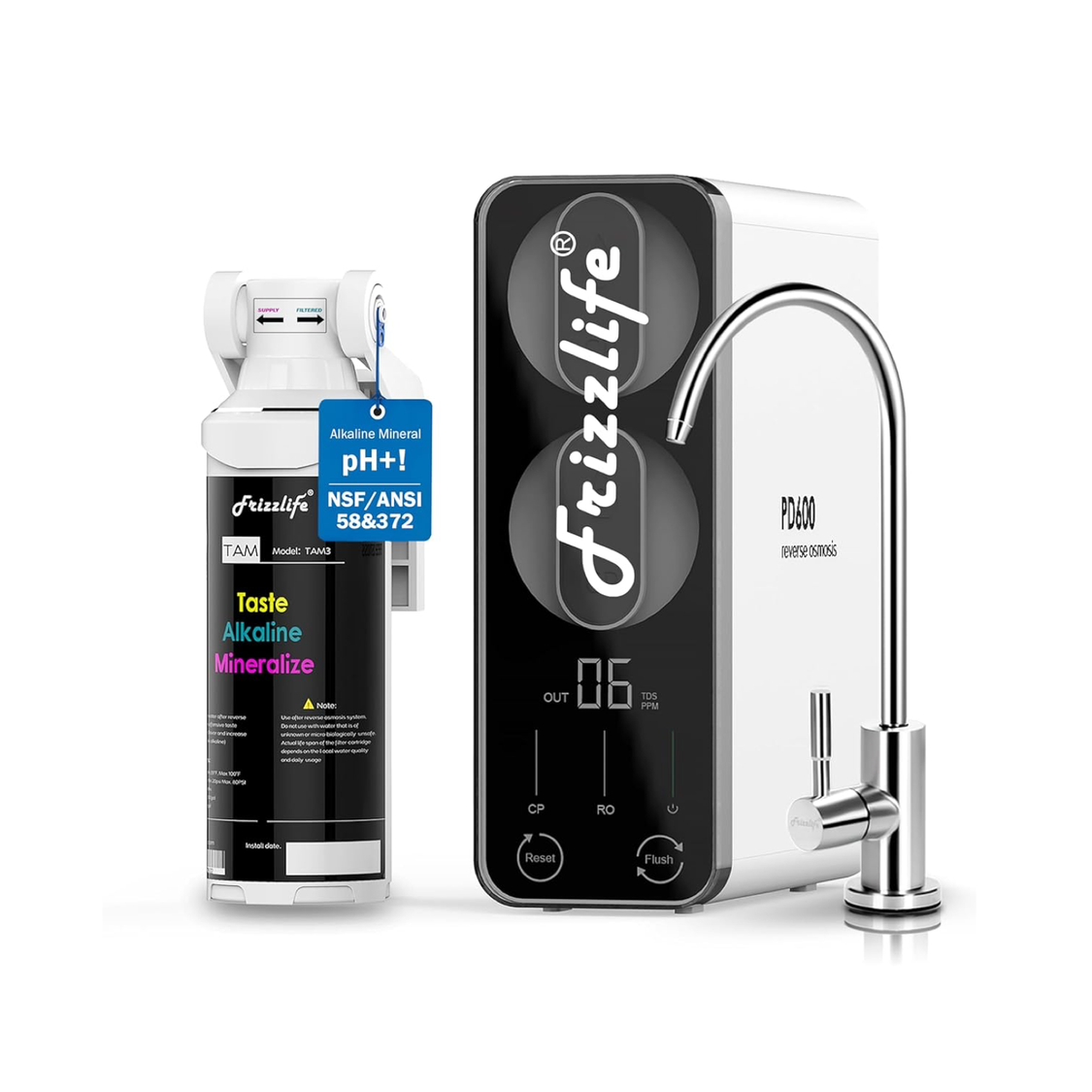
Frizzlife PD600-TAM3
A 600 GPD tankless reverse osmosis system with alkaline remineralization for a dedicated under-sink drinking-water setup.
View PD600-TAM3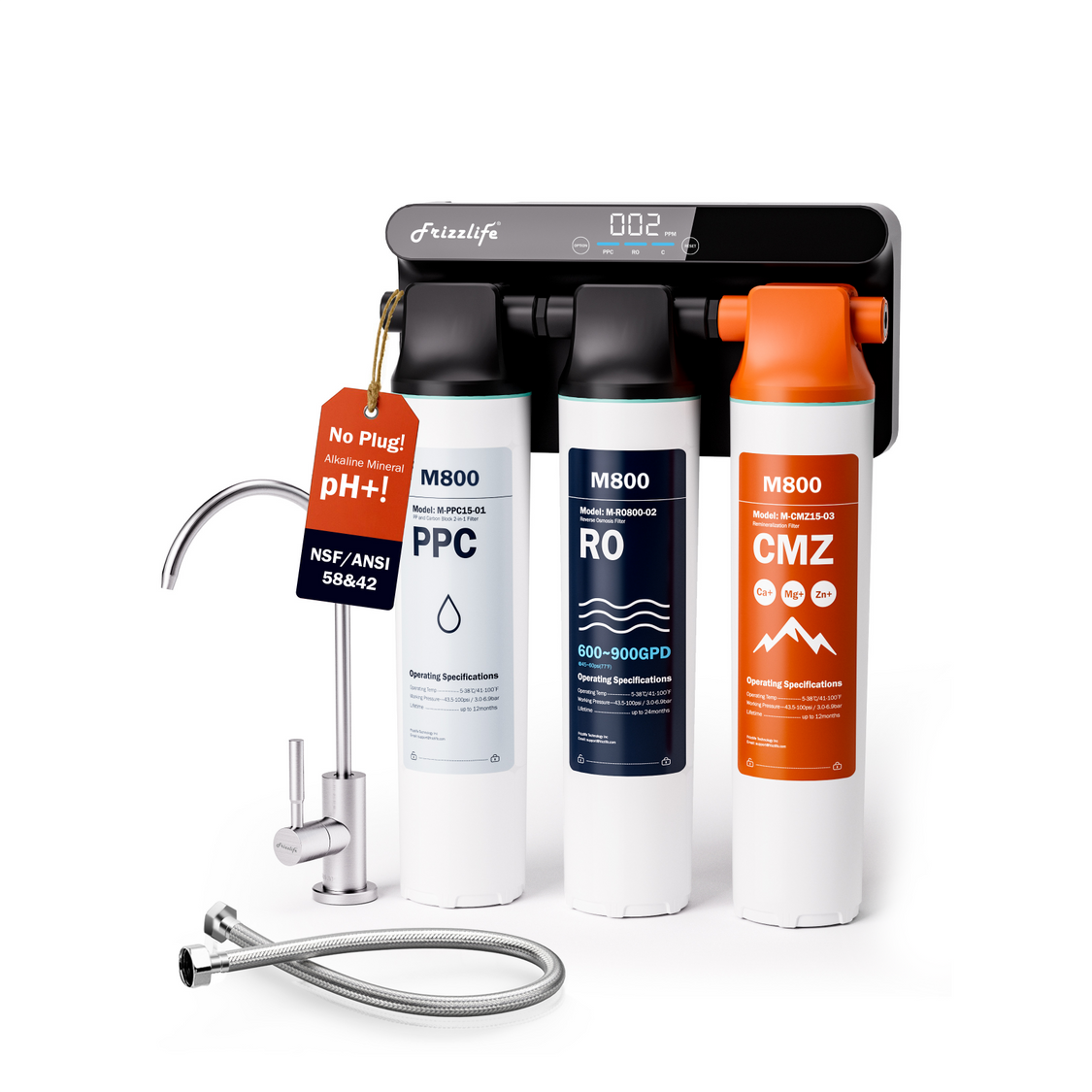
Frizzlife M800
A 900 GPD non-electric tankless reverse osmosis system designed for under-sink installation and high-flow drinking-water use.
View M800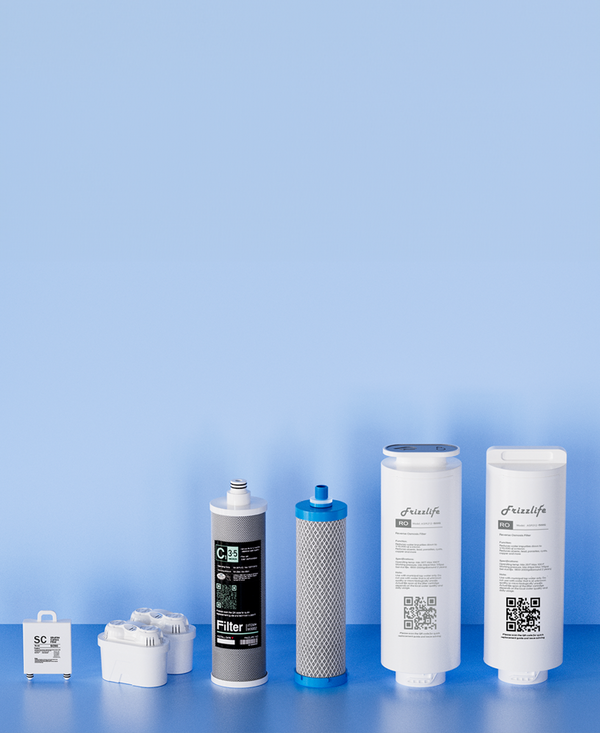
Replacement Filters
Find compatible replacement cartridges for Frizzlife RO and under-sink filtration systems by model.
Shop Replacement FiltersPull-down faucet with built-in filtration
If you are already replacing the kitchen faucet, a fixture engineered with built-in filtration can combine pull-down functionality and filtered-water delivery.
These faucets use their own internal water paths, hoses, controls, and compatible filtration modules. They should be treated as complete systems rather than as generic filters retrofitted onto an ordinary faucet.
Replacing a functioning fixture solely to gain filtration may involve more work than installing an inline under-sink filter. But built-in filtration can make sense during a kitchen renovation or planned faucet replacement.
Countertop and non-permanent alternatives for renters
Renters or homeowners who cannot modify plumbing may consider a countertop dispenser, gravity-fed unit, or another non-permanent filtration option.
Be careful with countertop systems that require attachment to the faucet outlet. They can encounter the same thread and aerator problems as faucet-mounted filters. A self-contained system that does not rely on the pull-out head may be easier to use, although it occupies counter space and must be filled or connected according to its design.
Why filtering the pull-out hose is not a universal retrofit
Certain purpose-built faucet systems route water through filtration components integrated with their hoses or valve bodies. That does not mean a generic inline cartridge can be inserted into any pull-out hose.
Pull-out hoses use model-specific quick-connects, pressure-rated parts, weights, and movement paths. Altering that assembly can interfere with retraction, create a leak point, or damage the faucet. Unless a product is expressly engineered and approved for that hose configuration, filter the cold-water supply line instead.
Can an Under-Sink Filter Work With My Existing Faucet?
Yes. An under-sink filter can work with an existing pull-out or pull-down faucet when the system is designed for inline installation and the plumbing connections are compatible.
The filter is installed before the faucet, so the type of spray head above the sink is largely irrelevant.
How the inline connection works
A typical inline path looks like this:
Cold-water shut-off valve → filter inlet → filtration cartridge → filter outlet → faucet cold-water supply hose
The faucet’s hot-water supply remains connected normally. Above the sink, nothing changes: you still operate the handle, extend the wand, switch spray modes, and dock the head as before.
Frizzlife offers multiple under-sink water filter configurations, but connection method, fitting requirements, performance claims, and faucet arrangement vary by model. Review the product manual before assuming a particular system will feed your existing faucet.
What happens with cold, hot, and mixed water?
With an inline filter connected only to the faucet’s cold supply:
-
Cold setting: Water passes through the filter before reaching the faucet.
-
Hot setting: Water comes from the hot-water line and does not pass through the cold-line filter.
-
Mixed setting: The faucet combines filtered cold water with unfiltered hot water.
If you want water that has passed only through the cold-line filter, use the cold setting rather than a mixed temperature. Do not send hot water through a filter unless the specific model is designed and approved for it.
When an existing-faucet system is a good fit
Choose an inline under-sink filter when:
-
You want to keep the existing pull-out faucet unchanged.
-
You do not have or cannot drill a second faucet hole.
-
You want filtered water from the main cold-water outlet.
-
The cold-water shut-off valve and supply connection are accessible.
-
The cabinet has sufficient room for mounting and cartridge replacement.
-
The model’s rated flow and pressure requirements suit your plumbing.
An adapter or professional installation may be necessary if the home has unusual fitting sizes, rigid piping, shared or inaccessible valves, old plumbing, or corroded connections.
Do You Need a Separate Faucet for Filtered Water?
Not always. Whether you need a separate faucet depends on the filtration system’s design.
An inline system can filter cold water going to your existing pull-out faucet. A system designed for dedicated delivery—including many multi-stage and reverse osmosis configurations—uses a separate tap.
Existing faucet or dedicated faucet?
|
Choose the existing pull-out faucet when… |
Choose a dedicated filtered-water faucet when… |
|
The filter is approved for inline connection to the main cold-water supply |
The filtration system requires a separate outlet |
|
You want to avoid drilling |
A spare sink hole is available or drilling is allowed |
|
You prefer one faucet for all sink tasks |
You want to reserve filtered water for drinking and cooking |
|
You accept filtering all cold water used at the sink |
You want the main faucet’s hot and cold operation left entirely separate |
|
The filter provides suitable flow for the kitchen faucet |
The treatment process is intended for a lower-flow drinking-water tap |
A dedicated faucet can reduce unnecessary use of filtered water, but it takes up sink-deck space. It also adds tubing and connections that must be installed and checked for leaks.
What if there is no spare hole?
Possible options include:
-
Use an inline filter that supplies the existing faucet.
-
Replace an unused accessory, such as a soap dispenser, if the hole fits and the change is permitted.
-
Have an appropriate hole drilled by a qualified professional.
-
Choose a non-permanent countertop or gravity-fed system.
-
If renovating, select a sink, countertop, or integrated filtration faucet that supports the desired configuration.
Do not drill into an unknown countertop material without confirming the correct method. Renters should obtain property-owner approval before modifying the sink, countertop, valves, or cabinetry.
Pre-Installation Compatibility and Go/No-Go Checklist
A few checks under the sink can prevent an incompatible purchase or a difficult installation.
Plumbing and connection checks
-
Locate the cold-water shut-off valve and verify that it turns fully.
-
Identify where the faucet’s cold-water supply hose connects.
-
Compare fitting sizes with the filter’s installation documentation.
-
Use only the supplied or model-approved adapters.
-
Look for corrosion, damaged threads, rigid piping, or signs of an existing leak.
-
Confirm that shutting off the cold valve actually stops cold flow at the faucet.
An old valve that will not close, a heavily corroded fitting, or unidentified plumbing is a reason to pause and call a plumber.
Cabinet space and hose movement
Measure the available area rather than relying on the cabinet’s outside dimensions. Account for:
-
Garbage disposal and drain piping
-
Dishwasher connections
-
Trash bins and stored supplies
-
Cabinet doors, shelves, and drawers
-
Filter body and mounting bracket
-
Tubing bend radius
-
Space needed to remove or replace the cartridge
-
The full travel path of the pull-out hose and its weight
Move the spray wand through its full range while watching under the sink. The filter, tubing, and stored items must remain clear of the retracting hose.

Pressure, flow, drain, and power
Every filter has a specified operating-pressure range and rated flow. Verify those values for the exact model rather than relying on a general range.
A filter that is too restrictive for the faucet can make stream and spray modes feel weak. Excessive inlet pressure may require plumbing correction or pressure control according to the product instructions.
Simple non-RO filters commonly need only a cold-water connection and cabinet space. Reverse osmosis and powered systems may also require:
-
A drain connection
-
An air-gap arrangement where applicable
-
A nearby electrical outlet
-
Additional treatment-unit or tank space
-
A dedicated faucet
These requirements are model-dependent.
Final go/no-go questions
Proceed only if you can answer yes to the relevant questions:
-
Can the cold-water supply be safely shut off?
-
Are the fittings identified and compatible?
-
Is there enough mounting and cartridge-change clearance?
-
Can tubing be routed without kinks?
-
Will the pull-out hose move freely?
-
Does the home’s pressure fall within the model’s required range?
-
Are required drain and electrical connections available?
-
Is drilling permitted if a separate faucet is required?
-
Does the installation comply with product, property, and faucet warranty requirements?
How to Install an Under-Sink Water Filter With a Pull-Out Faucet
The following is a general overview for an inline filter that supplies the existing faucet. Always follow the instructions for the exact model, because fittings, tubing, mounting orientation, flushing procedures, and connection methods vary.
Inline installation path
-
Clear the cabinet. Remove stored items and identify the pull-out hose’s movement path.
-
Shut off the cold water. Close the cold-water valve under the sink.
-
Relieve pressure. Open the faucet on the cold setting until the flow stops.
-
Disconnect the cold supply hose. Place a towel or container below the connection to catch residual water.
-
Connect the filter inlet. Attach the inlet side to the cold-water valve using the required fitting or hose.
-
Connect the filter outlet. Attach the outlet side to the faucet’s cold-water supply hose.
-
Confirm flow direction. The inlet and outlet must match the arrows or labels on the filter head.
-
Mount the system. Leave enough clearance for cartridge replacement and keep it away from the pull-out hose.
-
Restore the water supply slowly. Watch every connection as pressure returns.
-
Check for leaks. Inspect the valve, adapters, hoses, filter head, tubing, and cartridge connection.
-
Flush the cartridge. Follow the model-specific flushing instructions before drinking the water.
-
Recheck hose movement. Extend and retract the spray wand several times.
Avoid overtightening plastic fittings. A connection that leaks may have a misaligned washer, incorrectly seated tube, damaged thread, or incompatible adapter—not simply insufficient torque.
Dedicated-faucet installation differences
A dedicated-faucet system typically adds these steps:
-
Install a feed-water adapter on the cold-water supply.
-
Mount the filtered-water faucet in an existing or newly drilled hole.
-
Route separate tubing from the feed adapter to the filter.
-
Connect the filter outlet to the dedicated tap.
-
Add a drain connection if required by an RO system.
-
Connect power if the model uses a pump, controls, or powered display.
The main pull-out faucet remains on its original hot and cold supplies.
DIY or plumber?
A straightforward installation may be suitable for a homeowner comfortable with shut-off valves, threaded fittings, tubing, and leak testing.
Call a plumber when:
-
The shut-off valve is stuck or leaking.
-
Fittings are corroded or difficult to identify.
-
The faucet uses rigid rather than flexible supply connections.
-
Plumbing modifications are required.
-
A countertop hole must be drilled.
-
Drain work is needed.
-
The installation instructions do not match the plumbing layout.
-
Local requirements call for professional installation.
Flow, Maintenance, and Troubleshooting
Will a water filter reduce pressure at a pull-out faucet?
Any filtration media creates some resistance to flow. Whether the difference is noticeable depends on the filter design, household pressure, tubing, cartridge condition, and how much water the faucet demands.
A correctly sized and maintained inline filter should provide the flow specified for that model. However, the pull-out faucet’s spray mode may reveal restriction sooner than a gentle stream because the spray pattern depends on adequate flow and pressure.
Do not assume that every under-sink filter can support every kitchen faucet equally. Compare the filter’s rated flow and pressure requirements with the intended use.
Weak flow after installation
If flow drops sharply, check for:
-
A cold-water valve that is only partly open
-
Kinked or sharply bent tubing
-
Reversed inlet and outlet connections
-
A protective plug that was not removed
-
A tube that is not fully inserted
-
Debris disturbed during installation
-
A clogged or incorrectly installed cartridge
-
A filter that is undersized for the desired flow
-
Household pressure outside the required range
Compare cold and hot flow. If hot flow is normal but filtered cold flow is weak, the restriction is likely in the cold-side valve, connections, tubing, or filter.
Leaks after installation
Inspect every new and disturbed connection, including:
-
Shut-off valve
-
Feed adapter
-
Faucet supply hose
-
Filter inlet and outlet
-
Push-fit tubing connection
-
Filter head
-
Cartridge seal
Shut off the water before correcting a leak. Confirm that washers and seals are present, tubing ends are cut square where required, and fittings are compatible. Do not use thread-sealing material unless the instructions call for it.
Check again after the first flush and periodically afterward. Slow leaks may not appear immediately.
Pull-out hose no longer retracts smoothly
If the faucet worked normally before under-sink installation, look for interference inside the cabinet:
-
Tubing crossing the hose’s travel path
-
A filter housing blocking the hose weight
-
Stored items catching the hose
-
A moved or incorrectly positioned hose weight
-
Tight cable ties or tubing loops restricting movement
Reposition the filtration tubing and filter body rather than altering the faucet hose unless the faucet instructions specifically permit adjustment.
Cartridge replacement and ongoing care
Mount the system where the cartridge can be changed without disconnecting unrelated plumbing or moving the disposal. Follow the model instructions for:
-
Cartridge replacement procedure
-
Replacement interval
-
Flushing
-
Seal inspection
-
Leak checks
-
Winterization or periods of non-use, where applicable
Replacement timing depends on the specific cartridge, water conditions, and usage. Reduced flow, taste changes, or the recommended service limit may indicate that replacement is due, but only the model documentation should be used for the official interval.

How to Match a Filter to Your Water Concerns
Do not choose solely by the number of filtration stages or broad marketing language. Identify what you want to address, then review the exact model’s performance documentation.
When evaluating third-party certification or testing:
-
Confirm the listing applies to the exact model and cartridge.
-
Check which substances or performance categories are covered.
-
Distinguish material-safety or structural standards from contaminant-reduction claims.
-
Verify rated flow, capacity, and operating conditions separately.
-
Do not assume that one model’s certification applies to an entire product line.
If you are unsure what is in your water, review the local water-quality report or consider appropriate testing before selecting treatment goals.
Final Decision
You can use a water filter with a pull-out or pull-down faucet, but mounting a generic filter on the moving spray head is usually not the best approach. Compatibility is limited by threads, weight, clearance, hose retraction, and manufacturer approval.
For most kitchens, an inline under-sink filter is the simplest way to keep the existing faucet and filter its cold-water supply. A dedicated faucet makes more sense when the treatment system requires separate delivery or when you want filtered drinking water kept apart from general sink use.
Before buying, confirm the plumbing connections, cabinet clearance, pressure and flow requirements, maintenance access, and whether drilling, drainage, or power will be necessary. This installation-first approach is the most reliable way to find a water filter for a pull-out faucet that works safely and conveniently.