


You fill a glass, and the RO faucet only trickles water. Maybe it started after a filter change, after heavy use, or slowly over months. Slow RO water flow often feels like a broken system, but the cause may be normal tank behavior, overdue filters, incorrect tank pressure, cold water, or a restriction. Misreading those signs can lead to unnecessary membrane work, over-adjusted tanks, ignored maintenance, or real long-term damage.
This guide focuses on traditional storage-tank RO systems, where water is produced slowly and stored before use. Tankless RO systems work differently because they deliver water on demand rather than relying on a pressurized storage tank. Depending on the design, flow may depend on an electric pump or on household feed-water pressure, so their normal flow expectations are not the same.
Explore Frizzlife RO Options and Replacement Filters
Whether you are comparing a tankless RO design or checking overdue filters during slow-flow troubleshooting, explore these Frizzlife options based on your current system and maintenance needs.
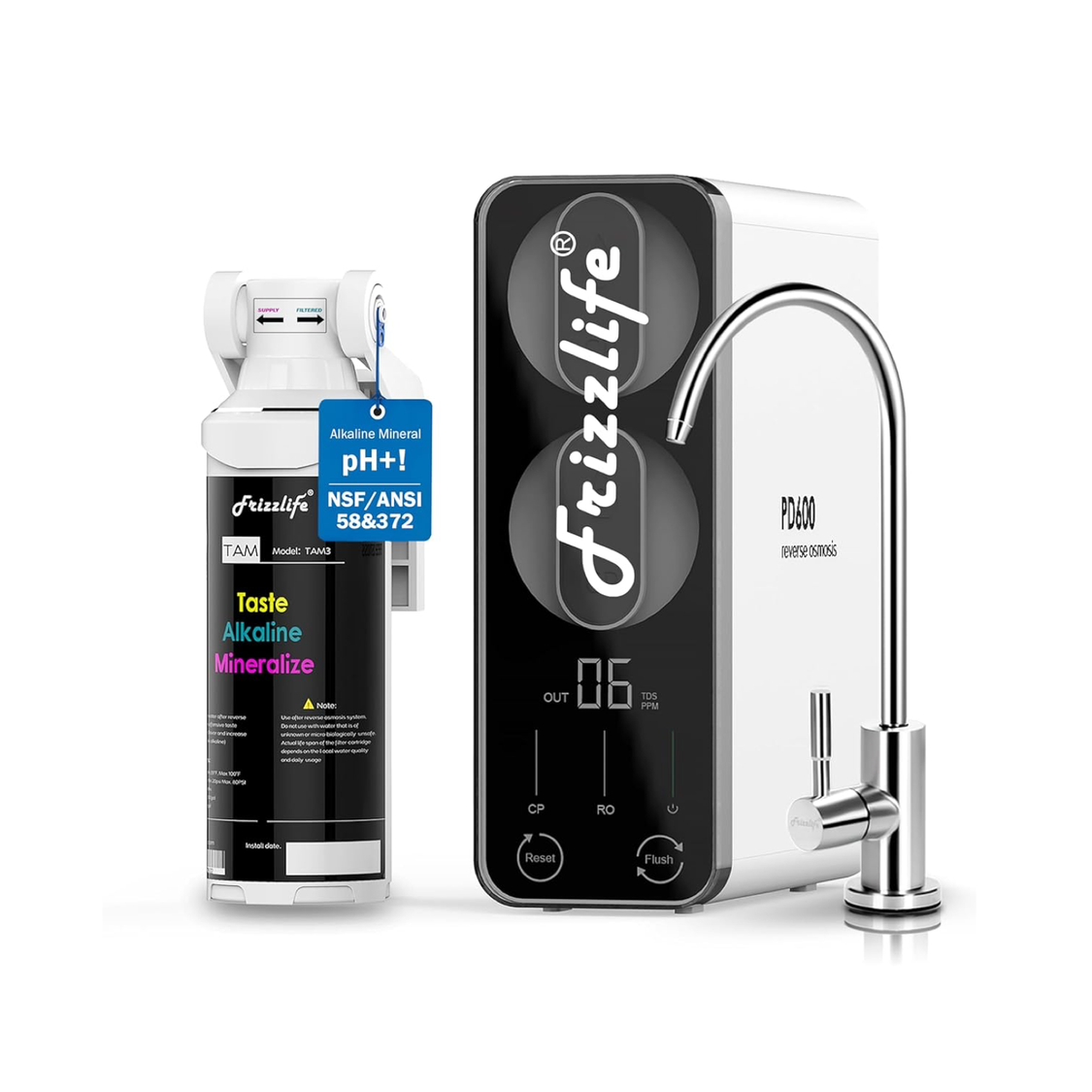
Tankless RO Option
Frizzlife PD600-TAM3
Explore a tankless under-sink RO option if you prefer on-demand water delivery instead of a traditional pressurized storage-tank setup.
View PD600-TAM3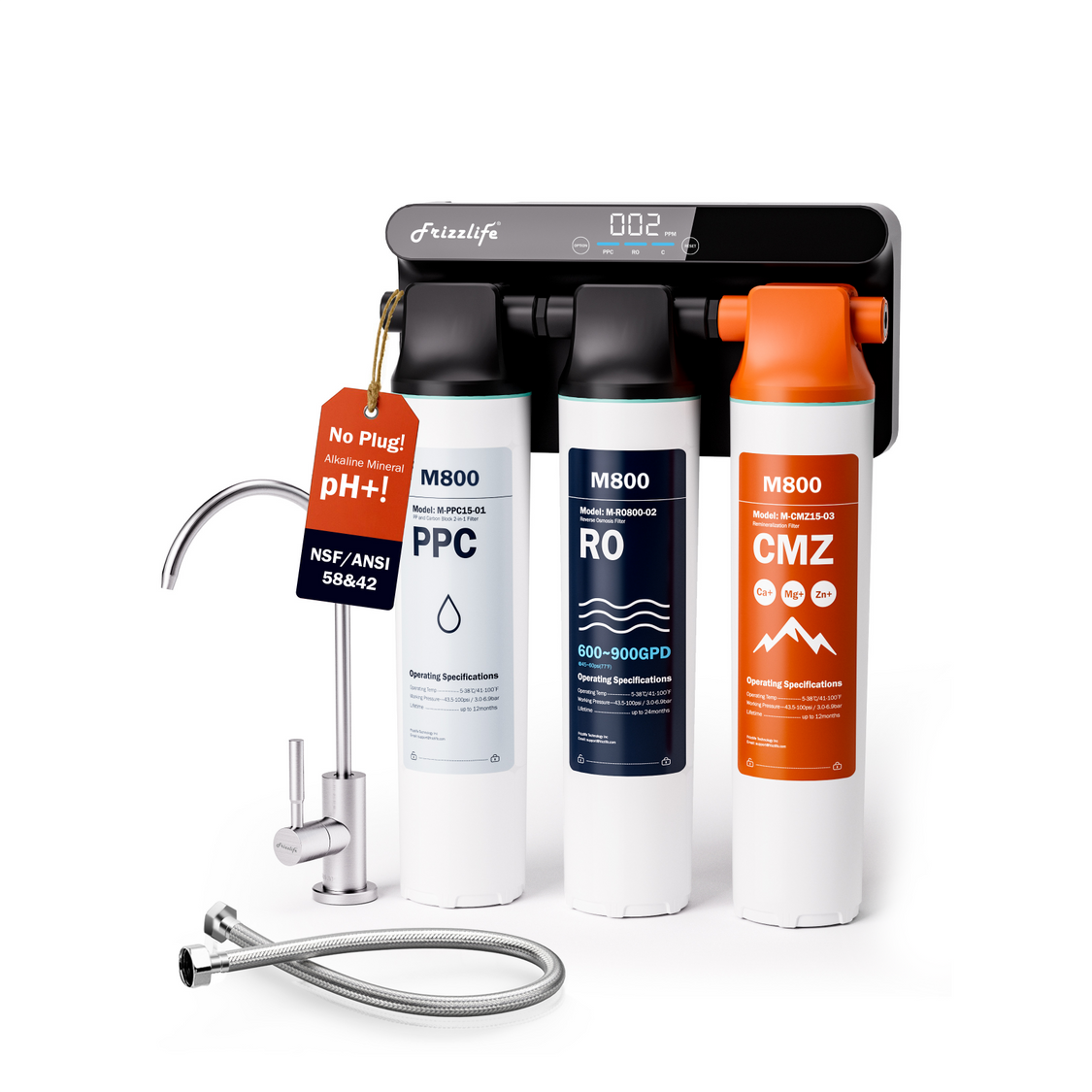
Tankless RO Option
Frizzlife M800
Compare another tankless RO option if you are considering a system design that does not rely on a conventional pressurized storage tank.
View M800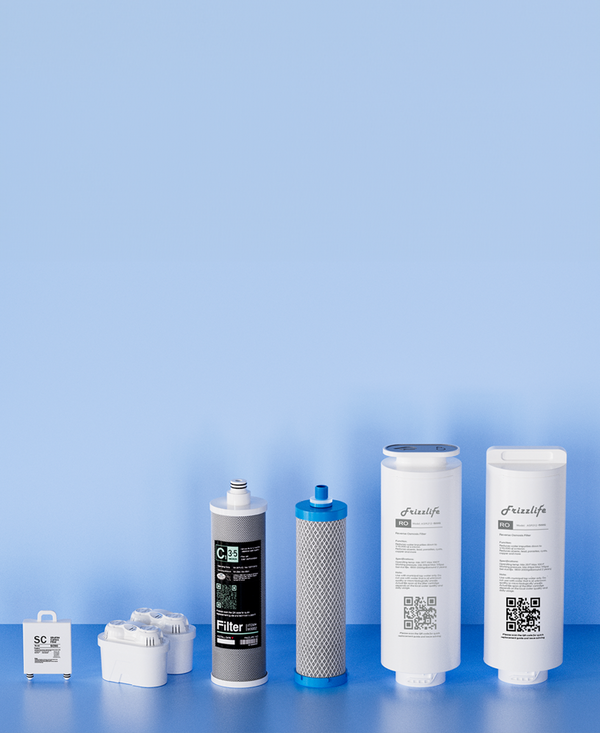
Routine Maintenance
Frizzlife Replacement Filters
If your filters are past their recommended service interval, find the correct replacement for your Frizzlife system before assuming a major component has failed.
Find Replacement FiltersHow Much RO Water Flow Is Normal?
RO Maintenance Basics That Affect Water Flow
Most users expect RO maintenance to mean “change a filter when taste or flow gets bad.” In real use, flow changes before taste changes in many cases. A healthy RO system depends on scheduled pre-filter changes, post-filter service, tank pressure checks, periodic sanitizing, and simple inspections.
Quick observations can help identify obvious issues such as leaks, closed valves, unusual noise, or sudden drops after service. However, taste, clear appearance, low TDS, or filter color alone cannot confirm that the system is maintaining normal flow. Those signs are only reassuring if flow, refill time, tank pressure, and filter age are also normal.
The RO membrane usually does not need attention every time flow slows. It often lasts several years if pre-filters are maintained. The parts that need more routine attention are sediment and carbon filters, the post-filter, tank air charge, tubing, faucet screen, drain restrictor, and sanitation.
Why RO Water Flow Slows After Heavy Use
The common confusion is expecting an RO faucet to behave like a regular pressurized faucet. RO systems make water slowly and store it in a tank so you can draw water faster than the membrane can produce it.
A temporary drop after filling several bottles is usually expected because stored tank pressure decreases during use. A different situation occurs when the faucet remains weak even after the tank has had enough time to refill.
Check simple things first: the tank may not be full, the feed valve may be partly closed, tubing may be kinked, or filters may be overdue. A useful habit is a 60-second full-tank flow test. Collect water from the RO faucet for one minute when the tank is full, then record the amount. That number matters more than memory. Keep in mind that results vary by tank size, faucet design, tank pressure, membrane capacity, and overall system design. A smaller tank or lower-pressure setup may naturally deliver less water during the same one-minute test.

Why Taste and TDS Do Not Always Show Flow Problems
People often judge RO health by taste or TDS. That works for some water quality problems, but it does not prove flow maintenance is fine. A clogged pre-filter may reduce pressure to the membrane while the water still tastes normal.
| What you notice | Often normal when… | Possible problem when… |
| Flow slows after heavy use | Tank was mostly drained | It never recovers after hours |
| Winter flow is slower | Feed water is colder | Drop is sudden or severe |
| TDS is still low | Membrane rejection is stable | Refill time is much longer |
| Tank feels heavy | It may be full | It is “empty” but still heavy |
A real-life mistake is replacing the membrane because the faucet feels slow, while the actual cause is tank pressure or clogged pre-filters.
Takeaway: Confirm basic flow conditions before replacing major components.
Common Maintenance Misses
Overdue Maintenance
The big misconception is that filters only need changing when flow gets very slow or taste changes. In practice, clogged RO filters are one of the most common causes of low water flow.
Sediment and carbon pre-filters are commonly changed according to manufacturer recommendations and usage conditions. In high sediment water, well water, heavy use, or poor source water, replacement intervals may become shorter. Post-filters also need scheduled service because different filtration stages work together to maintain overall system performance.
People often run filters for years because “water still comes out.” The problem is that clogged pre-filters reduce feed pressure to the membrane. The tank then fills more slowly, and the system may look like it has a bad membrane when it is really starved for pressure.
Filter Appearance
A filter can look clean and still be spent. Microscopic clogging and carbon exhaustion do not always show as heavy discoloration.
This becomes a problem when an old pre-filter is reinstalled because it is “still white.” Flow may keep dropping, the RO tank may not fill well, and the membrane may be exposed to more sediment or chlorine than intended.
Check age, not just appearance. If flow worsened gradually over months and filters are past schedule, start there before assuming membrane trouble.
Tank Pressure
Many owners do not know the tank has an air charge. Others know it exists but check it with water still inside, which gives a misleading reading.
Tank pressure should be checked only when the tank is completely empty:
- Turn off feed water.
- Open the RO faucet and drain the tank fully.
- Measure air pressure at the Schrader valve.
- Adjust only to the specified empty-tank range, often around 5–8 psi or 7–8 psi.
- Do not exceed the stated range.
Low tank pressure can cause weak faucet flow even if filters and membrane are working. Too much tank pressure can also reduce usable water volume, so adding more air is not a safe shortcut.
Problem signs include a tank that feels heavy when “empty,” water that spurts then stops, or pressure that will not hold. These signs should not be treated as a normal reason to keep adding air. Repeated air loss, a tank that remains heavy after draining, or a repeated spurt-then-stop pattern may indicate a failing tank or another pressure-related issue that needs further inspection.

Membrane Assumptions
A bad or fouled membrane can reduce production rate, but slow faucet flow is often caused first by clogged pre-filters, low feed pressure, tank pressure errors, or restrictions.
Membrane problems become more likely when the membrane is several years old, feed pressure has been verified, pre-filters have recently been replaced, refill time remains much longer than normal, and product-water TDS is increasing. Membrane performance typically declines over years, often depending on water quality and maintenance conditions. Judge membrane health by production trends, refill time, and TDS changes together rather than faucet flow alone.
Do not judge the membrane by faucet feel alone. As explained earlier, membrane capacity and faucet delivery describe different parts of an RO system. GPD reflects production capability over time, while actual faucet flow depends on storage pressure, system design, and operating conditions.
Takeaway: Check simple causes first, including filters, pressure, and restrictions, before replacing major components.
Normal vs Problematic RO Flow Patterns
Normal vs. Problematic RO Flow
The common doubt is simple: “Is slow flow normal, or is something wrong?” The answer depends on timing.
Normal slow flow happens after draining most of the tank, during temporary low household pressure, or in colder seasons. Abnormal slow flow is a trickle from a tank that should be full, a sudden major drop, repeated pulsing, constant drain noise, or no recovery after several hours.
First checks should be basic: tank fullness, feed valve position, kinked tubing, faucet screen or aerator debris, and filter age.
What Do Different Slow-Flow Patterns Mean?
Different slow-flow patterns point to different areas.
A brief strong stream followed by a fast drop usually points to normal tank behavior or a pressure-related issue.
A steady weak trickle from the start may suggest clogged filters, partly closed valves, pinched tubing, faucet debris, or low feed pressure.
Slow flow only after recent service often means trapped air, mis-seated filters, reversed cartridges, kinked tubing, or a valve left partly closed. This is why the first post-service check should be orientation arrows, housing seating, tubing path, and valve positions.
Refill Time
There is no single refill time that fits every home. Tank size, membrane capacity, feed pressure, water temperature, and water quality all matter. Many residential tanks may take a few hours to refill after a large draw.
The more useful question is: “How long did my system usually take before?” A refill time that doubles or triples without a clear reason is a stronger warning than a generic number. If your usual refill was about two hours and it becomes 4–6 hours or more, check pre-filters, feed pressure, tank air charge, membrane output, and the drain restrictor.
Noise or Leaks
Noise is often treated as an annoyance, but changed noise can be a maintenance signal.
Short drain sounds during production, brief gurgling after service, and temporary air noise after filter changes can be normal. Continuous drain hissing, pump chatter, new vibration, water hammer, or leaks around housings and fittings are not signs to ignore.
A real-life issue is leaving a new hiss for months, then discovering a drain restriction or valve position problem that has affected flow the whole time.
Takeaway: Watch persistent or changing patterns; ignore brief post-use or post-service variation if it clears and flow returns.
Factors That Affect RO Water Flow
Feed Water Pressure
Low feed pressure directly reduces RO performance. The membrane needs enough incoming pressure to produce water at its expected rate.
Temporary slowdown is normal during municipal pressure dips or when other fixtures are running. Chronic slow refill after filters are changed is different. Check that the feed valve is fully open, the cold-water supply pressure is normal, the home pressure regulator is not limiting flow, and there are no restrictions before the RO unit.
If source water pressure remains low after filters, valves, tubing, and tank pressure have been checked, the incoming water supply itself may be the limiting factor. In that case, improving system components alone may not restore normal RO production.
If the system includes a permeate pump, its noise, cycling, and line restrictions become part of maintenance observation. Do not try to solve feed-pressure problems by over-pressurizing the tank; that can make usable flow worse.
Water Temperature
Cold feed water moves through RO membranes more slowly. So reverse osmosis water flow can be slower in cold weather even when nothing is broken.
Seasonal flow changes are expected because colder water passes through the membrane more slowly. A sudden or persistent reduction after temperatures return to normal points to other causes, such as filter loading or pressure issues. Cold weather plus overdue filters can also make a weak system feel much worse.
Do not judge membrane failure based only on winter flow. Look at TDS rejection, refill trend, filter age, and pressure first.
Water Quality
Maintenance intervals change with source water. Generic 6–12 month filter advice may be too long for high sediment, hardness, iron, high TDS, well water, or heavy use.
| Condition | What changes over time | What to watch |
| Typical municipal water | Slower filter loading | Calendar schedule and flow test |
| Well water | More sediment or iron risk | Faster clogging, staining, odor |
| High sediment | Pre-filters load early | Pressure drop and slow refill |
| High hardness | Scaling risk rises | Gradual production loss |
| Heavy use | More gallons through filters | Shorter service intervals |
Repeated slow flow soon after filter service means conditions may be tougher than the schedule assumes.
Flow Restrictors
The drain flow restrictor is often overlooked. It helps maintain proper membrane conditions by controlling drain flow.
A clogged restrictor, blocked drain line, disturbed drain saddle, or wrong restrictor behavior can cause poor production, pressure imbalance, abnormal waste flow, or constant drain noise. People sometimes try to remove or enlarge restrictors to chase faster output, but that can harm membrane performance.
Changing or removing a flow restrictor can affect the balance between drain flow and filtered water production. Incorrect restrictor sizing may increase scaling risk, create unnecessary membrane stress, reduce rejection performance, or change system recovery rates. Flow restrictor adjustments should only be made with the correct specifications and operating conditions in mind.
If service recently disturbed tubing, check the drain line and restrictor location before changing larger parts.
Takeaway: Watch pressure, temperature, water quality, and drain behavior; ignore one-size-fits-all timing when your conditions are harsher.
Long-Term Upkeep Rhythm
Filter Life
Long-term owners often drift from preventive maintenance to reactive maintenance. That is when slow flow becomes the reminder, but by then the membrane may already have been stressed.
A simple maintenance rhythm works better: replace pre-filters and post-filters according to the manufacturer’s recommended schedule, and monitor membrane performance over time through changes in flow rate, refill time, and product-water TDS. Water quality, system usage, and maintenance history can all affect how often filters need attention.
Before diagnosing complex causes, check the maintenance dates. If nobody knows when the filters were last changed, that is already useful information.
Sanitizing Routine
Sanitizing is often seen as only a taste or cleanliness step. In real use, biofilm, slime, and scale can narrow small passages and contribute to slow performance over time.
Periodic sanitizing during filter service helps keep the tank, housings, and lines cleaner. Follow approved procedures and flush thoroughly afterward. Protect the membrane from chemicals not approved for it.
A common long-term mistake is changing filters but never sanitizing. If musty taste, odor, recurring slime, or slow flow returns quickly after new filters, sanitation and buildup deserve attention.
Pressure Logs
Gradual decline is hard to notice because you forget what normal used to be. Track simple values:
- 60-second faucet output with a full tank.
- Approximate refill time after draining.
- Empty-tank air pressure once or twice a year.
- Feed and product TDS.
- Filter change dates.
Small changes over time can be normal. Sharp drops in flow, rising TDS, tank pressure loss, or refill time increasing quickly are stronger warning signs.
Maintenance Fatigue
Many users start with good habits and then stretch intervals as years pass. A complicated schedule is easy to abandon.
A practical yearly routine is easier: replace scheduled filters, sanitize, check empty-tank pressure, inspect tubing and fittings, clean the faucet screen, and record TDS and flow. Adjust the timing only when usage or water quality requires it.
The real-life risk is waiting until the faucet barely flows. At that point, the issue may have moved beyond simple filter loading.
Takeaway: Watch dates and trends; ignore the feeling that good taste means the system can skip routine care.
After-Service Mistakes
After Filter Changes
An RO system slow after filter change is common and not always a failed part. Temporary air, cloudiness, sputtering, and uneven flow can happen during flushing. These symptoms are usually temporary and should improve after the system has been flushed properly. If uneven flow continues after flushing is complete, further checks may be needed.
A warning sign appears when low flow persists after proper flushing. Then check filter direction, housing seating, O-rings, valve positions, bypass positions, and tubing that may have been pinched when the unit was moved.

A simple sequence helps:
- Was the system flushed long enough?
- Are all valves fully open?
- Are cartridges in the right order and direction?
- Are housings seated evenly?
- Is any tube kinked behind the cabinet?
O-Rings and Housings
More tightening does not always improve sealing. The O-ring must be clean, seated, and compatible with the lubricant used.
Use only food-grade silicone lubricant where the system allows it. Petroleum products can damage rubber over time. Over-tightening can distort O-rings, crack housings, or make future service harder.
After service, leaks or air ingress can cause pressure loss and erratic flow. Check threads, cracks, O-ring position, and cross-threading before assuming a filter or membrane problem.
Too Much Maintenance
Yes, it is possible to over-maintain an RO system. The common version is repeated tank pressure adjustment, aggressive chemical cleaning, or changing restrictor behavior without measured evidence.
Normal maintenance means scheduled filter changes, periodic sanitizing, measured tank pressure checks, and trend tracking. More force is not better. More air in the tank is not better. Stronger chemicals are not better.
Use measured triggers: meaningful production drop, TDS rejection decline, refill time change, or manufacturer guidance.
Takeaway: Watch what changed during service; ignore the urge to tighten, pressurize, or chemically clean your way out of every slow-flow symptom.
How Proper Maintenance Restores Stable Flow
How to Maintain Consistent RO Water Flow
Good maintenance does not make RO behave like a standard faucet. It makes flow more predictable.
It prevents the common chain: clogged pre-filters → lower feed pressure → slower tank refill → weak faucet flow. It also helps prevent restricted tubing, low tank pressure, blocked faucet screens, and drain restrictor problems.
A practical order for slow flow is:
- Confirm household/feed pressure.
- Confirm feed valve is fully open.
- Look for kinked tubing.
- Check filter age.
- Clean faucet screen if flow is weak at the faucet.
- Measure empty-tank pressure.
- Compare refill time.
- Then evaluate membrane performance.

Membrane Protection
Pre-filters protect the membrane from sediment and chlorine. Neglecting them can shorten membrane life even if water still tastes fine.
Tank pressure and drain restriction also affect how the system operates. Poor pressure balance can cause symptoms that feel like membrane failure. Sanitizing reduces buildup that can worsen restrictions and fouling.
The key distinction is that low TDS alone does not prove the membrane is unstressed. Quantity and quality trends should be read together.
Fewer False Alarms
Clear maintenance habits reduce false alarms. Slower flow after heavy use, colder water, or short-term low feed pressure can be normal. A full tank that only trickles, filters far past schedule, refill time much longer than baseline, rising TDS, tank pressure loss, or recurring drain noise is different.
Common Post-Purchase Misconceptions
- Slow flow means bad membrane → check filters, tank pressure, feed pressure, and restrictions first.
- Clean-looking filters may still need replacement → follow service intervals and performance changes.
- Tank pressure is set forever → check it only when the tank is fully empty.
- Good taste means maintenance is fine → flow can decline before taste or TDS changes.
- More air or more cleaning improves flow → over-adjusting can create new problems.
FAQ
Why is my RO water flow so slow after filling several bottles?
This is often normal. The storage tank loses pressure as it empties, so faucet flow weakens after a large draw. The key test is recovery. If flow returns after the tank has time to refill, it is likely normal tank behavior. If it stays weak for hours, check filter age, feed pressure, tubing, and empty-tank air pressure.
How long should an RO tank take to refill?
Refill time depends on tank size, membrane capacity, feed pressure, water temperature, and water quality. Many home systems take a few hours after a large draw. Your own baseline matters most. If refill time doubles or stretches to 4–6 hours without cold water, low pressure, or heavy use as an explanation, start troubleshooting.
Can a bad RO membrane reduce water pressure at the faucet?
A fouled membrane can reduce production, which means the tank refills more slowly. But weak faucet pressure is often caused by tank air pressure, clogged filters, closed valves, faucet debris, or tubing restrictions. Suspect the membrane more strongly when slow production appears with rising product-water TDS or poor rejection after basic checks are normal.
Should I add more air to the RO tank to improve flow?
Only adjust tank pressure when the tank is completely empty, and follow the pressure range listed in your system manual. Adding too much air can reduce usable water volume and make flow worse. If the tank will not hold pressure or feels heavy when empty, repeated air adjustments are not a real fix.
Is slow RO water flow in cold weather normal?
Yes, some winter slowdown is normal because cold water passes through the membrane more slowly. Further checks are needed when the drop is sudden, severe, does not improve when temperatures rise, or appears with overdue filters and longer refill times. Compare the change with your usual seasonal pattern before blaming the membrane.