


Point of entry filtration treats water near the place where the main supply enters a home, before that water is distributed to downstream fixtures. Point of use filtration treats water at a specific outlet, such as a kitchen faucet. This difference in treatment location determines how much of the home receives treated water, how the system must be sized, and which water-quality goals it can address efficiently.
A point of entry, or POE, system is often described as a whole-house water filter. It can serve sinks, showers, toilets, water heaters, and connected appliances downstream of the installation point. A point of use, or POU, system usually serves one drinking-water location and can focus treatment on water used for drinking and cooking.
Neither category is automatically more effective. “POE” and “POU” describe where treatment happens—not what a filter removes. Actual performance depends on the treatment technology, system design, water conditions, and verified contaminant-reduction claims.
What Is the Difference Between POE and POU?
The central difference between POE and POU is coverage:
- POE filtration: Treats most or all water entering a home before it reaches the plumbing branches.
- POU filtration: Treats water at one outlet, usually where people collect water for drinking or cooking.
That location affects every other part of the decision. A POE water filter system must handle the home’s combined water demand, including periods when several fixtures are used simultaneously. A POU system handles a much smaller volume at one location, allowing it to target drinking-water needs without treating water used for toilets, laundry, or outdoor faucets.
The treatment goals also tend to differ. Homeowners may choose point of entry water filtration when sediment, taste, odor, or another identified incoming-water concern affects multiple fixtures. A POU system may make more sense when the concern is limited to water consumed at the kitchen sink.
Coverage should not be confused with purification level. A whole-house filter can provide broad treatment without producing highly treated drinking water. Conversely, a properly selected under-sink system may provide more specialized treatment at one faucet while doing nothing for showers or appliances elsewhere in the home.
What Is a Point-of-Entry Water Filtration System?
A point-of-entry water filtration system is installed on the main incoming water line, generally before that line divides into the home’s hot- and cold-water plumbing branches. The exact location depends on the property’s plumbing layout, water source, system instructions, and local requirements.
For a municipal supply, a POE system may be installed downstream of the service entry and meter. For a private well, placement may involve the pressure tank and other existing treatment equipment. There is no single installation sequence that applies to every home. The manufacturer’s instructions and a qualified plumbing or water-treatment professional should determine the appropriate layout.
Once installed, a whole house point of entry filter treats the water flowing through it before that water reaches downstream locations such as:
- Kitchen and bathroom faucets
- Showers and bathtubs
- Water heaters
- Dishwashers and washing machines
- Toilets
- Other connected indoor or outdoor fixtures, depending on the plumbing layout
POE describes the treatment location, not a specific filtration method. Depending on the identified water problem, a whole-home treatment train might use sediment filtration, carbon media, softening, oxidation, disinfection, or another technology. These processes are not interchangeable.
For example, a sediment filter is intended to capture certain suspended particles; it should not be assumed to soften water or disinfect it. A softener addresses hardness but is not the same as a general-purpose contaminant filter. Carbon-based treatment may be designed for particular taste, odor, or chemical-reduction goals, but its capability must be verified for the specific model and claim. Ultraviolet treatment has a different purpose and requires appropriate water conditions and system design.
The phrase “whole house” therefore means broad plumbing coverage. It does not mean that one device removes every possible contaminant.
POE vs POU Water Filtration Comparison
The following comparison summarizes the practical differences in POE vs POU water filtration.
|
Decision factor |
Point of entry filtration |
Point of use filtration
|
|---|---|---|
|
Installation location |
On the main incoming water line before water is distributed through the home |
At or near one outlet, such as under a kitchen sink |
|
Fixtures served |
Most or all downstream fixtures |
Usually one faucet or dedicated drinking-water outlet |
|
Typical goal |
Address an incoming-water issue throughout the home |
Provide targeted treatment for drinking and cooking water |
|
Flow demand |
Must support whole-home demand and simultaneous fixture use |
Handles demand at a single outlet |
|
Pressure considerations |
Improper sizing, restrictive media, or overdue maintenance may affect flow and pressure throughout the home |
Flow effects are generally limited to the treated outlet |
|
Installation complexity |
Usually requires main-line plumbing changes, shutoffs, drainage or power for some technologies, and service space |
Usually less extensive, although requirements vary by system |
|
Water use treated |
Includes water used for bathing, laundry, cleaning, toilets, and appliances downstream |
Primarily water collected from the treated outlet |
|
Maintenance impact |
Service can affect the home’s main water supply; access and bypass planning are important |
Service normally affects only the individual outlet |
|
Best fit |
A verified water concern affects many fixtures or the home’s plumbing and appliances need upstream protection |
The treatment goal is concentrated at one drinking-water location |
|
Main limitation |
Higher capacity and installation demands; does not automatically provide complete purification |
Does not treat showers, bathrooms, appliances, or other unconnected fixtures |
Neither option is universally better. The right choice starts with three questions:
- What is in the water?
- Where does the problem need to be controlled?
- Does the selected system have a verified claim for that specific treatment goal?
If the water contains visible sediment at several faucets, a main-line solution may be logical. If the only goal is targeted drinking-water treatment at the kitchen sink, treating the entire household supply may be unnecessary. If both broad and targeted concerns exist, a combined POE and POU arrangement can be appropriate.
When to Choose POE Over POU
Choose point of entry filtration when an identified incoming-water issue affects multiple parts of the home and the chosen system is designed for the required household flow. Before selecting a system, evaluate the water source, target issue, plumbing configuration, and maintenance requirements.
Start with water testing. Treatment should be based on actual water conditions rather than appearance, taste, or odor alone. Municipal water customers can review their utility’s water-quality report and may consider additional testing when there is a building-specific concern. Private well owners are responsible for their own water quality and should use appropriate laboratory testing to identify microbial, chemical, mineral, or aesthetic issues.

Testing is particularly important because similar symptoms may have different causes. Staining, cloudiness, odors, scale, and particles do not all call for the same treatment. A system selected for the wrong cause may add cost and maintenance without resolving the problem.
Identify where the concern originates. POE treatment is most relevant when the issue is present in water entering the home. It may be less effective when contamination is introduced after the treatment point.
Lead and copper illustrate this limitation. Even if incoming water is treated at the point of entry, corrosive water may interact with interior pipes, solder, fixtures, or fittings downstream. A POE device therefore should not be assumed to resolve contaminants released by the home’s own plumbing. Building-specific testing and, where appropriate, treatment at the drinking-water outlet may still be needed.
Calculate whole-home demand. A POE system must accommodate peak use, not just average daily consumption. Consider how many showers, faucets, toilets, and appliances may operate at the same time. A system that is too restrictive for the household’s demand can create unsatisfactory flow at multiple fixtures.
Evaluate model-specific service flow information and pressure requirements rather than relying only on connection size or housing appearance. The condition of the plumbing, existing supply pressure, cartridge loading, treatment media, and installation layout can all influence performance.
Plan for pressure drop. Any device installed in the main line can add resistance. The practical effect varies by system and installation. Pressure or flow problems may result from:
- A system that is undersized for peak household demand
- A cartridge that has collected sediment and needs service
- Media or filters that are too restrictive for the application
- Small plumbing connections or unnecessary fittings
- Existing low supply pressure
- Improper valve position
- An installation problem elsewhere in the main line
A sudden decline after a period of normal operation may indicate a loaded cartridge or another maintenance issue. Poor flow immediately after installation may point to sizing, valve, or plumbing-layout problems. Troubleshooting should follow the system instructions and, when needed, involve a qualified professional.
Confirm service access. Whole-house equipment should be installed where cartridges, housings, valves, and other serviceable parts can be reached safely. There should be adequate space for filter changes and a plan for controlling or draining water during maintenance. A bypass arrangement may also be useful or required, depending on the system design.
Avoid placing a system where leakage or service water could cause major property damage. Freezing conditions, direct sunlight, electrical access, drainage, and local plumbing requirements may also affect placement for particular technologies.
Evaluate evidence for the exact product. A broad phrase such as “NSF certified” does not, by itself, identify what a system has been evaluated to reduce. Certification is standard- and claim-specific.
For example, NSF/ANSI 42 includes aesthetic claims such as chlorine taste and odor reduction. Certification under that standard should not be interpreted as blanket certification for health-related contaminant reduction. Review the exact model, standard, certified claim, operating conditions, and replacement requirements.
Systems covered by NSF/ANSI 42 are intended for water considered microbiologically safe. A conventional filter should not be used as a substitute for adequate disinfection when water has unknown or unsafe microbiological quality unless the full treatment arrangement is specifically designed and validated for that application.
When Does a Home Need a Whole-House Point-of-Entry Filter?
A home may benefit from a whole-house point-of-entry filter when the water issue is confirmed, originates upstream of the home’s plumbing, and affects more than one outlet.
Use this practical checklist:
- The concern appears at several faucets or fixtures.
- Testing confirms an incoming-water condition that the proposed treatment is designed to address.
- Sediment or another targeted condition is affecting plumbing components or connected appliances.
- Taste or odor concerns occur beyond the primary drinking-water faucet.
- The household wants the relevant treatment applied to shower, laundry, and general-use water—not only drinking water.
- The system can support the home’s peak flow without an unacceptable pressure effect.
- There is a suitable main-line installation location with enough service access.
- The household is prepared to follow the required maintenance schedule.
- The exact model has evidence or certification matching the desired reduction claim.
- For private well water, testing and professional guidance have established an appropriate treatment sequence.

POE may be unnecessary when the goal is limited to drinking and cooking water at one sink. It can also be the wrong first response when the issue originates in one fixture or in interior plumbing downstream of the proposed installation point.
Most importantly, whole-house treatment is not automatically whole-house purification. A sediment pre-filter, for example, can perform a useful upstream role without addressing dissolved substances, microorganisms, hardness, or every chemical concern. The system should be defined by what it is designed and verified to do.
Point-of-use treatment may also be preferable when a contaminant requires highly targeted treatment of a relatively small volume of drinking water. EPA guidance generally views POU and POE devices as more appropriate for certain chronic contaminant concerns than for conditions that could cause acute harm after short-term exposure. Suspected acute or microbial hazards require prompt guidance from the relevant health or water authority, not casual reliance on an ordinary household filter.
Practical Applications of Point of Entry Filtration and POU Systems
The most effective approach is to match the treatment location and technology to the identified problem. Start with the water-quality result, determine where the issue originates, and then decide how broadly the water needs to be treated.
Sediment affecting multiple fixtures: A main-line pre-filter may help capture targeted particulate matter before it moves through the home. This can be useful where incoming water carries visible particles, but the filter’s micron rating, capacity, and flow characteristics must suit the application. Sediment filtration should not be presented as treatment for dissolved contaminants.
Taste or odor at the kitchen sink only: A POU system may be sufficient if the concern is limited to drinking and cooking water. This avoids treating the larger volume used for bathing, toilets, and laundry.
Taste or odor throughout the home: Point of entry treatment may be considered when testing and system specifications show that the selected technology matches the cause. Not every odor has the same source, so diagnosis should come before equipment selection.
Hardness and scale: Hardness treatment is a separate technical function from ordinary filtration. If hardness affects showers, plumbing, water heaters, or appliances throughout the home, a whole-home treatment location may be logical. However, a cartridge labeled as a filter should not be assumed to soften water unless it is specifically designed and supported for that purpose.
A drinking-water concern associated with interior plumbing: When a substance may be released from pipes or fixtures after the POE treatment location, a properly selected POU device at the drinking tap may be more directly positioned to address exposure at that outlet. The exact reduction claim still needs to be verified.
Private well concerns: Well-water treatment should be built around current testing. Sediment, minerals, chemicals, and microbiological concerns can require different technologies and a carefully arranged treatment sequence. Water of unknown microbiological quality should not be assumed safe because it passes through a basic sediment or carbon filter.
Municipal water concerns: Review the utility’s water-quality information, then assess whether the concern is present at the service entry or introduced within the building. This distinction helps determine whether broad POE treatment, targeted POU filtration, plumbing remediation, or a combination is more appropriate.
High-demand households: Homes with several bathrooms or frequent simultaneous water use need particular attention to system sizing. A POE housing or treatment system that appears adequate for one fixture may not maintain acceptable performance when multiple showers and appliances run together.
Limited installation space: POU can be practical when there is no suitable location for main-line equipment. POE systems require room not only for installation but also for future servicing. A housing that technically fits in a narrow area may still be impractical if there is no clearance to remove it or control service water.
These examples show why POE vs POU is not simply a choice between “more” and “less” filtration. The categories solve different coverage problems.
Can Point-of-Entry and Under-Sink Filters Be Used Together?
Yes. A point-of-entry system and an under-sink filter can be used together when each has a distinct, verified purpose. This layered approach can address a broad incoming-water concern while reserving more targeted treatment for drinking and cooking water.
A practical arrangement may include:
- Whole-home prefiltration at the entry point for an identified incoming-water issue, such as targeted particulate matter.
- Additional whole-house treatment, when justified by testing, for a specific condition affecting general household water.
- Targeted under-sink treatment for water collected at the kitchen faucet.
The POU stage is not necessarily correcting inadequate POE treatment; it may simply perform a different job. It can also be useful when a drinking-water concern may be introduced by interior plumbing after the entry-point treatment stage.
Explore Under-Sink RO Systems for Drinking Water
When targeted filtration at the kitchen sink is the goal, an under-sink reverse osmosis system may be a practical POU solution. Explore two Frizzlife options designed for drinking and cooking water.
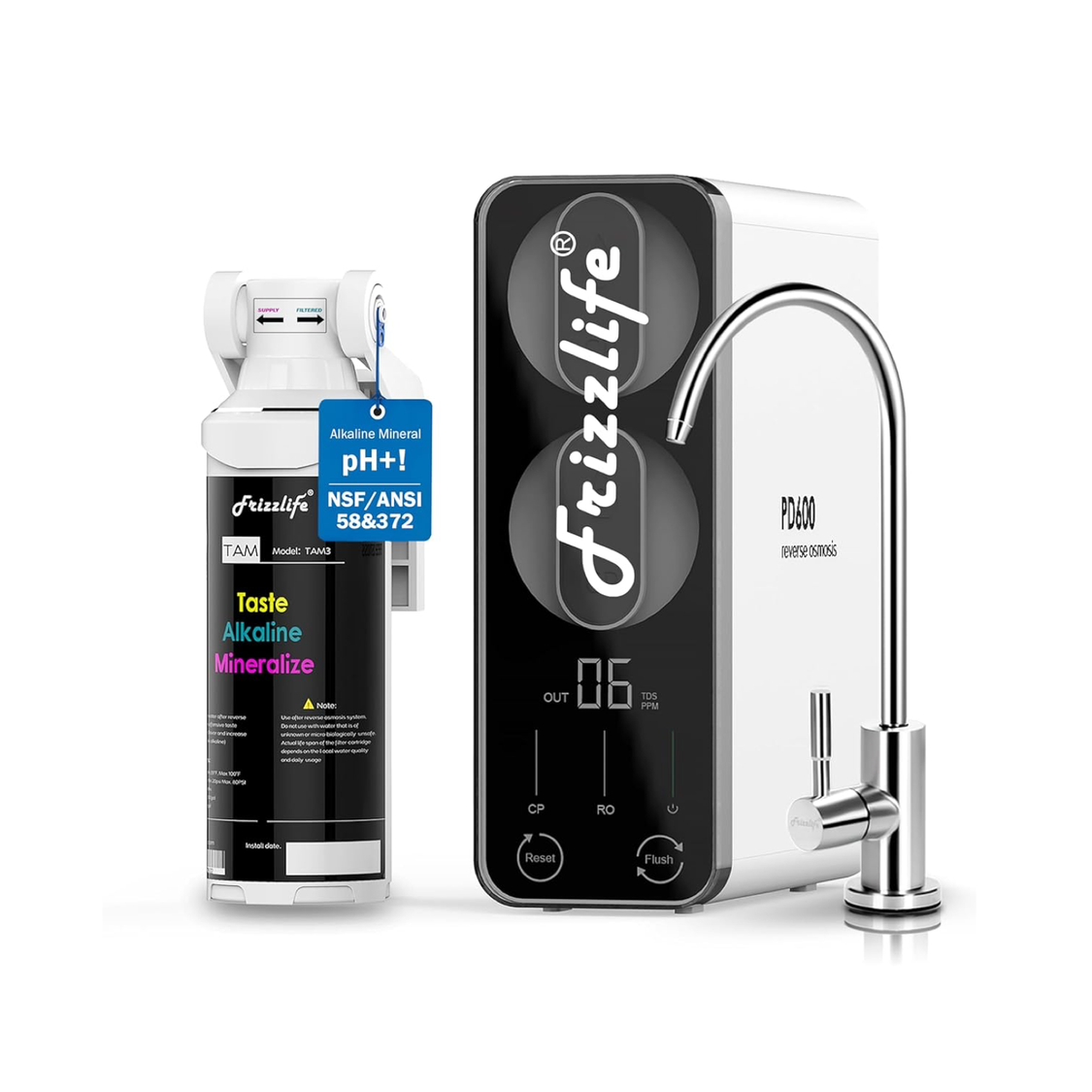
Frizzlife PD600-TAM3
A tankless under-sink RO system with alkaline remineralization, designed to provide filtered water at a dedicated kitchen drinking-water outlet.
- 600 GPD rated RO capacity
- Tankless under-sink design
- Alkaline remineralization stage
- Real-time TDS and filter status display
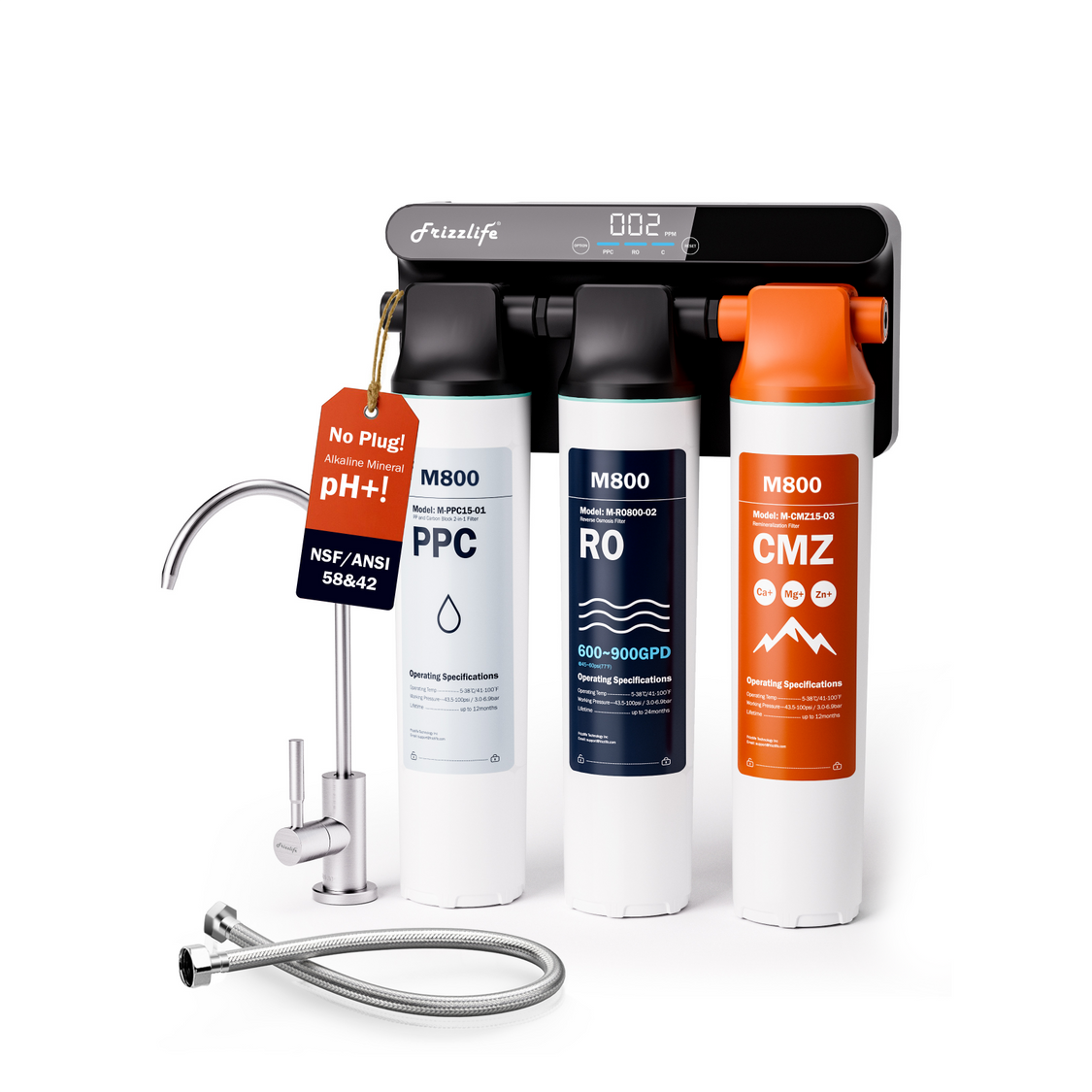
Frizzlife M800
A non-electric tankless RO system designed for under-sink drinking-water treatment, with alkaline remineralization and high-capacity filtration.
- Up to 900 GPD rated RO capacity
- Non-electric water filtration operation
- Tankless under-sink design
- Alkaline remineralization stage
Both are point-of-use systems, not whole-house POE filters. Check the specific model's installation requirements, operating conditions and verified reduction claims before choosing a system.
Homeowners planning the upstream stage can review Frizzlife’s whole-house pre-filter options and whole-house filtration systems by treatment role, installation needs, and model-specific specifications. Product claims should always be matched to water-test results rather than inferred from the category name.
Before combining systems, document:
- The water-quality concern assigned to each stage
- Where the concern enters the water path
- The treatment order required by the system instructions
- Peak household flow and available pressure
- Plumbing, bypass, drainage, electrical, and service-access requirements
- The exact reduction claim and operating conditions for each system
A layered design should remain as simple as the water conditions allow. Extra stages add resistance, maintenance requirements, and potential points of failure. If two devices are assigned the same treatment job, confirm that the duplication is intentional and technically appropriate.
Maintenance must also be coordinated. An overdue upstream cartridge can reduce flow throughout the home and affect the under-sink system. If flow declines everywhere, inspect the entry-point equipment and main-line valves first; if the problem is limited to the drinking-water faucet, inspect the POU system and its local plumbing. Use only the replacement filters specified for the applicable system, and follow its product guidance for replacement timing.
Point of entry filtration is appropriate when water needs treatment before distribution throughout the home. Point of use filtration is generally more efficient when the goal is concentrated at one drinking-water outlet. A combined setup can make sense when testing, plumbing conditions, household demand, and verified product claims support separate whole-home and drinking-water treatment goals.
References
- Centers for Disease Control and Prevention: About Home Water Treatment Systems
- U.S. Environmental Protection Agency: WaterSense Guide to Home Water Treatment
- NSF: Standards for Water Treatment Systems
- U.S. Environmental Protection Agency: Point-of-Use or Point-of-Entry Treatment Options for Small Drinking Water Systems