


Water that tastes strongly of chlorine, leaves mineral spots, or comes from an unfamiliar source does not always require the same type of treatment. Activated carbon may help improve chlorine-related taste and odor, reverse osmosis may reduce selected dissolved substances, UV treatment focuses on microorganisms, and gravity or inline filters may suit situations where portability, plumbing layout, or electricity access matters.
This guide compares the main types of water purifiers, explains how each technology works, and shows which water sources and treatment goals they may suit. No single purifier is automatically right for every household. Start by identifying your water source, the specific issue you want to address, and the product claims supported by testing or certification.

What Is a Water Purifier?
A water purifier is a home or portable treatment device designed to change the quality of water before it is used. Depending on the technology, it may filter particles, adsorb chlorine and selected organic compounds, reduce certain dissolved substances, soften hard water, or treat microorganisms.
The words “filter” and “purifier” are often used broadly in product descriptions. The product name alone does not show what a system can address. Filtration media, membrane type, flow rate, certification, and product-specific contaminant reduction claims are more useful when comparing different systems.
Do You Need a Water Purifier at Home?
Not every household needs the same type of additional water treatment. Municipal tap water is normally treated before distribution, but taste, odor, hardness, plumbing conditions, local advisories, and specific water-quality concerns can vary by location.
Begin by reviewing your local water-quality report or testing the water when you have a specific concern. A carbon filter may be sufficient when the main issue is chlorine taste or odor. A reverse osmosis system may be more relevant when reduction of certain dissolved substances is the goal. UV treatment may be considered when microbial treatment is needed, while a whole-house system may be useful when water must be treated before it reaches several fixtures.
The purpose of a water purifier should therefore be defined before purchase. Choose a system whose specifications and verified claims match the water problem rather than assuming that a larger or more expensive system is automatically better.
Types of Water Purifiers and What They Do
Home water treatment systems differ in both technology and installation format. Whole-house systems treat water as it enters the property, while point-of-use systems treat water at a particular faucet, appliance, or drinking-water outlet.
Reverse osmosis uses a membrane, UV systems use ultraviolet light, activated carbon relies on adsorption, and gravity filters move water through filter media without a powered pump. Inline filtration describes how a filter is installed in a water line rather than one single filtration technology.
| Purifier Type | Common Use | Main Strength | Important Limitation |
|---|---|---|---|
| Whole-house filtration | Treating water before it reaches several fixtures | Can address selected sediment, chlorine, scale, or other concerns throughout a home | Performance depends on the installed media and system design |
| Reverse osmosis | Drinking and cooking water | Can reduce selected dissolved substances based on the membrane and tested claims | Produces reject water and may reduce minerals along with unwanted substances |
| UV treatment | Microbial treatment | Uses UV light to treat susceptible microorganisms | Does not remove sediment, dissolved minerals, or most chemicals |
| Gravity filtration | Countertop, backup, off-grid, and group use | Operates without electricity or a pressurized pump | Flow can be slower, and treatment claims vary by cartridge |
| Activated carbon | Taste, odor, and chlorine-related concerns | Adsorbs selected aesthetic and organic compounds | Does not normally provide meaningful TDS or hardness reduction |
| Inline filtration | Refrigerators, appliances, faucets, RV lines, and compact installations | Treats water immediately before a selected outlet | Connections, pressure, flow, media, and verified claims must be checked |
Whole-House Water Filtration Systems
Whole-house water filtration systems, also called point-of-entry systems, treat water near the point where it enters a property. This allows treated water to reach several faucets, showers, appliances, and plumbing fixtures.
How Whole-House Water Filtration Systems Work
A whole-house system may use one or several treatment stages. A sediment prefilter can capture sand, rust, and larger particles. Activated carbon may reduce chlorine-related taste and odor, while scale-control media, water-softening resin, UV treatment, or other specialized stages may be added for specific water conditions.
Not every whole-house system includes all these technologies. Performance depends on the filtration media, service flow rate, installation design, maintenance schedule, and verified product claims.
Advantages
Multiple-outlet treatment: Water can be treated before it reaches several fixtures rather than at only one drinking-water faucet.
Plumbing and appliance support: Sediment control or hardness treatment may help reduce buildup when the system is correctly selected for local water conditions.
Convenient daily use: Users do not need to install a separate basic filter at every outlet covered by the system.
Customizable treatment: Different stages can be selected for sediment, chlorine, hardness, microorganisms, or other identified concerns.
Considerations
Initial cost and installation: Whole-house systems require sufficient space, plumbing compatibility, and a suitable service flow rate. More complex systems may require professional installation.
Maintenance: Sediment filters, carbon media, UV lamps, softening resin, and other components have different service requirements.
Specific treatment limits: A whole-house sediment or carbon filter should not be assumed to reduce every dissolved substance or microorganism.
Point-of-use treatment may still be useful: When the main concern is drinking and cooking water, a correctly selected point-of-use system may be more practical than treating every gallon used throughout the home.
Reverse Osmosis Systems
Reverse osmosis systems are commonly used as point-of-use treatment systems for drinking and cooking water. They are most relevant when the treatment goal includes selected dissolved salts, minerals, metals, or other substances that may pass through basic sediment and carbon filters.
How RO Systems Work
An RO system uses water pressure to move feed water across a semipermeable membrane. Part of the water passes through the membrane as treated water, while another portion carries rejected substances away.
Most residential RO systems also include sediment and carbon stages before or after the membrane. The exact substances reduced depend on the complete system, membrane, operating conditions, certification, and verified performance claims.
Advantages
Reduction of selected dissolved substances: RO membranes can address substances that many basic carbon filters are not designed to reduce.
Point-of-use treatment: RO water can be supplied through a dedicated faucet or compatible dispensing system for drinking and cooking.
Multi-stage design: Sediment, carbon, membrane, and optional post-filtration stages can address different treatment goals.
Considerations
Mineral reduction: RO treatment may reduce calcium, magnesium, and other dissolved minerals along with unwanted substances. Some systems include a remineralization stage, but its composition and performance vary by model.
Reject water: The RO process produces both treated water and reject water. Efficiency varies according to system design, feed-water temperature, pressure, water quality, and filter condition.
Installation format: Some systems require under-sink plumbing and a dedicated faucet. Countertop RO systems may instead use a refillable tank and electrical connection.
Product claims differ: Do not assume that every RO system reduces every contaminant. Review the specification, certification, and performance data for the exact model.

Tankless under-sink RO systems are one point-of-use format. Compare current model specifications, flow rate, installation requirements, drain ratio, filter life, and verified reduction claims before choosing.
Compare Under-Sink RO Options
If testing or local water information indicates that reverse osmosis matches your treatment goal, compare system size, output, drain ratio, faucet design, filter replacement requirements, and product-specific performance information.
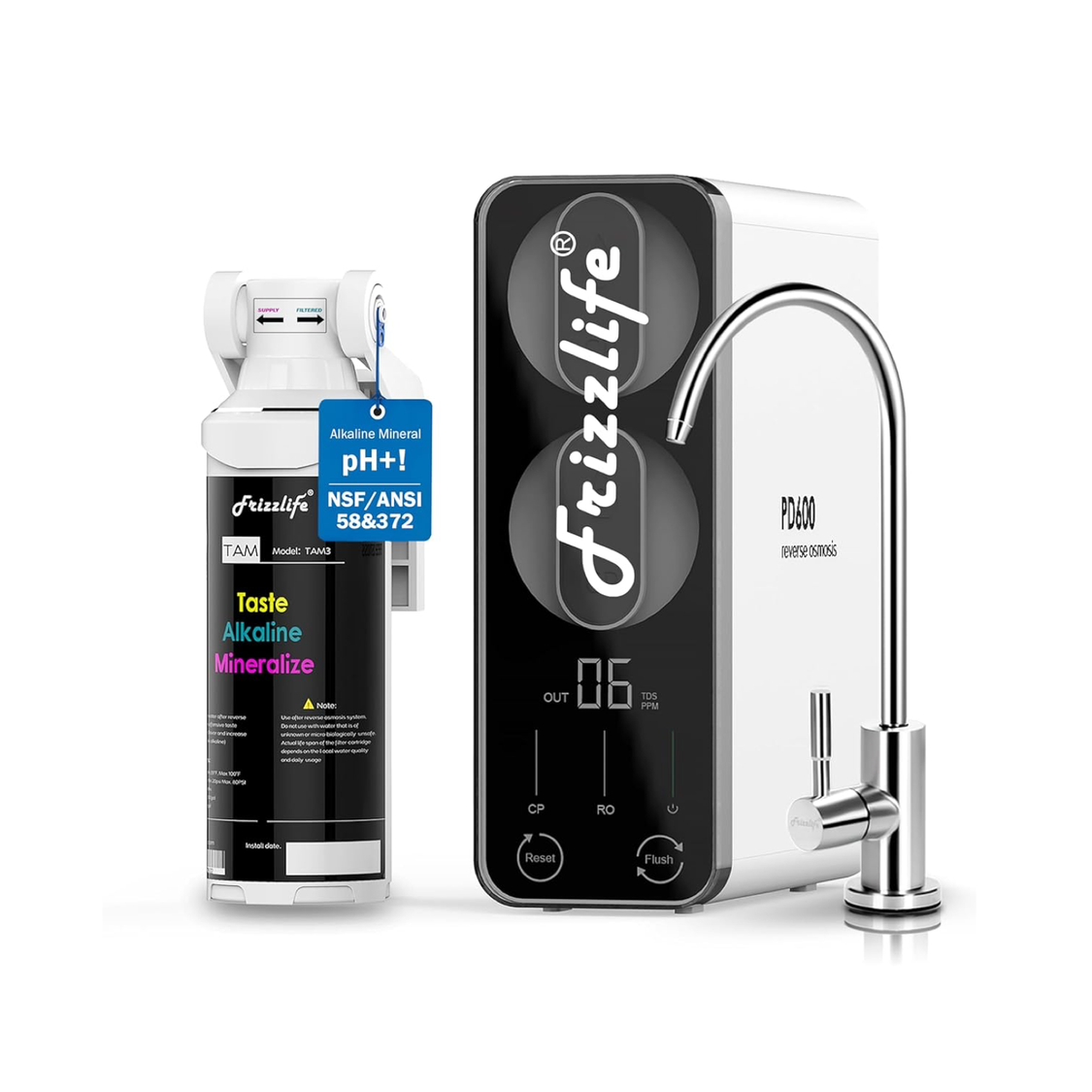
Frizzlife PD600-TAM3
An under-sink reverse osmosis option for users comparing tankless installation, treated-water output, remineralization, filter maintenance, and available cabinet space.
View PD600-TAM3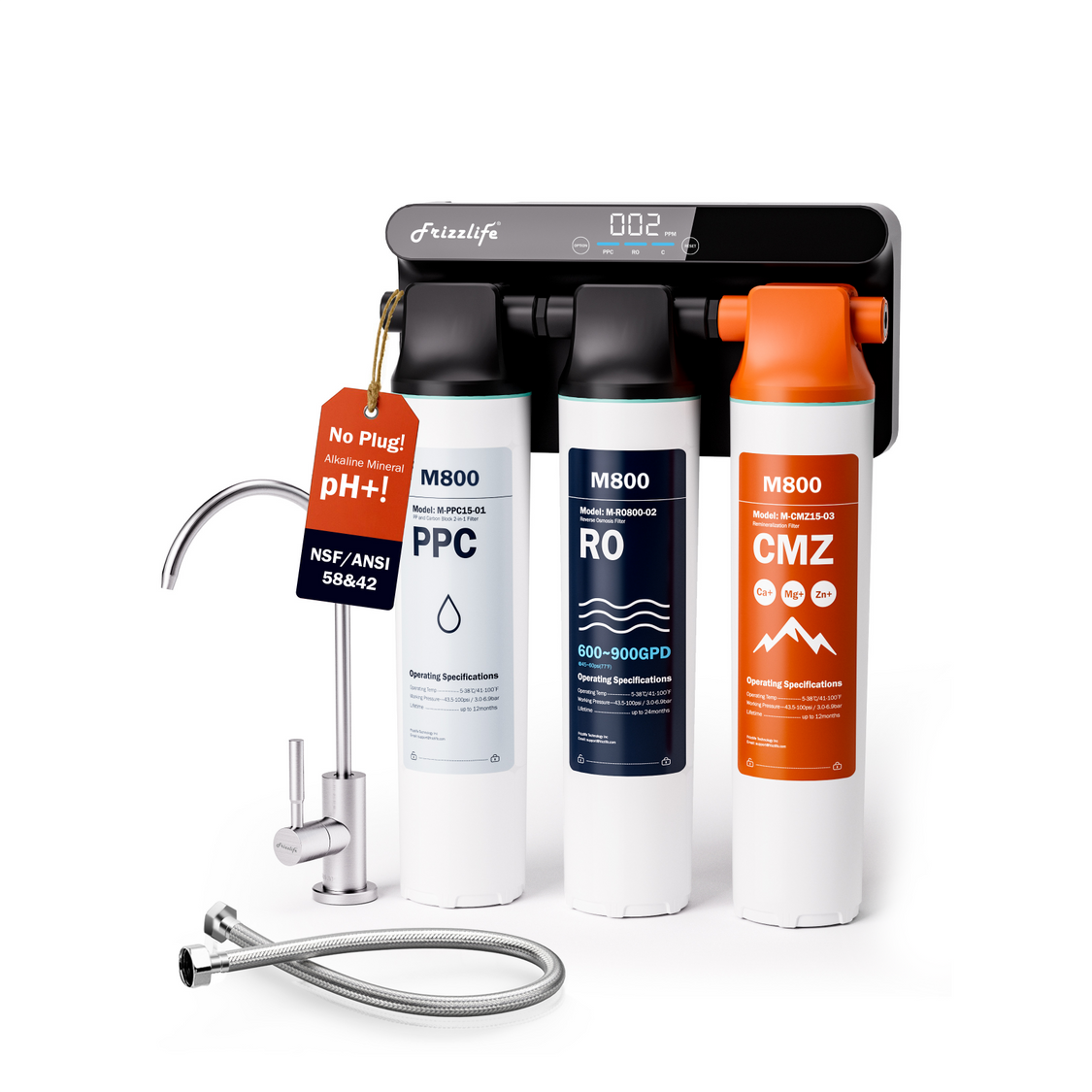
Frizzlife M800
A higher-output under-sink RO option to compare when daily water demand, dispensing speed, installation dimensions, and ongoing filter replacement are important.
View M800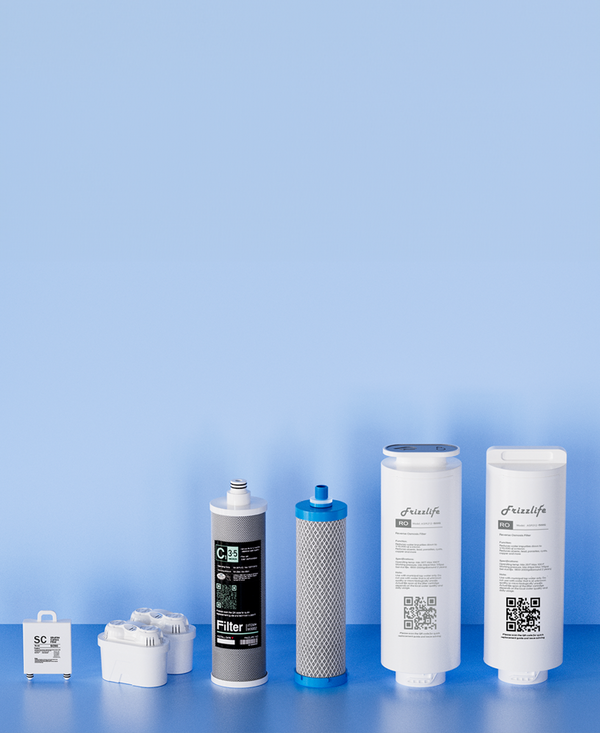
Find Replacement Filters
Filter compatibility varies by system and model. Use the replacement-filter page to locate the correct cartridge before ordering.
Find Compatible FiltersUV Water Treatment Systems
Ultraviolet water treatment systems use UV light to disinfect water or treat susceptible microorganisms. They are generally selected for a microbial treatment goal rather than for improving taste or reducing dissolved minerals.
How UV Treatment Works
Water passes through a chamber containing a UV lamp. When the system delivers the required UV dose under the correct operating conditions, the light interferes with the ability of susceptible microorganisms to reproduce.
UV performance can be affected by sediment, cloudiness, lamp condition, flow rate, and system design. Pretreatment is often important because particles can shield microorganisms from UV exposure.
Advantages
Chemical-free treatment process: UV treatment does not require adding a disinfectant directly to the water.
Focused microbial treatment: A correctly selected and maintained system can be used when microorganisms are the identified concern.
Limited effect on taste: UV treatment does not normally add a chemical taste or odor to water.
Considerations
Does not remove sediment or dissolved substances: UV treatment alone does not filter particles, reduce hardness, lower TDS, or remove most dissolved chemicals.
Requires electricity: The lamp and control system need a reliable power supply.
Maintenance remains necessary: Lamps, sleeves, sensors, and pretreatment filters must be maintained according to the manufacturer’s instructions.
System-specific performance matters: Avoid applying one general reduction percentage to all UV systems. Check the exact model, validation standard, flow conditions, and intended water source.
Gravity-Based Water Filters
Gravity-based filters move water through filter media without an electric pump or pressurized plumbing connection. They may be used on a countertop, at a base camp, in an RV setup, or as part of an emergency water plan.
How Gravity-Based Filters Work
Untreated water is placed in an upper chamber or container. Gravity moves it through one or more filter elements into a lower storage chamber.
Depending on the product, the filter may use ceramic material, activated carbon, hollow-fiber membranes, or another type of filtration. Because cartridge designs vary, users should not assume that every gravity filter addresses the same microorganisms, chemicals, metals, or dissolved substances.
Advantages
No electricity required: Gravity systems can operate during power interruptions or in locations without a convenient electrical supply.
Simple operating method: Many models require users only to fill the upper chamber and allow sufficient time for filtration.
Useful for group or backup water: Larger gravity systems may be more convenient than repeatedly pumping or squeezing small quantities of water.
Considerations
Slower flow: Gravity-driven filtration is normally slower than a pressurized faucet or pumped system.
Storage and capacity: Chamber size, treated-water storage, and refill frequency should match the number of users.
Cleaning requirements: Sediment and cloudy source water can reduce flow and may require pretreatment or more frequent cleaning.
Different treatment capabilities: A gravity filter should not automatically be treated as a complete solution for every untreated outdoor water source. Review the product’s exact specifications and verified claims.

Countertop gravity systems can be useful when users want a larger storage chamber and filtration without a powered pump. For camping or emergency use, compare the product’s size, filled weight, flow rate, cartridge requirements, cleaning process, and treatment claims before purchase.
Activated Carbon Filters
Activated carbon is commonly used in refrigerator filters, faucet filters, under-sink systems, inline cartridges, countertop filters, and multi-stage treatment systems. It is often selected to improve chlorine-related taste and odor and to reduce selected organic compounds when supported by the product’s tested claims.
How Activated Carbon Filters Work
Activated carbon contains a large internal surface area. Selected substances adhere to the surface of the carbon through adsorption as water passes through the filter.
Carbon quality, contact time, cartridge size, flow rate, water conditions, and filter age all affect performance. A carbon filter certified for one reduction claim should not be assumed to reduce every chemical or health-related contaminant.
Advantages
Taste and odor improvement: Carbon is widely used for reducing chlorine-related taste, unpleasant odor, and selected aesthetic concerns.
Flexible installation formats: Carbon media can be used in pitchers, refrigerators, faucets, inline systems, and multi-stage filters.
No reject-water stream: Standard carbon filtration does not normally produce a separate wastewater stream.
Considerations
Limited TDS reduction: Activated carbon does not normally provide meaningful reduction of total dissolved solids.
Not a water softener: Activated carbon does not remove the calcium and magnesium responsible for most household water hardness.
Microbial claims require evidence: Do not assume that a basic carbon cartridge treats bacteria, viruses, or parasites.
Filter replacement is essential: Performance can decline as the carbon reaches capacity, so the product’s replacement instructions should be followed.
Inline Water Filters
An inline water filter is installed directly in a water line before the water reaches a refrigerator, ice maker, dedicated faucet, appliance, or compatible RV connection. “Inline” describes the installation format rather than one specific filtration technology.
Some inline systems use activated carbon to improve taste and odor, while others may include sediment filtration, scale-control media, remineralization, or other stages. Inline filters are useful when users want to treat one selected outlet without installing a large countertop or whole-house system.
Advantages
Compact installation: Inline cartridges can often fit behind an appliance, inside a cabinet, or along a compatible supply line.
Targeted filtration: Only the water going to the selected outlet or appliance is treated.
Multiple applications: Depending on the model, an inline filter may be used with refrigerators, ice makers, drinking-water faucets, coffee equipment, or RV hose lines.
Considerations
Compatibility is not universal: Check tubing diameter, thread type, connector size, water pressure, and installation direction.
Flow rate matters: A restrictive or clogged cartridge can affect faucet, refrigerator, ice maker, or RV water performance.
Filtration media varies: An inline carbon filter is not the same as an RO membrane and should not automatically be expected to reduce TDS or every health-related contaminant.
Replacement access: Install the cartridge where it can be reached without moving heavy appliances or dismantling surrounding plumbing.

The Frizzlife MV99 is an example of a line-connected water filter designed for compatible RV and campground hose setups. Before purchasing an RV inline filter, check its connection type, installation order, operating pressure, flow rate, replacement schedule, and exact certification claims.
How to Choose the Right Water Purifier Type
Choosing a water purifier should begin with the water source and treatment goal—not with a product name or the number of filtration stages. Use the following steps to narrow the options.
1. Identify the Water Source and Main Concern
Municipal tap water, private well water, campground water, and natural outdoor water do not have the same risk profile. Review a local water-quality report, test the water when appropriate, and identify the main concern.
- Chlorine-related taste or odor
- Sediment, sand, or rust
- Hardness and scale
- Selected dissolved substances
- A microbial concern
- A refrigerator, appliance, or RV water line
- Portable or emergency filtration
A general TDS reading, unpleasant taste, or visible mineral residue cannot identify every substance present in water. Use an appropriate test or local water report when a specific contaminant is the concern.
2. Match the Concern to the Treatment Technology
- Consider activated carbon when the main goal is chlorine-related taste and odor improvement.
- Consider reverse osmosis when reduction of selected dissolved substances is required.
- Consider UV treatment when microorganisms are the identified concern and the source water meets the system’s operating conditions.
- Consider a whole-house system when treatment is needed at several fixtures.
- Consider a gravity or portable filter when electricity and pressurized plumbing are unavailable.
- Consider an inline filter when one appliance, faucet, or RV water line needs a compact treatment solution.
No single system should be assumed to address every concern. A carbon filter, UV unit, water softener, and RO membrane perform different jobs.
3. Estimate Flow, Capacity, and Daily Use
A drinking-water faucet, refrigerator line, whole-house inlet, RV connection, and group camping system require very different flow rates and capacities.
- Number of users
- Drinking and cooking demand
- Required faucet, appliance, or fixture flow
- Available treated-water storage
- Frequency of refilling
- Length of trips or seasonal use
- Expected cartridge capacity
Avoid choosing an oversized system when only drinking and cooking water require treatment. Also avoid a small personal filter when several people need a consistent supply.
4. Review Installation and Maintenance
Installation and maintenance requirements affect both long-term performance and ownership cost. Before ordering, confirm:
- Plumbing and connector compatibility
- Available installation space
- Water pressure requirements
- Electricity requirements
- Cartridge or membrane model
- Replacement frequency
- Cleaning and flushing procedure
- Access for routine maintenance
- Product certification and exact reduction claims
- Ongoing replacement-filter cost
A system will not maintain its intended performance without the required cartridge changes, cleaning, flushing, and operating conditions.
Conclusion
The main types of water purifiers solve different water-quality and installation problems. Whole-house systems treat water at the point of entry, RO systems focus on selected dissolved substances, UV systems provide microbial treatment, activated carbon improves selected taste and odor concerns, gravity filters work without a powered pump, and inline filters treat water before a specific outlet or appliance.
Do not select a purifier based only on the number of stages or a broad claim that it produces “pure” water. Identify the water source, define the treatment goal, compare verified product claims, and confirm flow, installation, and maintenance requirements.
Frequently Asked Questions
What are the main types of water purifiers?
Common home treatment options include whole-house filters, reverse osmosis systems, ultraviolet treatment, activated carbon filters, gravity-fed filters, water softeners, and inline filters. These categories do not all address the same substances or water conditions.
How do I choose the right water purifier?
Start by identifying the water source and the specific concern you want to address. Then compare treatment technology, product-specific reduction claims, flow rate, installation requirements, capacity, and replacement costs.
Can one water purifier remove every contaminant?
No water purifier should automatically be assumed to address every particle, microorganism, chemical, mineral, or dissolved substance. Check the exact model’s certification and performance data for the substances you are concerned about.
Is an inline water filter the same as a reverse osmosis system?
No. “Inline” describes how a filter is installed in a water line. Many inline filters use carbon or other media, while an RO system uses a semipermeable membrane and produces both treated water and reject water.
Which type of water filter is suitable for camping?
The answer depends on the water source, number of users, trip style, desired flow, weight, and tested treatment claims. Personal filters may suit lightweight trips, gravity systems may help groups, and inline filters may be suitable for compatible RV or campground hose connections.
Do activated carbon filters reduce TDS?
Standard activated carbon filtration generally does not provide meaningful TDS reduction. It is more commonly used for chlorine-related taste, odor, and selected organic compounds.
Does a UV water purifier remove chemicals?
UV treatment focuses on microorganisms. It does not by itself remove sediment, hardness minerals, TDS, heavy metals, or most dissolved chemicals.
How often should water purifier filters be replaced?
Replacement timing depends on the product, cartridge capacity, water quality, usage, and filter condition. Follow the exact model’s instructions rather than applying one general replacement schedule to every filter type.
Choose a Filter by Installation and Use
Compare compact filters for refrigerators, appliances, dedicated water lines, RV connections, campground use, travel, and portable filtration.