


Reverse osmosis membranes are the central separation components in reverse osmosis drinking water systems. Unlike a sediment cartridge that catches visible particles or a carbon filter that adsorbs selected chemicals, an RO membrane uses pressure and a selective barrier to separate water from many dissolved salts, ions, microorganisms, and other unwanted substances.
The process sounds simple: feed water enters, treated water comes out, and rejected material goes to the drain. Inside the membrane, however, several factors work together. Applied pressure must overcome natural osmotic pressure, water must pass through a very thin selective layer, and cross-flow must carry concentrated contaminants away from the membrane surface.
Understanding how an RO membrane works makes it easier to evaluate system performance, recognize maintenance problems, and decide whether a membrane should be cleaned, checked, or replaced.
Key Takeaway: How Does the RO Membrane Work?
An RO membrane works by applying pressure to water on the more concentrated side of a semi-permeable barrier. That pressure drives water through the membrane while the membrane rejects much of the dissolved material. The water that passes through is called permeate or product water. The remaining stream, which carries rejected substances toward the drain, is called concentrate, reject water, or brine.
This is reverse osmosis because it reverses the direction associated with natural osmosis. In natural osmosis, water tends to move through a selective barrier toward the side with a higher concentration of dissolved substances. In RO membrane filtration, applied pressure pushes water in the opposite direction—from the more concentrated feed side toward a lower-concentration product stream.
The membrane is not the entire filtration system. Prefilters protect it from sediment and selected chemicals, while downstream stages can address taste, odor, or other product-water characteristics. The performance of a reverse osmosis membrane filter therefore depends on the membrane, the surrounding components, feed-water conditions, and correct installation.
What Does the Membrane Do in a Reverse Osmosis System?
The membrane performs the system’s main dissolved-solids separation step. It is designed to allow water to move through its selective layer more readily than many dissolved ions and other substances.
A typical household RO treatment path follows this sequence:
-
Feed water enters the system.
-
Sediment and carbon prefilters condition the water.
-
Pressure moves the conditioned water into the RO membrane element.
-
Some water crosses the membrane and becomes permeate.
-
The remaining water carries rejected material to the drain.
-
Permeate moves to a storage tank or directly to the faucet, depending on system design.
-
One or more post-filters may further condition the treated water.
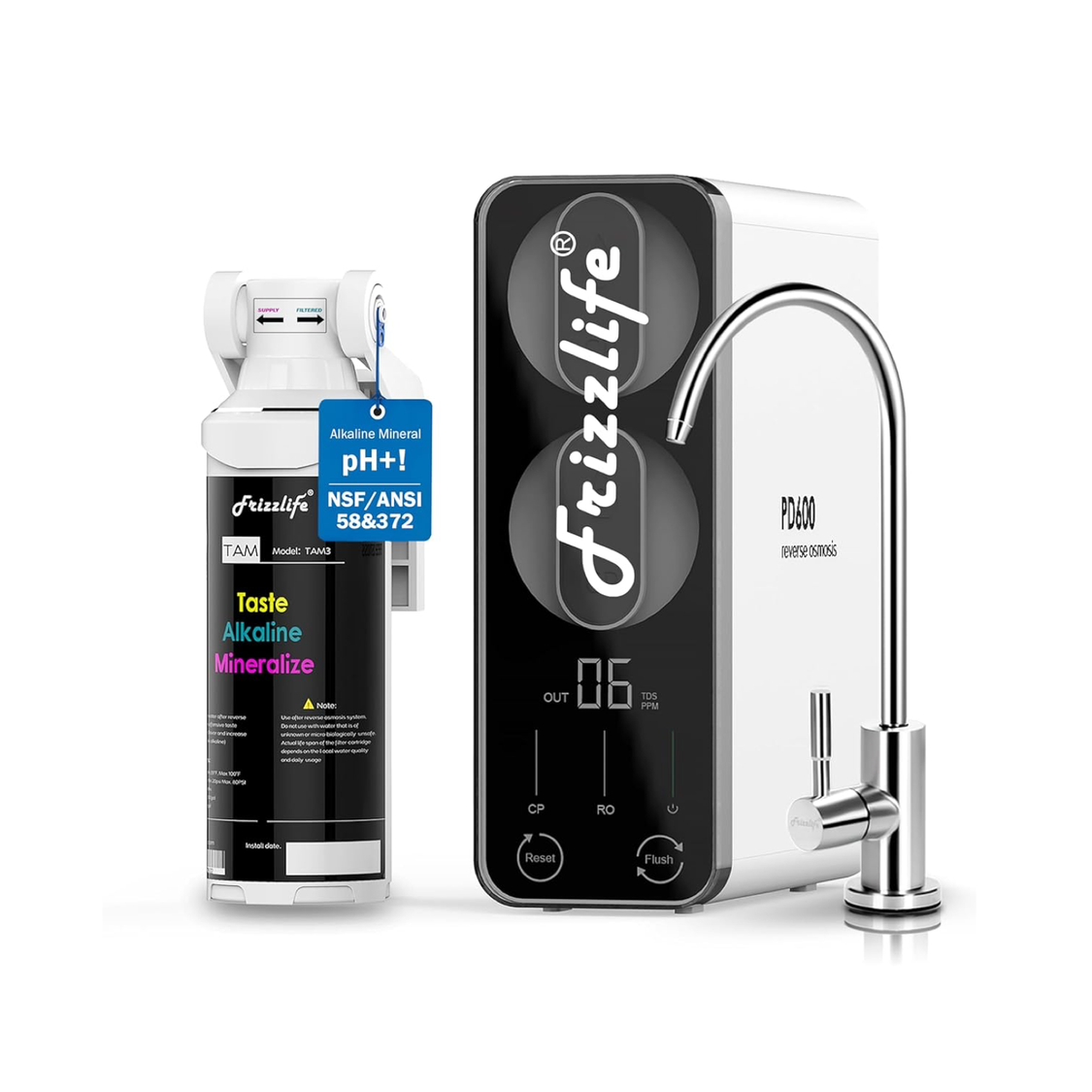
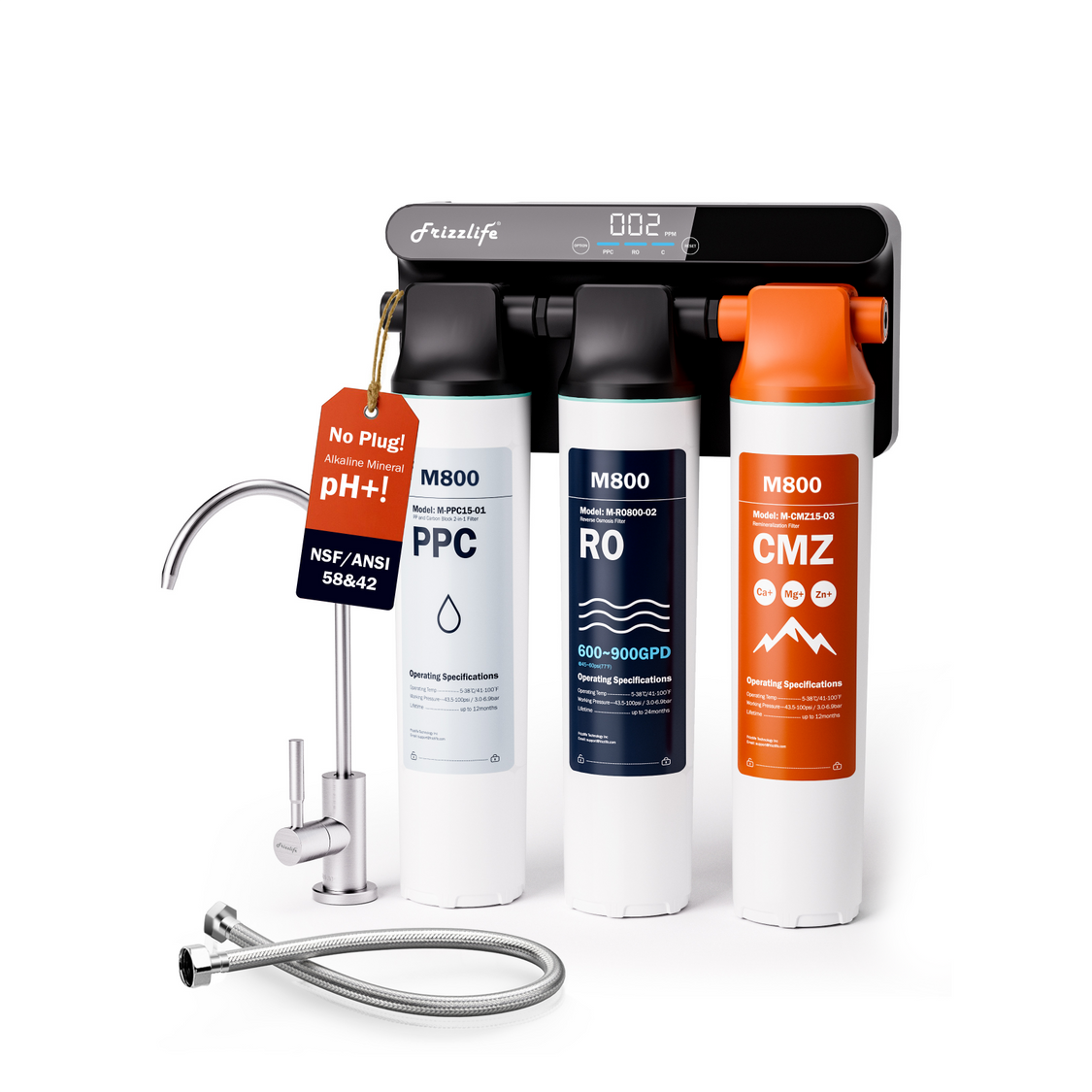
Readers comparing complete treatment setups can review Frizzlife reverse osmosis filter systems while checking each model’s documented stages, capacity, maintenance requirements, contaminant claims, and system-specific certifications.
The membrane’s role differs from those of the other filter stages. Sediment filtration helps intercept suspended particles that could accumulate on the membrane. Activated carbon can reduce substances the carbon media is designed to adsorb and may help protect membrane materials that are sensitive to certain oxidants. Post-filtration takes place after the membrane and is commonly used to refine the characteristics of the product water.
If membrane performance is normal but a taste or odor issue remains, check the applicable post-filter and its replacement schedule. Review only RO post-filter options documented as compatible with the specific system.
Because these stages have different jobs, replacing a carbon cartridge does not restore a damaged RO membrane, and installing a new membrane will not correct every taste, pressure, drainage, or post-filter issue.
How RO Membrane Filtration Produces Permeate and Concentrate
RO membrane filtration divides incoming water into two streams rather than trapping every rejected substance inside a cartridge.
Permeate is the portion that crosses the membrane. It contains a lower concentration of many rejected substances than the feed water. It becomes the system’s product water.

Concentrate is the portion that stays on the feed side and flows past the membrane. As water leaves this stream by crossing the membrane, the remaining stream becomes more concentrated. It carries much of the rejected material toward the drain.
The drain stream is necessary to the separation process. Without adequate concentrate flow, rejected salts and other materials can build up near the membrane surface. This concentration can increase scaling and fouling risk and reduce performance.
The exact relationship between permeate production and drain flow varies by system. It should not be assumed from a general RO description. System design, feed pressure, water temperature, membrane condition, and feed-water chemistry can all influence the result.
What Reverse Osmosis Membranes Can and Cannot Reduce
According to the CDC, reverse osmosis filtration can address parasites, bacteria, and viruses and can reduce various dissolved substances. Examples include lead, copper, chromium, chloride, and sodium. Depending on the system and conditions, RO may also reduce arsenic, fluoride, radium, sulfate, calcium, magnesium, potassium, nitrate, and phosphorus.
RO is also relevant to PFAS treatment. The EPA identifies properly certified reverse osmosis systems as one filtration option for reducing certain PFAS in drinking water. Research indicates that size, membrane charge, chemical interactions, pressure, and the surrounding water matrix can all affect PFAS rejection.
These are general capabilities—not a guarantee that every RO membrane reduces every listed contaminant to the same degree. Keep several limitations in mind:
-
Performance varies by membrane and system. Membrane material, construction, pressure, temperature, feed concentration, and system condition influence rejection.
-
“Reduce” does not always mean “remove completely.” Some substances may pass through to different degrees.
-
The entire system matters. Leaks, damaged seals, incorrect installation, or membrane imperfections can compromise treatment.
-
Certification applies to specific claims. NSF/ANSI 58 is a principal standard for residential reverse osmosis systems, but certification does not mean a system removes every possible contaminant.
-
A system certification is not automatically a standalone membrane certification. Consumers should review the certification listing for the complete model and the exact reduction claims.
-
RO is not a substitute for water testing. When a specific contaminant is a concern, identify it through appropriate testing and choose treatment based on a verified product claim.
Microorganisms illustrate why careful wording matters. RO membranes can provide a strong barrier to parasites, bacteria, and viruses, but microscopic leaks, damaged seals, membrane defects, or downstream contamination can affect the final water. A household RO system should not be described as an absolute sterilization method unless it has been specifically evaluated and approved for that purpose.
RO also removes or reduces minerals that contribute to total dissolved solids. That may change the taste or mineral character of the water. Whether that is desirable depends on the treatment goal and system design.
How Pressure, Feed Water Quality, and Prefilters Affect Membrane Performance
A reverse osmosis membrane cannot perform independently of its operating conditions. Four factors are especially important.
Feed pressure: Pressure provides the driving force for water to cross the membrane. If pressure is insufficient for the system’s design, product-water output may fall. Low output is not automatically proof that the membrane has failed; a restricted prefilter, low supply pressure, cold feed water, or another flow problem may produce a similar symptom.
Feed-water concentration: Water with more dissolved material creates greater osmotic resistance and leaves more material to manage on the feed side. Its effect depends on the membrane and system design.
Suspended solids and organic matter: Sediment, colloids, organic material, and biological growth can cover the membrane surface. This is known broadly as fouling. Fouling can restrict water passage and interfere with rejection.
Scale-forming minerals: As the concentrate stream becomes more concentrated, minerals may precipitate on the membrane surface. This scaling can reduce production and shorten useful membrane life.
Prefilters limit some of these stresses. A sediment filter can capture suspended material before it reaches the membrane. Carbon filtration may reduce selected chemicals and protect membrane materials when required by the system design. Prefilters must be maintained on schedule; an exhausted or clogged prefilter can expose the membrane to damaging conditions or restrict flow.
Other influences include water temperature, usage patterns, drain-line function, and the integrity of seals and fittings. Because these variables interact, membrane troubleshooting should start with the whole system instead of treating every performance change as a membrane problem.
Reverse Osmosis Membrane Troubleshooting and Replacement Decision Table
|
What you notice |
Possible membrane-related cause |
Other conditions to check first |
Practical next step
|
|---|---|---|---|
|
Product-water flow has gradually decreased |
Fouling, scaling, or normal membrane deterioration |
Clogged prefilters, low inlet pressure, cold water, closed valves, tank pressure, kinked tubing |
Replace overdue prefilters, inspect the flow path, and follow the system’s diagnostic instructions before replacing the membrane |
|
Product-water TDS is rising compared with the established baseline |
Reduced rejection, membrane degradation, damaged seals, or incorrect membrane installation |
TDS meter calibration, recent filter changes, incomplete flushing, feed-water TDS changes |
Compare feed and product water under similar conditions; reseat or inspect the membrane if the manual permits |
|
Membrane appears to fail soon after replacement |
Incompatible membrane, damaged seal, fouling, scaling, or improper drainage |
Correct model, capacity rating, dimensions, flow restrictor, drain connection, and installation direction |
Verify exact system compatibility rather than assuming that similarly shaped membranes are interchangeable |
|
Water has an unusual taste or odor |
Membrane performance may have changed |
Exhausted post-filter, stagnant water, new-filter flushing, storage tank condition, plumbing contamination |
Flush as directed and evaluate the post-filter before assigning the problem to the membrane |
|
System runs or drains unusually often |
Poor rejection or low permeate production may be contributing |
Leaks, automatic shutoff operation, tank pressure, faucet use, drain restriction |
Inspect the system as a complete hydraulic circuit; do not block or reduce required drain flow |
|
No improvement after installing a new membrane |
The original membrane may not have been the cause |
Prefilters, post-filter, valves, tubing, pressure, storage tank, seals, or installation error |
Recheck installation and system components using the model-specific manual |
|
Visible damage, deformation, or a failed seal |
Loss of membrane or element integrity |
Housing condition and correct element seating |
Stop relying on the system’s treatment performance and replace damaged components as directed |
A handheld TDS meter can be useful for noticing trends, but one reading alone does not identify the cause. Feed-water TDS naturally varies, and readings may be affected by temperature, flushing, measurement technique, and recent system use. It is more useful to compare feed and product water under similar conditions and to consider the system’s normal baseline.
How Long Does an RO Membrane Usually Last?
There is no universal lifespan for reverse osmosis membranes. Replacement timing depends on:
-
Feed-water chemistry and TDS
-
Sediment and organic loading
-
Scale formation
-
Water pressure and temperature
-
Household water use
-
Prefilter condition
-
Drain-flow performance
-
Membrane and system design
-
Installation quality
-
Manufacturer maintenance instructions
A membrane supplied with relatively clean, properly pretreated water may remain effective longer than one exposed to heavy sediment, scaling conditions, oxidants it is not designed to tolerate, or a malfunctioning concentrate line.
For that reason, a calendar estimate should not be treated as the only replacement rule. Follow the schedule for the specific system while also watching product-water quality and output. If the membrane repeatedly deteriorates much earlier than expected, replacing it again without finding the cause can lead to the same result.
What Are the Signs That an RO Membrane Needs to Be Replaced?
A membrane may need replacement when there is a sustained decline in rejection, a persistent reduction in production after other causes have been ruled out, physical damage, or performance that no longer meets the manufacturer’s criteria.
Common warning signs include:
-
Product-water TDS remains unusually high after proper flushing.
-
Rejection performance has declined compared with the system’s established baseline.
-
Product-water flow remains low after checking pressure, prefilters, valves, tubing, and the storage tank.
-
The membrane or its seals are visibly damaged.
-
Scale or fouling cannot be corrected using a procedure approved for the system.
-
Water quality does not return to normal after checking prefilters and post-filters.
-
The membrane has reached the replacement point specified in the model’s maintenance guidance.
Before ordering a replacement, verify the model number and compatibility. Capacity labels, dimensions, connection design, sealing arrangement, and the required flow restrictor may differ. Similar appearance does not prove interchangeability.
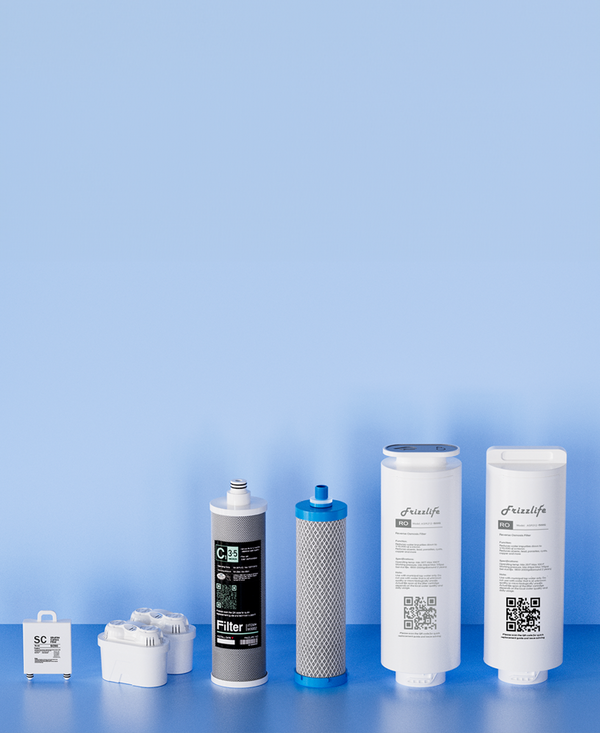
Homeowners who have confirmed the correct model can review Frizzlife’s selection of compatible replacement filters. Product documentation should remain the controlling source for fit, installation, flushing, and replacement timing.
Can an RO Membrane Be Cleaned, or Should It Be Replaced?
It depends on the membrane, system design, and type of contamination.
Large commercial installations may use controlled membrane-cleaning procedures based on the foulant and membrane manufacturer’s requirements. Household membrane elements are different: many are treated as replaceable components, and attempting an improvised chemical cleaning process can damage the selective layer, seals, housing, or downstream plumbing.

For a residential system:
-
Confirm that the problem is actually the membrane.
-
Check prefilters, pressure, valves, tubing, drain flow, tank operation, and seals.
-
Consult the system manual for an approved flushing or cleaning procedure.
-
Do not expose the membrane to household cleaners or unapproved chemicals.
-
Replace the membrane if it is damaged, incompatible, exhausted, or cannot be restored through an authorized procedure.
Cleaning cannot repair chemical degradation, tears, deformation, or damaged sealing surfaces. It also may not fully reverse deeply established scale or biological fouling. When no approved household cleaning procedure exists, replacement is generally the safer decision.
Inside the Reverse Osmosis Membrane – Layers and Materials
A reverse osmosis membrane is thin, but it is not usually a single unsupported film. Typical RO membrane construction combines a selective surface with supporting layers that provide strength and a path for water movement.
The precise materials and arrangement vary by model and application. Household drinking water systems, municipal desalination plants, and industrial process systems may all use RO, but their membrane chemistry, element dimensions, operating conditions, and pretreatment needs are not interchangeable.
The Selective Layer, Porous Support, and Structural Backing
A layered membrane generally has three functional parts:
-
Selective layer: The extremely thin surface responsible for most separation. Water moves through this layer more readily than many dissolved substances.
-
Porous support: A more open layer beneath the selective surface. It supports the thin active layer without creating the same resistance to product-water flow.
-
Structural backing: A fabric-like or otherwise durable base that provides mechanical stability during manufacturing and operation.
The selective layer must balance competing requirements. It needs to reject targeted solutes while allowing useful water flow. It must also withstand pressure and remain attached to its support.
A thicker or denser active layer may provide stronger separation under some conditions but can also increase resistance to water movement. A highly permeable design may produce more water but still must meet its intended rejection performance. This balance is one reason membranes with similar dimensions can behave differently.
Why “Pore Size” Is a Useful but Incomplete Explanation
Consumer resources often describe an RO filter as having an approximate pore size of 0.0001 micron. The comparison is useful because it communicates the extremely fine scale of reverse osmosis filtration and helps distinguish RO from sediment, microfiltration, and ultrafiltration.
But an RO membrane is not simply a screen with uniform holes.
In an ordinary strainer, particles larger than the openings stay behind while smaller particles pass through. In RO, transport through the dense selective polymer layer also depends on how water and dissolved substances interact with the membrane material. Researchers commonly describe this using a solution-diffusion model: water associates with or dissolves into the selective layer, moves through it, and emerges on the permeate side.
This does not make size irrelevant. Molecular size remains important, but it works alongside electrical charge, molecular shape, solubility, feed concentration, pressure, and membrane chemistry. “Tiny pores block contaminants” is therefore a helpful introductory analogy, not a complete molecular explanation.
How Does the RO Membrane Work at the Molecular Level?
At the molecular level, water on the feed side is under pressure. When the applied driving force is sufficient, water interacts with the selective membrane material and moves through it. Many dissolved ions and molecules move through much less readily, so their concentration becomes lower in the permeate.
The process involves several connected effects:
-
Pressure creates a driving force. It opposes natural osmotic movement and pushes the system toward product-water formation.
-
Water enters or interacts with the selective layer. The membrane’s chemistry allows water transport.
-
Water diffuses across the thin layer. The layer is thin enough to permit practical flow while maintaining selectivity.
-
Many solutes remain on the feed side. Their size, charge, hydration, shape, or limited compatibility with the membrane makes transport less favorable.
-
Cross-flow carries rejected material onward. Concentrate flow reduces, but does not eliminate, accumulation at the surface.
The concentration near the membrane surface can become higher than in the bulk feed stream. This effect, known as concentration polarization, makes cross-flow and adequate drainage important. If the concentrated boundary becomes excessive, it can increase osmotic resistance and contribute to scale or fouling.
How Size, Charge, and Polymer Chemistry Influence Rejection
RO rejection cannot be predicted from molecular size alone.
Size and shape: Larger or less mobile dissolved substances may have more difficulty crossing the selective layer. Molecular shape can also affect transport.
Electrical charge: Charged ions interact with the membrane and with other ions in the water. Membrane charge can influence rejection, including the rejection of some PFAS under appropriate conditions.
Hydration: Dissolved ions in water are surrounded by water molecules. This hydrated form can behave differently from the bare ion when interacting with the membrane.
Polymer chemistry: Different selective-layer materials interact differently with water, oxidants, salts, and organic compounds. These interactions affect both performance and durability.
Water matrix: pH, ionic strength, competing substances, and organic matter can alter how a contaminant behaves. A reduction result obtained under one water condition should not automatically be applied to every household supply.
These factors explain why one generalized rejection percentage cannot accurately describe all reverse osmosis membranes. Product-specific performance should come from a valid test or certification covering the complete system and the contaminant in question.
Why Membrane Materials and Performance Vary by Model
A membrane intended for residential tap water does not necessarily have the same design requirements as one used for seawater desalination, industrial processing, or recycled water treatment. Manufacturers adjust membrane chemistry and element construction around factors such as feed-water composition, required product quality, pressure, capacity, chemical tolerance, and cleaning approach.
Model variation can affect:
-
Rated water production
-
Salt and contaminant rejection
-
Sensitivity to oxidants
-
Temperature and pH limitations
-
Required pretreatment
-
Housing and seal compatibility
-
Flow-restrictor requirements
-
Flushing and storage instructions
This is why a replacement membrane should be matched to the system rather than selected only by visual similarity or a broad capacity label. The correct element must work with the housing, seals, pressure conditions, drain control, and other stages.
How Does the RO Membrane Work in a Spiral‑Wound Element?
Many RO systems package flat membrane sheets into a spiral-wound element. This construction places a large membrane area inside a compact cylindrical component.
A spiral-wound element contains membrane sheets, feed-channel spacers, permeate-carrier material, sealed edges, and a central permeate tube. These parts organize separate paths for untreated feed water and treated permeate while allowing concentrate to leave the element.
The “spiral” describes how the membrane envelopes and spacer materials are wrapped around the central collection tube. Feed water does not simply enter one end and pass straight through the membrane into an empty core. It moves along channels between membrane surfaces while a portion crosses the selective layer.
Feed Water, Permeate, and Concentrate Flow Paths
The three flow paths perform different jobs:
-
Feed water enters the element and travels along the membrane surface.
-
Permeate crosses through the selective layer, enters a permeate carrier, and moves inward toward the central collection tube.
-
Concentrate remains in the feed channel and exits with a higher concentration of rejected substances.
The membrane sheet is sealed so that untreated feed water cannot freely mix with the permeate channel. If a seal fails or an element is installed incorrectly, feed water may bypass the intended separation path. That can produce poor water quality even if the membrane material itself remains intact.
How Cross-Flow Helps Carry Rejected Material Toward the Drain
Spiral-wound RO elements use cross-flow: feed water moves across the membrane surface rather than being forced entirely into it.
Only part of the stream crosses the membrane. The rest continues along the feed channel and carries rejected material away. This helps limit the accumulation that would occur if the membrane operated as a dead-end filter.
Cross-flow does not prevent all deposits. If the feed contains heavy sediment, scale-forming minerals, organic material, or biological contamination, some material can still collect on the membrane. Insufficient drain flow can make this worse by allowing a more concentrated boundary to develop.
The drain or concentrate line should therefore never be treated as an unnecessary leak. Restrictors and valves control system hydraulics, and changing them without model-specific instructions may reduce membrane flushing, lower production, or disrupt rejection.
How Membrane Sheets, Spacers, and the Permeate Tube Work Together
Each component of a spiral-wound element supports the separation process:
Membrane sheets provide the selective surface. They are typically arranged so that the active sides contact feed-water channels.
Feed spacers keep adjacent membrane surfaces apart and create channels for feed and concentrate flow. They also help distribute water across the element.
Permeate carriers provide a path for treated water after it crosses the membrane. Product water travels through this layer toward the central tube.
Sealed membrane envelopes prevent feed water from entering the product-water path without crossing the selective layer.
The permeate tube collects treated water from the membrane envelopes and directs it out of the element.
Damage or incorrect assembly at any of these points can affect performance. A folded seal, poorly seated element, blocked flow path, or mismatched component may look like membrane exhaustion even when the selective layer is not the original cause.
Why Seals, Drain Flow, and Correct Membrane Compatibility Matter
An RO membrane only works as intended when water follows the designed path. Three practical details deserve particular attention.
Seals prevent bypass. O-rings and other sealing surfaces keep untreated feed water from mixing with permeate. Lubrication, positioning, and housing condition should follow the manufacturer’s instructions.
Drain flow removes concentrate. A blocked, kinked, or incorrectly connected drain line can interfere with cross-flow. An unsuitable flow restrictor may also change the balance between product water and concentrate.
Compatibility involves more than physical fit. The replacement element must match the system’s design. Capacity, membrane dimensions, sealing arrangement, housing, flow control, and operating requirements can all matter.
If a new membrane performs poorly, check these details before concluding that the element is defective. Verify that it was installed in the correct direction, fully seated, flushed as directed, and paired with the required system components.
References
-
EPA: Identifying Drinking Water Filters Certified to Reduce PFAS
-
EPA WaterSense Specification for Point-of-Use Reverse Osmosis Systems
- NSF Public Access Repository: PFAS Membrane Filtration Study