


Compatible replacement water filters can be a practical alternative to genuine cartridges, but compatibility requires more than finding a filter that looks similar or slides into the same space. The replacement must fit the housing, seal correctly, work within the system’s pressure and temperature limits, deliver an appropriate flow rate, and provide documented filtration performance for the intended treatment stage.
That is why an OEM vs compatible filter decision should begin with specifications—not price, packaging, or appearance. A physically incorrect cartridge can leak or fail to lock in place. A cartridge that fits physically but has the wrong media, flow characteristics, or connections may reduce pressure, disrupt system operation, or provide different filtration than expected.
This guide explains how to evaluate a genuine replacement cartridge and third-party alternatives across refrigerator, under-sink, reverse osmosis, faucet-mounted, inline, and standard-housing systems.
Decision Snapshot: Can You Use a Compatible Water Filter Instead of the Original?
Yes, you can use a compatible water filter instead of the original when the replacement’s fit, operating specifications, and filtration claims have been verified for your exact system.
A compatible filter is a reasonable option only if you can confirm:
-
The system model number or original filter part code
-
The replacement filter dimensions
-
The cartridge and housing format
-
The locking mechanism, threads, or tubing connections
-
The location and design of O-rings, gaskets, and seals
-
Operating pressure and temperature limits
-
Rated flow and expected pressure drop
-
Filter media, micron rating, and intended treatment stage
-
Installation and removal clearance
-
Model-specific certification and contaminant-reduction claims
Physical fit alone does not guarantee functional compatibility. Two cartridges may have nearly identical dimensions while using different seal positions, flow directions, pressure limits, or filter media. Even a small difference at the locking interface or O-ring seat can prevent proper installation or create a slow leak.
The safest go/no-go rule is simple: do not install a compatible cartridge if the seller or manufacturer cannot document an exact model match and the relevant operating specifications.
What Is the Difference Between OEM and Compatible Filters?
An OEM or genuine filter and a compatible filter may serve the same general purpose, but they come from different sources and require different levels of verification.
What an OEM or genuine replacement cartridge means
OEM stands for original equipment manufacturer. A genuine replacement cartridge is generally made by, for, or under authorization from the company responsible for the original appliance or filtration system.
The main benefit is direct system integration. The cartridge is intended for the named system, so its dimensions, seals, connections, and operating characteristics should correspond with that system’s design.
However, the OEM label by itself does not tell you every performance detail. You should still review the exact model’s specifications, certification scope, replacement instructions, and contaminant-reduction claims.
What compatible, generic, aftermarket, and third-party mean
A compatible, aftermarket, generic, or third-party filter is made by a manufacturer other than the original system manufacturer. It is designed or marketed to fit one or more existing systems.
These terms are often used interchangeably, but they do not guarantee the same level of documentation. One compatible filter may have a precise model cross-reference, detailed technical specifications, and independent certification. Another may offer only a broad “universal fit” statement.
The term “generic” should not automatically be interpreted as unsafe or ineffective. Likewise, “compatible” should not automatically be interpreted as proven. The exact cartridge and its supporting documentation matter more than the category label.
Compatible vs. equivalent
“Compatible” generally means a filter is intended to work with a particular system. “Equivalent” can suggest that it offers comparable specifications or performance.
Those are not necessarily the same claim. A cartridge may be compatible in size and connection type while using different media or having a different micron rating. It may fit but not provide equivalent contaminant reduction, flow, capacity, or service life.
Look for documentation rather than relying on either word.
OEM vs. compatible filter comparison
|
Buying factor |
OEM or genuine filter |
Compatible or third-party filter |
|
Manufacturer |
Original system manufacturer or an authorized source |
A different manufacturer |
|
Fit |
Intended for the original system |
Must be verified by exact model or part code |
|
Interface |
Designed for the system’s housing or manifold |
May match exactly, require verification, or use adapters |
|
Performance |
Model-specific specifications still need review |
Media, micron rating, flow, and claims must be compared |
|
Certification |
Not guaranteed by the OEM label alone |
Not guaranteed by the compatible label alone |
|
Availability |
May be limited to original distribution channels |
May offer more purchasing options |
|
Warranty clarity |
Usually easier to document |
System and filter warranty terms should be reviewed |
|
Main buying risk |
Assuming the brand label proves every claim |
Assuming physical fit proves complete compatibility |
Neither label alone proves safety, filtration performance, or long-term value. The strongest purchasing decision is based on exact fit, verified specifications, certification scope, installation requirements, and total replacement cost over time.
How to Know Which Compatible Replacement Water Filter Fits Your System
To determine whether a replacement filter fits, start with identifying information and then work outward through dimensions, interfaces, seals, and available space.
Start with the system model and original filter part code
Find the model number on the appliance, filtration unit, manifold, or system label. Do not rely only on the name of the product family, because systems in the same family may use different cartridges.
Next, remove or inspect the existing cartridge and record:
-
The complete part number
-
Any revision number or suffix
-
Cartridge type
-
Directional arrows
-
Connection information
-
Printed operating specifications
-
Certification markings
Use both the system model and original filter code when checking a compatibility list. A cross-reference based on only one of those identifiers leaves more room for error.
If a compatible filter listing shows a shortened code, confirm that omitted letters or numbers do not indicate another cartridge revision.
Confirm the replacement filter dimensions
Compare the replacement filter dimensions with the original manufacturer’s documentation. Depending on the design, relevant measurements may include:
-
Overall length
-
Outer diameter
-
Diameter at the neck or locking area
-
End-cap dimensions
-
Distance between connections
-
Cartridge diameter inside a canister
-
O-ring position relative to the cartridge end

A tape measure may be adequate for larger dimensions, but small interface differences may require more precise measurements. Published technical drawings are preferable to estimates taken from photographs.
Do not assume a slightly shorter or longer cartridge is acceptable. A small difference can prevent a refrigerator compartment from closing, leave a canister seal uncompressed, or make a cartridge difficult to remove later.
Match the cartridge and housing format
Identify how the original filter is held in place:
-
Twist-lock or quarter-turn cartridge
-
Push-in cartridge
-
Drop-in cartridge inside a reusable canister
-
Threaded inline filter
-
Quick-change manifold cartridge
-
Encapsulated reverse osmosis membrane
-
Standard-size open-ended or double-open-ended cartridge
These formats are not interchangeable simply because the filters have similar dimensions.
A drop-in cartridge must fit inside the housing and seal as designed. A quick-change cartridge must match the manifold interface. An inline filter must have the correct connection configuration and flow direction.
Identify the connection or locking interface
Examine the connection at both ends of the filter or at the filter head. Confirm:
-
Number and placement of locking tabs
-
Twist direction and locking travel
-
Thread diameter and thread type
-
Push-fit or tubing connection size
-
Inlet and outlet configuration
-
Presence of an automatic shutoff mechanism
-
Alignment keys or locating grooves
A cartridge that begins to engage but will not fully lock is not a confirmed match. Do not file, force, lubricate, or modify locking tabs to make it fit.
Check O-rings, seals, and gaskets
O-rings prevent water from bypassing the filter or escaping the housing. Compare the original and replacement for:
-
O-ring position
-
Number of O-rings
-
Groove dimensions
-
Seal diameter
-
Gasket shape
-
Seal condition
When replacing a drop-in cartridge, inspect the housing O-ring for flattening, cuts, stretching, or debris. Clean the groove and seat the O-ring evenly according to the system instructions.
A housing that requires excessive force to close may have a displaced O-ring or incorrectly seated cartridge. Overtightening does not correct a bad seal and can damage components.
Verify installation and removal clearance
Measure the space around the filter, not just the filter itself. You may need room to:
-
Lower a canister
-
Rotate a twist-lock cartridge
-
disconnect tubing
-
Use a housing wrench
-
Place a towel or container under the unit
-
Remove shelves or access panels
-
Replace an RO membrane horizontally
A replacement that technically fits the connection can still be impractical if nearby plumbing, cabinetry, a disposal unit, or an appliance blocks removal.
Treat “universal” and “standard size” cautiously
Some canister and reverse osmosis systems use widely shared cartridge dimensions. Cross-brand compatibility may be possible when the housing, cartridge dimensions, end-cap design, seals, and operating specifications all match.
However, “standard size” does not mean universal. Proprietary manifolds, unusual end caps, adapters, and model-specific connections can prevent interchangeability.
Use a compatibility list as a starting point, not as a substitute for checking the technical specifications. Appearance alone is not reliable.
Fit and installation readiness checklist
Before ordering, confirm that you can answer yes to each applicable question:
-
Is my exact system model listed?
-
Is the full original filter part code cross-referenced?
-
Do the dimensions match?
-
Is the cartridge format the same?
-
Do the locking tabs, threads, or tubing connections match?
-
Are the O-ring positions and seal design correct?
-
Is there enough installation and removal clearance?
-
Is the direction of water flow documented?
-
Are pressure, temperature, and flow specifications available?
-
Is the cartridge intended for the same filtration stage?
-
Are certification claims tied to this exact replacement model?
If key information is missing, request a technical sheet or choose a replacement with clearer documentation.
Checking the exact model and filter type before ordering can help avoid fit and compatibility problems. Explore Frizzlife systems or find replacement filters for your existing setup.
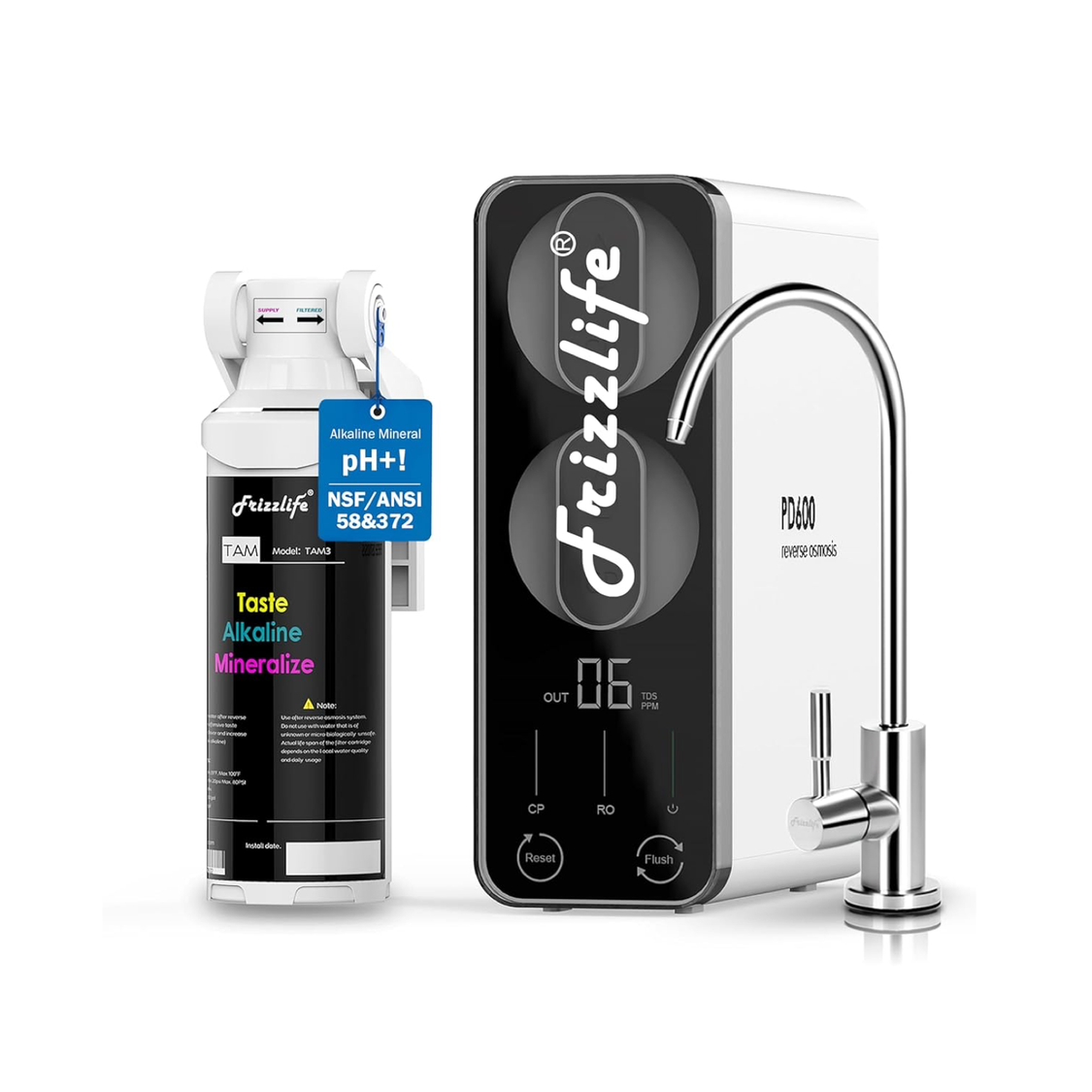
Explore the PD600-TAM3 system and review its product-specific filtration, installation, and replacement-filter information.
View PD600-TAM3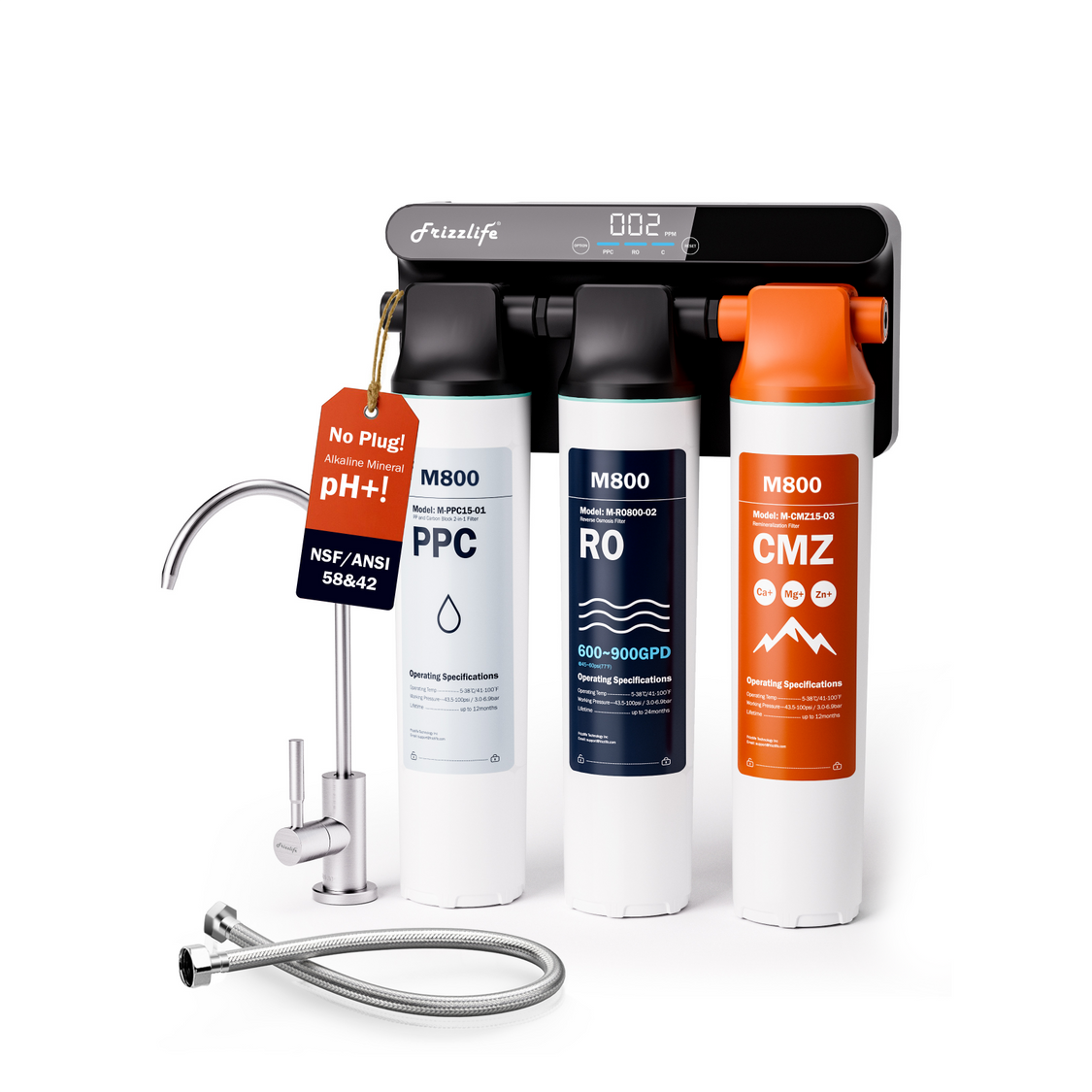
View the M800 system to check its model-specific specifications, filter configuration, and replacement requirements.
View M800
Already own a Frizzlife system? Find replacement filters by system and cartridge type before placing your order.
Find Your FilterCheck Performance and Plumbing Specifications Before Buying
True third-party water filter compatibility includes hydraulic and filtration performance. A filter that attaches correctly can still be unsuitable for the system around it.
Match pressure and temperature ratings
Compare the replacement filter’s operating pressure range with the system manual and the conditions at the installation point. Both the cartridge and housing must be rated for the application.
Also compare operating temperature limits. A cartridge intended for cold drinking water should not be installed on a hot-water line unless it is expressly rated for that use.
Pressure specifications are model-dependent. Do not assume that an inline refrigerator filter, under-sink cartridge, and whole-house cartridge can operate under the same conditions.
Compare flow and expected pressure drop
Flow rate describes how much water a filter is designed to deliver under stated conditions. Pressure drop is the loss of pressure as water moves through the cartridge.
A more restrictive replacement can lead to:
-
A weaker refrigerator dispenser stream
-
Slow filling at a filtered-water faucet
-
Reduced production in an RO system
-
Longer appliance fill cycles
-
Pump cycling or unusual system behavior
Compare specifications under similar test conditions where possible. A flow rating without information about pressure or test conditions is difficult to evaluate.
Also consider the application. A dedicated drinking-water faucet and a system serving several fixtures do not have the same flow demands.
Check tubing, ports, and connections
Verify the inlet, outlet, tubing, and thread sizes. If the filter connects directly to plumbing, also confirm that the existing tube material and fittings are appropriate for the new connection.

Adapters can solve limited connection issues, but each added joint creates another possible leak point. An adapter also does not correct an incompatible pressure rating, flow path, cartridge type, or seal design.
If several adapters are required, an explicitly matched replacement is usually the simpler option.
Match filter media and micron rating to the treatment stage
Cartridges in different stages are not interchangeable merely because they share a housing size.
Common roles include:
-
Sediment filtration
-
Carbon filtration for taste and odor concerns
-
Specialized contaminant reduction
-
Reverse osmosis membrane treatment
-
Post-filtration or final polishing
A micron rating indicates the nominal or absolute particle size performance described by the manufacturer, depending on how the product is rated. It does not independently explain which dissolved contaminants the filter reduces.
A finer cartridge may be more restrictive than the original. Installing it without considering flow and pressure drop may affect system performance or cause it to clog sooner under challenging water conditions.
Confirm orientation and system-level requirements
Follow all arrows or inlet/outlet markings. Some filters are directional because the internal media, support layers, and flow channels are arranged for water to move one way.
For reverse osmosis systems, changing a cartridge does not change the system’s underlying requirements. Prefilters, membranes, postfilters, storage tanks, drain lines, faucets, pumps, and electrical components must continue to operate as designed.
Confirm that the replacement is intended for the exact stage. A similar-looking inline postfilter is not a replacement for an RO membrane, and a standard sediment cartridge cannot substitute for a carbon stage simply because it fits the canister.
Are Generic Replacement Water Filters Safe to Use?
Generic replacement water filters can be safe to use when the exact model is appropriately constructed, correctly installed, and independently certified for the claims that matter to the buyer. An uncertified or poorly documented cartridge creates more uncertainty because fit, material safety, and filtration performance may not have been independently verified.
Look for certification on the exact model
Check the cartridge label and product documentation for an exact model number. Then verify that model in the certifying organization’s official listing.

The certification should match:
-
The manufacturer
-
The exact filter model
-
The applicable standard
-
The specific contaminant-reduction claims
-
Any conditions or system configurations covered by the listing
Do not assume that certification for one filter applies to every cartridge sold by the same manufacturer. Different cartridges may use different media, housings, or construction.
Understand NSF/ANSI 42, 53, and 401
These standards address different types of claims:
-
NSF/ANSI 42 generally covers aesthetic effects, such as certain taste, odor, chlorine, and particulate claims.
-
NSF/ANSI 53 addresses specified contaminants with health-effect claims.
-
NSF/ANSI 401 covers specified incidental or emerging compounds.
A standard number alone does not mean a filter reduces every substance associated with that standard. Certification applies to the specific claims shown in the official listing.
For example, certification under NSF/ANSI 53 should not be interpreted as proof that the filter reduces every possible health-related contaminant. Check the exact reduction claims.
“Certified” is not the same as “tested”
These phrases are materially different:
-
Certified: An authorized certification process covers the listed model and claims.
-
Tested: A test may have been performed, but the scope, laboratory, protocol, and ongoing oversight need to be reviewed.
-
Compliant with: Usually a manufacturer statement unless supported by certification documentation.
-
Designed to meet: Describes design intent, not confirmed certification.
-
Uses certified components: Does not necessarily mean the complete cartridge or system is certified.
Product listings sometimes present these terms close together. Read the exact wording and verify the model rather than relying only on a logo or image.
A point-of-use filter does not sterilize water
Ordinary refrigerator, faucet, and under-sink filters should not be assumed to sterilize water or make microbiologically unsafe water safe to drink. Their function depends on their design and verified claims.
During a boil-water advisory, follow instructions from the local water utility or public health authority. Do not assume a point-of-use cartridge replaces boiling or bottled-water guidance unless the responsible authority explicitly says it does.
Compatibility Rules by Water Filter System Type
The same core principles apply across systems, but the most important fit checks vary by design.
Refrigerator filters
Refrigerator cartridges frequently use proprietary locking mechanisms and model-specific interfaces. Confirm the full refrigerator model and original filter code, then check:
-
Tab and key placement
-
Neck and O-ring dimensions
-
Push-in or twist-lock action
-
Dispenser flow requirements
-
Clearance behind shelves or access doors
-
Filter-monitor reset instructions
If the replacement does not seat with normal pressure or will not lock, remove it rather than forcing it. A cartridge that is only partially engaged may leak when the water supply is restored.
Under-sink filters
Under-sink systems may use reusable canisters, quick-change cartridges, inline filters, or proprietary manifolds. Check:
-
Canister dimensions and internal cartridge format
-
Manifold connection
-
Tubing and port size
-
Shutoff valve accessibility
-
Vertical or horizontal removal clearance
-
Filtered-faucet flow requirements
Plan for residual water during replacement. A towel and container can help protect cabinetry, but they are not substitutes for shutting off the supply and relieving pressure.
Reverse osmosis systems
RO systems contain several treatment stages that perform different jobs. Confirm the identity and position of every replacement:
-
Sediment prefilter
-
Carbon prefilter
-
RO membrane
-
Postfilter
-
Any additional treatment stage
The membrane must match its housing or encapsulated interface as well as the system’s operating design. Prefilters affect membrane protection and system flow, while postfilters serve a different purpose.
Drain-line, storage-tank, faucet, pump, and power requirements remain part of the complete system. Do not modify these components simply to accommodate a cartridge that was not designed for the system.
Faucet-mounted filters
For faucet-mounted systems, verify both the faucet interface and the replacement cartridge model. A cartridge may fit several models within a product family without being universal across all faucet-mounted units.
Check that the filter locks securely, the selector operates normally, and the assembly does not leak where it attaches to the faucet.
Inline filters
Inline filters require careful attention to:
-
Inlet and outlet size
-
Flow direction
-
Pressure and temperature ratings
-
Mounting orientation
-
Tubing support
-
Installation clearance
Avoid allowing the filter’s weight to hang from unsupported tubing. Use the mounting method specified for the system.
Standard-size housings and proprietary systems
Cross-brand compatibility is most plausible when a system uses a documented standard housing and a conventional drop-in cartridge. Even then, verify dimensions, end-cap style, seals, media, micron rating, and flow.
With proprietary quick-change manifolds or keyed cartridges, a genuine replacement or a cartridge explicitly verified for that exact interface is the safer choice. “Nearly identical” is not a suitable fit standard for a pressurized water connection.
How to Install and Validate a Compatible Replacement Filter
Always follow the system manual and the replacement filter’s model-specific instructions. Exact flushing requirements, tightening methods, and reset procedures vary.
A general replacement process is:
-
Review the manual. Confirm the cartridge model, orientation, tools, and flushing procedure before removing the old filter.
-
Shut off the water. Use the appropriate supply valve. Follow system instructions for appliances, tanks, pumps, and powered equipment.
-
Relieve pressure. Open the filtered faucet, use the pressure-relief control if provided, or follow the appliance procedure.
-
Prepare for residual water. Place a towel or container beneath the housing.
-
Remove the old filter carefully. Note its direction, seal placement, and installation depth.
-
Inspect the housing and seals. Clean sealing surfaces and check O-rings or gaskets for damage.
-
Install the replacement in the specified direction. Seat it fully without forcing the connection or overtightening the housing.
-
Restore water slowly. A gradual return to operating pressure makes it easier to spot a sealing problem.
-
Inspect every connection. Check the housing, filter head, tubing connections, valves, and adapters.
-
Flush as directed. Use the replacement manufacturer’s model-specific procedure to purge air and loose filter media.
-
Recheck under full pressure. Inspect immediately, after flushing, and again after the system has been operating.

After installation, confirm that taste, flow, pressure, dispenser operation, pump behavior, and appliance functions are normal. A dry paper towel placed beneath a connection can make a slow drip easier to detect.
Troubleshooting Fit, Leaks, Low Flow, and Installation Problems
The filter will not seat, lock, or allow the housing to close
Stop and compare the part number, dimensions, tabs, and seal locations. Make sure the old filter did not leave a cap, adapter, or seal in the housing.
Do not force the cartridge or use excessive leverage. If the correct installation position is unclear, reinstall the previous cartridge if it remains serviceable or contact system support.
Water leaks around the housing or connector
Shut off the water and relieve pressure before making adjustments. Then check for:
-
A twisted, dirty, flattened, or damaged O-ring
-
An O-ring outside its groove
-
Cross-threaded housing components
-
A cartridge that is not fully seated
-
Damaged tubing
-
An incompletely inserted push-fit connection
-
An unnecessary or poorly sealed adapter
-
Debris on a sealing surface
Do not attempt to stop a leak by continually overtightening the housing. Replace damaged seals with the specified type.
Flow drops sharply after replacement
First confirm that every shutoff valve is fully reopened and that the cartridge is installed in the correct direction. Then consider:
-
A more restrictive micron rating
-
Different filter media
-
Incomplete flushing
-
A kinked tube
-
A partially seated connection
-
Low supply pressure
-
A clogged upstream stage
-
Air trapped in the system
If flow remains substantially different from normal, compare the new cartridge’s rated flow and pressure-drop information with the original specifications.
The faucet spits air or the water looks cloudy
Air introduced during replacement can temporarily cause sputtering or a cloudy appearance. If the cloudiness clears from the bottom of a glass upward after standing, entrained air may be the cause.
Continue the model-specific flushing procedure. Persistent particles, unusual color, or cloudiness that does not clear should be investigated rather than assumed to be normal.
The system buzzes, pulses, or makes unusual noises
Some noise can occur while trapped air is purged. Persistent buzzing or pulsing may indicate restricted flow, unstable pressure, an incorrectly opened valve, or a cartridge mismatch.
For an RO system, also check whether the tank, pump, and drain are behaving as described in the system manual. Disconnect power before handling powered components when instructed.
Taste, odor, or particles persist after flushing
Confirm that the filter was flushed according to its instructions and installed in the correct stage and direction. Persistent problems may indicate:
-
The cartridge does not address the relevant water-quality concern
-
The media or certification claims differ from the original
-
The cartridge is damaged
-
Another system component requires maintenance
-
The source-water condition has changed
If the filter does not fit securely, leaks, causes severe flow loss, or produces persistent abnormal system behavior, stop using it. Reinstall a known compatible cartridge or have the installation inspected by qualified support or a plumbing professional.
When to Choose OEM vs. Compatible Replacement Water Filters
Choose a compatible cartridge when the exact fit is documented, the operating specifications align with the system, the intended filtration role matches, and any important performance claims can be independently verified.
Choose an OEM or explicitly verified system cartridge when:
-
The interface is proprietary
-
No precise third-party model match is available
-
The compatible cartridge lacks dimensions or operating specifications
-
Certification claims cannot be verified
-
The system is sensitive to flow or pressure changes
-
Warranty or service requirements are unclear
-
The installation would require multiple adapters or physical modification
Before choosing based on purchase price, consider total value across the cartridge’s expected service conditions. An inexpensive filter is not good value if it requires extra fittings, reduces usable flow, needs more frequent replacement, or creates an avoidable leak risk. Conversely, an accurately matched and properly documented compatible cartridge may be a practical choice.
Review warranty terms for both the system and replacement filter before installation. Coverage varies by manufacturer and policy, so do not assume that third-party use is either automatically allowed or automatically excluded.
After confirming the exact system model, original cartridge code, fit, operating specifications, treatment stage, certification scope, installation instructions, and warranty terms, you can browse Frizzlife replacement filters by system and cartridge type.
The central rule is straightforward: a compatible replacement should match the complete system, not merely the empty space left by the old cartridge. Verify the model, dimensions, seals, connections, operating limits, filtration role, and certification before buying. That process gives you a much stronger basis for choosing between a genuine replacement cartridge and a compatible alternative.