


Choosing between a faucet-mounted water filter and a direct-connect under-sink filter comes down to more than price or appearance. Your faucet design, available cabinet space, daily water use, installation limits, and contaminants of concern all affect which option makes sense.
In a faucet water filter vs under sink filter comparison, faucet-mounted units generally offer the simplest setup and use no cabinet space. Direct-connect under-sink systems require basic plumbing access but typically provide greater capacity, a cleaner sink area, and more convenient filtration for frequent drinking and cooking.
Neither category is automatically more effective. Filtration performance depends on the cartridge design, system configuration, verified contaminant-reduction claims, and operating conditions. This guide explains how to compare the two without assuming that every under-sink filter outperforms every faucet attachment.
Comparison Snapshot: Faucet Water Filter vs Under-Sink Filter
A faucet-mounted filter attaches to the end of a compatible faucet. It usually includes a switch that lets you choose filtered or unfiltered water. A direct-connect under-sink filter connects to the cold-water supply below the sink and sends filtered water through the existing kitchen faucet.
The basic trade-off is straightforward:
-
Faucet-mounted filters favor quick, reversible installation and minimal upfront commitment.
-
Direct-connect under-sink filters favor higher-demand use, larger cartridges, an uncluttered faucet, and less frequent maintenance in many configurations.
Is an under-sink filter better than a faucet filter?
An under-sink filter is often the better choice for a family, a frequent cook, or anyone who wants filtered cold water without a bulky attachment on the faucet. Many under-sink systems also support larger cartridges and multi-stage filtration.
However, “under the sink” describes where the filter is installed—not what it removes. A basic under-sink carbon filter may have narrower contaminant coverage than a faucet-mounted model with stronger third-party certification. Compare the actual performance data for each system rather than relying on installation type alone.
A faucet filter may be the better practical choice when:
-
Cabinet space is unavailable.
-
The installation must be completely reversible.
-
Water use is relatively light.
-
The existing faucet accepts the attachment.
-
You want a simple solution without working on supply-line fittings.
Choose a faucet-mounted filter if…
A faucet filter attachment is a reasonable fit when you:
-
Rent and cannot modify the sink or plumbing.
-
Have a standard threaded faucet with a removable aerator.
-
Need filtered water mainly for glasses, bottles, coffee, or light meal preparation.
-
Have very limited under-sink storage.
-
Prefer the simplest possible cartridge access.
-
Do not mind the filter body being visible on the faucet.
-
Are comfortable switching between filtered and unfiltered modes.
Choose a direct-connect under-sink filter if…
A direct-connect system is likely to fit better when you:
-
Use substantial amounts of filtered water for drinking and cooking.
-
Regularly fill pots, kettles, water bottles, or pet bowls.
-
Have a pull-down or pull-out faucet that cannot accept a faucet-mounted filter.
-
Want to keep the faucet and sink area uncluttered.
-
Prefer a larger cartridge and potentially longer service intervals.
-
Have accessible cabinet space near the cold-water line.
-
Want a no-drill water filter that supplies the existing faucet.
-
Need a multi-stage configuration designed for specified water-quality concerns.
Households considering this configuration can compare Frizzlife direct-connect and under-sink water filter options by faucet arrangement, rated flow, capacity, installation requirements, and documented filtration claims.
At-a-glance comparison table
|
Feature |
Faucet-mounted filter |
Direct-connect under-sink filter |
|
Installation |
Usually attaches in place of the faucet aerator |
Connects to the cold-water supply line under the sink |
|
Drilling |
Normally not required |
Not required when the system supplies the existing faucet; other configurations may need a dedicated faucet hole |
|
Faucet compatibility |
Often unsuitable for pull-down, pull-out, sensor, or nonstandard faucets |
Works independently of the faucet spout, provided the plumbing connections are compatible |
|
Filtration |
Commonly carbon-based; exact reduction claims vary by model |
May be single-stage or multi-stage; exact capabilities vary by model |
|
Flow |
Can feel restricted when filtered mode is selected |
Often better suited to higher daily demand, but model and plumbing conditions matter |
|
Filter life |
Typically shorter than that of many under-sink cartridges |
Often greater capacity, although rated life is model-specific |
|
Maintenance |
Cartridge is visible and easy to reach |
Cartridge is hidden but requires cabinet access |
|
Space |
Uses no cabinet space but adds faucet bulk |
Keeps the faucet clear but uses under-sink space |
|
Cooking convenience |
Suitable for light use; slower flow may be noticeable when filling pots |
Generally more convenient for frequent cooking and larger volumes |
|
Initial commitment |
Lower and highly reversible |
More installation work and plumbing compatibility checks |
|
Long-term value |
Can be practical for low-volume use |
Often offers stronger value for high-volume use, depending on cartridge price and rated capacity |
How Faucet-Mounted and Under-Sink Filters Work
Both options are point-of-use systems. They treat water at or near the kitchen sink rather than filtering all water entering the home.
What is a faucet filter attachment?
A faucet-mounted filter is a compact device connected directly to the faucet outlet. Installation commonly involves removing the existing aerator, choosing the correct adapter, and securing the filter body to the exposed faucet threads.
Most designs let you divert water through the cartridge only when filtration is needed. Unfiltered mode can be used for tasks such as washing dishes, which conserves cartridge capacity. The user must remember to select the appropriate mode.
Because the filter sits at the end of the spout, it can change the balance and working clearance of the faucet. This matters when washing large cookware or filling tall containers.
What is a direct-connect under-sink filter?
A direct-connect under-sink filter is installed between the cold-water shutoff valve and the line feeding the kitchen faucet. When the cold tap is opened, water passes through the filtration system before reaching the existing faucet.
This configuration is sometimes called an under-faucet or inline under-sink filter. It can provide filtered cold water without a second dispenser and without adding an attachment to the faucet spout.
Some direct-connect systems filter all cold water used at the main tap. That improves convenience, but it can also use cartridge capacity for tasks that do not require filtered water. Whether that is a disadvantage depends on the system’s rated capacity and the household’s habits.
Existing faucet vs dedicated filtered-water faucet
Under-sink systems use one of two common delivery arrangements:
-
Existing-faucet connection: Filtered water is routed to the main kitchen faucet. This can be a no-drill setup because no new dispenser is added.
-
Dedicated-faucet connection: A small separate faucet dispenses filtered water while the main tap continues supplying regular hot and cold water.
A dedicated faucet preserves cartridge capacity by treating only water drawn for drinking or cooking. It may use an existing accessory hole previously occupied by a soap dispenser or side sprayer. If no suitable opening is available, drilling may be necessary.

Where a built-in filtered faucet fits
The phrase built-in filtered faucet can describe more than one configuration. It may refer to a multi-function kitchen faucet with a separate internal waterway for filtered water, or it may be used more broadly for a faucet designed to work with an under-sink filtration system.
This differs from a faucet filter attachment. The filter cartridge normally remains below the sink, while the faucet provides a dedicated control or outlet for filtered water. These systems can create a streamlined appearance, but installation may involve replacing the primary faucet and confirming that the sink’s mounting holes fit the new fixture.
Direct-connect carbon filtration vs under-sink reverse osmosis
Not every under-sink system is a reverse osmosis system.
A direct-connect carbon system may use sediment media, activated carbon, carbon block, or multiple non-RO stages. These systems do not necessarily require a drain connection and may be designed to supply the existing faucet.
Reverse osmosis, or RO, uses a membrane and generally has a more complex installation. A typical under-sink RO configuration may include prefilters, a membrane, post-filtration, a drain connection, and either a storage tank or tankless components. It often uses a dedicated filtered-water faucet.
RO may be appropriate when verified testing identifies contaminants that the selected membrane system is certified or tested to reduce. It should not be treated as an automatic upgrade for every household. Installation requirements, drain water, available space, maintenance, and water characteristics all need consideration.
Considering an Under-Sink RO System?
If you want to go beyond conventional faucet-mounted or direct-connect filtration, compare these Frizzlife under-sink reverse osmosis options and replacement filters.
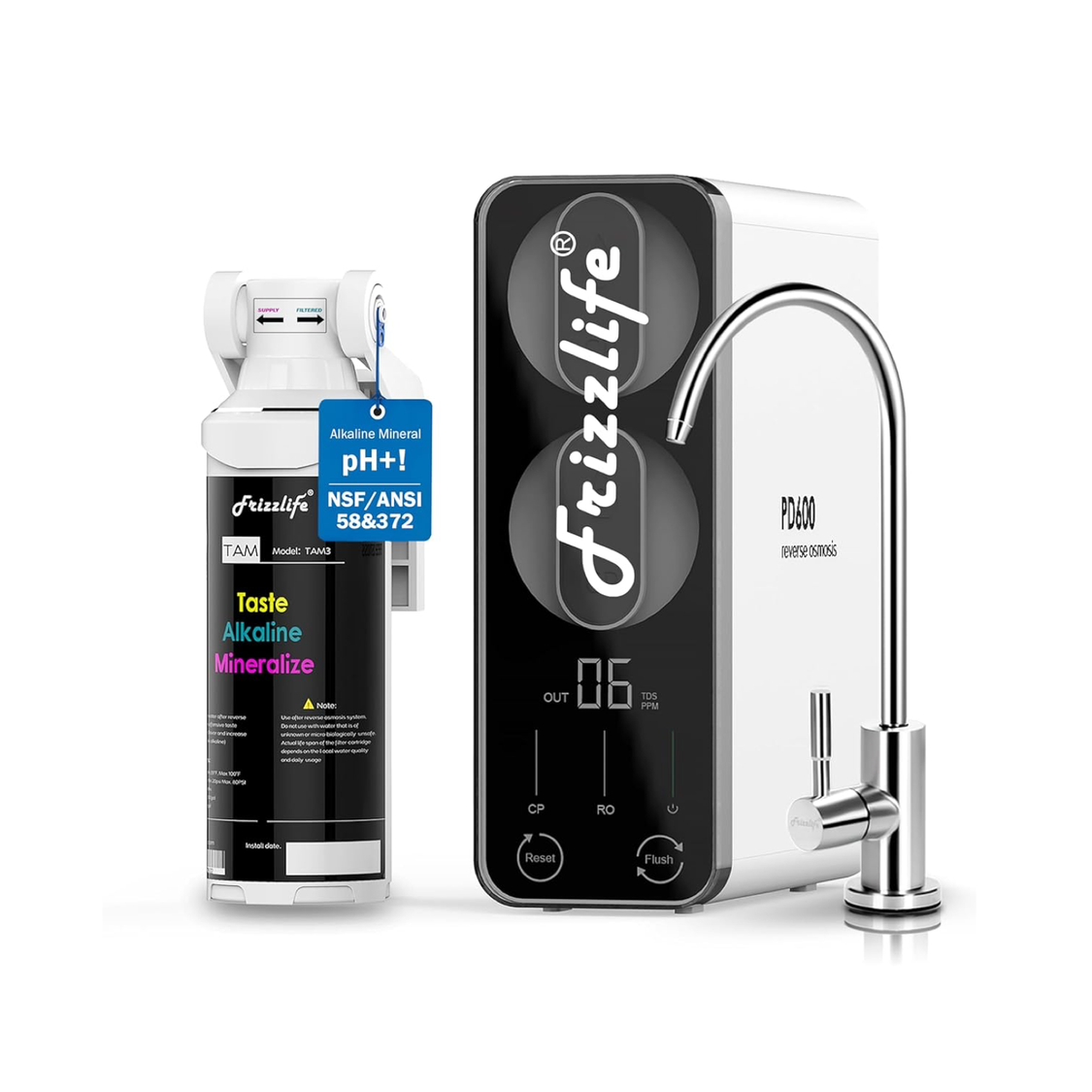
Frizzlife PD600-TAM3
A tankless under-sink reverse osmosis option for households considering a dedicated RO setup rather than a conventional faucet-mounted or direct-connect filter.
View PD600-TAM3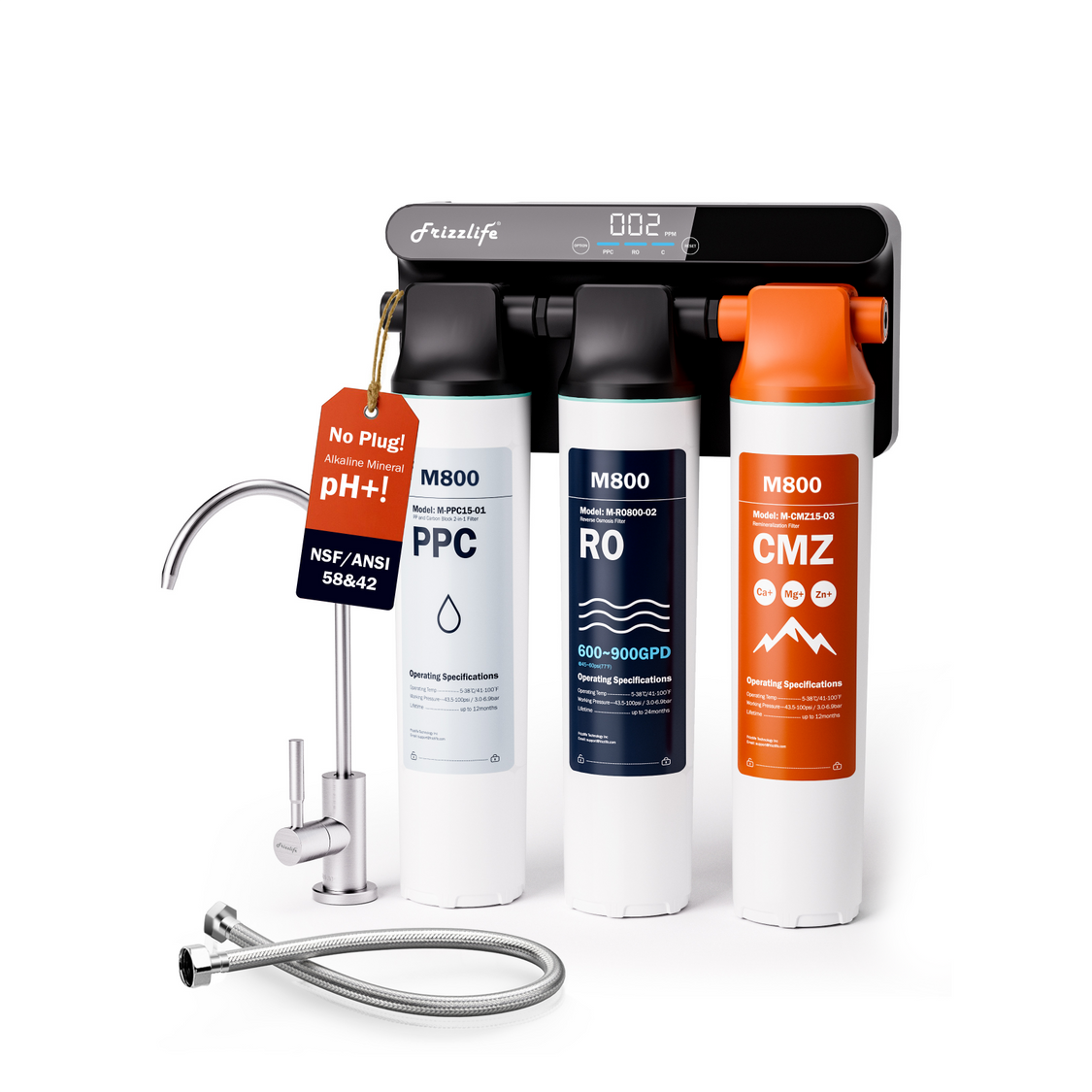
Frizzlife M800
Another tankless under-sink RO option to compare when you want a more complete reverse osmosis setup beneath the kitchen sink.
View M800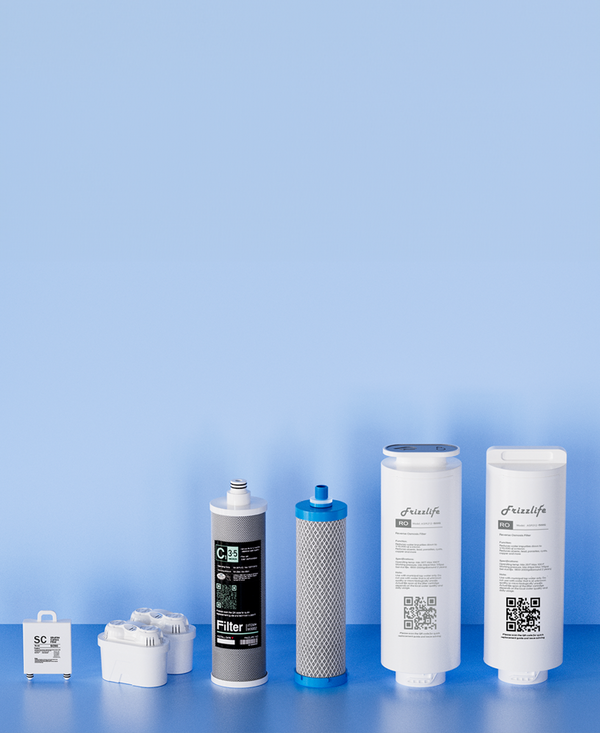
Replacement Filters
Already use a Frizzlife filtration system? Browse replacement filter options by system and model.
Find Replacement FiltersFaucet Mount vs Direct-Connect Filter: Key Differences
Filtration capability and contaminant coverage
Many faucet-mounted filters use activated carbon to address chlorine-related taste and odor. Depending on the product’s design and certification, a faucet filter may also reduce particular health-related contaminants.
Under-sink filters allow more physical room for larger media volumes and multiple filtration stages. A system might combine sediment filtration with one or more carbon stages, for example. Under-sink RO systems add membrane separation for a different level and type of treatment.
These category patterns do not prove how an individual model performs. Before buying either type, verify:
-
The exact model number covered by the test or certification.
-
The contaminants for which reduction claims are made.
-
Rated capacity and service flow.
-
Required pressure, temperature, and source-water conditions.
-
Cartridge replacement instructions.
-
Whether the claim says “certified,” “tested,” or only “designed to.”
Water flow and everyday sink convenience
Faucet-mounted cartridges create resistance as water moves through compact filter media. Filtered mode may therefore feel slower than the faucet’s normal flow. The effect varies with cartridge condition, incoming pressure, plumbing, and product design.
A slower faucet filter may be acceptable when filling a glass. It becomes more noticeable when filling a stockpot or several bottles. The filter body can also reduce clearance below the spout.
Direct-connect under-sink systems are often better suited to regular kitchen demand, but they can also restrict flow. A dense carbon block, clogged sediment stage, undersized tubing, low household pressure, or an overdue cartridge can affect delivery. Always compare the manufacturer’s rated service flow under stated conditions.
Rated capacity and cartridge replacement frequency
Faucet-mounted filters commonly use small cartridges, so they tend to require more frequent replacement than many under-sink systems. Their compact size is helpful for easy access but limits the amount of filtration media they can hold.
Under-sink systems can accommodate larger cartridges and may offer longer service intervals. Still, no universal replacement schedule applies. A filter’s useful life can be affected by:
-
Household water consumption.
-
Sediment levels.
-
Chlorine concentration and other source-water conditions.
-
Incoming water pressure.
-
Filter media and pore structure.
-
Whether all cold water or only drinking water is filtered.
-
The manufacturer’s time or capacity limit.
Replace cartridges according to the model’s instructions, even if the water still tastes normal. Taste is not a reliable indicator for every contaminant.
Upfront cost vs long-term cost per gallon
Faucet filters generally require less initial equipment and installation effort. That makes them attractive for temporary housing or light use. However, frequent replacement of smaller cartridges can raise long-term cost for a busy household.
Under-sink systems usually involve a larger initial commitment. The equipment may cost more, and installation could require tools, adapters, or professional help. Larger capacity can improve long-term value when the system is used heavily, but this is not guaranteed.
To compare cost per gallon using actual product information:
-
Add the purchase price and expected cartridge costs over the period you plan to own the system.
-
Use the manufacturer’s rated capacity rather than an assumed service life.
-
Account for all required stages—not just the least expensive cartridge.
-
Consider whether your household is likely to reach the gallon limit or the time limit first.
-
Include installation expenses if professional work is required.
Faucet clutter vs under-sink cabinet space
A faucet mount keeps the cabinet free but occupies visible space at the sink. It may interfere with large cookware, alter the faucet’s appearance, or add stress to a lightweight spout.
An under-sink filter keeps the sink area cleaner but competes with a garbage disposal, waste bins, cleaning products, and plumbing. Space must be evaluated with future cartridge changes in mind. A unit that technically fits may still be difficult to maintain if the sump or cartridge cannot be removed easily.
Installation, Faucet Compatibility, and No-Drill Options
Which water filter is easiest to install without drilling?
For a compatible standard faucet, a faucet-mounted filter is usually the easiest no-drill option. It typically replaces the aerator and does not require work inside the cabinet.
A direct-connect under-sink filter can also be a no-drill water filter. Instead of adding a dedicated dispenser, it connects to the cold-water supply and sends treated water through the existing faucet. This setup requires more plumbing work than a faucet attachment, but it avoids making a new hole in the sink or countertop.
The easiest choice therefore depends on compatibility:
-
Choose a faucet attachment when the spout has suitable threads and you want minimal installation.
-
Consider direct-connect filtration when the faucet is incompatible with attachments but the cold-water connection is accessible.
-
Choose a dedicated-faucet system only when an existing hole is available or drilling is permitted.
How to check whether a faucet filter attachment will fit
Before ordering, inspect the faucet rather than assuming an adapter will solve every issue.
Check the following:
-
Removable aerator: Confirm that the tip of the faucet unscrews.
-
Thread location: Determine whether the exposed threads are internal or external.
-
Thread size: Compare the faucet dimensions with the included adapters.
-
Spout construction: Avoid adding an attachment if the manufacturer does not permit added weight.
-
Clearance: Make sure the filter will not collide with the sink, backsplash, handles, or cookware.
-
Sprayer design: Identify whether the faucet head pulls out or down.
-
Special functions: Sensor-operated, designer, or multi-spray faucets may not accept attachments.
Do not force an adapter onto mismatched threads. Cross-threading can damage the faucet and contribute to leaks.、

Why faucet filters often do not fit pull-out or pull-down faucets
A pull-out or pull-down faucet combines the outlet, spray selector, and retractable hose into a removable head. The tip often lacks the standard fixed aerator connection required by a faucet-mounted filter.
Even when an improvised adapter appears to fit, the extra weight can affect docking and hose movement. It may also interfere with spray controls. For these faucets, a direct-connect under-sink filter is usually the cleaner solution because filtration occurs before water reaches the faucet.
How a no-drill under-sink filter uses the existing faucet
A typical direct-connect installation follows this general path:
-
Shut off the cold-water valve.
-
Open the faucet to relieve pressure.
-
Disconnect the cold-water faucet line.
-
Install the supplied tee, adapter, or inlet connection.
-
Route water through the filter and back to the faucet line.
-
Secure the filter in an accessible position.
-
Restore water pressure slowly.
-
Inspect every connection for leaks.
-
Flush the system according to its instructions.
Actual fittings and procedures vary. Confirm valve type, line size, thread standard, mounting position, and clearance before starting. If connections are corroded, inaccessible, or unfamiliar, professional installation may be safer.

When an under-sink system requires a dedicated faucet or new hole
A separate faucet is required when the selected system is designed to isolate filtered drinking water from the main tap. This is common with many RO configurations and some multi-stage systems.
A new hole may not be necessary if the sink or countertop already has:
-
An unused accessory opening.
-
A removable soap dispenser.
-
A side-sprayer opening that is no longer needed.
-
Another compatible factory-cut hole.
Never drill before checking the sink and countertop material. Stainless steel, composite material, stone, and porcelain require different tools and techniques, and some modifications may affect warranties or rental agreements.
Renter and condo considerations
A renter is not necessarily limited to a faucet filter, but reversibility matters.
Before installing an under-sink system:
-
Review the lease or building rules.
-
Ask whether supply-line accessories are allowed.
-
Avoid drilling without written permission.
-
Keep original fittings and faucet components.
-
Confirm that the shutoff valve works properly.
-
Consider professional installation if the building requires it.
-
Plan how the system will be removed and the plumbing restored.
Condo owners should also consider building rules and shared-water shutoff procedures. Even a reversible installation may need approval if work affects building plumbing.
Pre-installation kitchen compatibility checklist
Use this checklist before choosing between a tap filter and under-sink filter:
-
Is the faucet fixed, pull-out, or pull-down?
-
Does it have a removable threaded aerator?
-
Is there a working cold-water shutoff valve?
-
Are the supply-line fittings accessible?
-
Is there enough cabinet space for the unit and replacement cartridges?
-
Can cartridges be removed without moving plumbing or the garbage disposal?
-
Is an unused sink hole available?
-
Is drilling allowed?
-
Do you want all cold water filtered or only drinking water?
-
How often do you fill large pots and bottles?
-
Does the system’s rated flow suit that use?
-
Are the needed contaminant-reduction claims documented for the exact model?
Which Type Provides Better Filtration?
Why filter design matters more than installation location
Installation location does not establish filtration quality. Media type, contact time, filter construction, membrane design, system condition, and verified performance claims matter more.
A well-documented faucet-mounted filter may provide verified reduction for a particular contaminant that a basic under-sink filter does not claim to address. Conversely, a multi-stage under-sink system may target a wider range of concerns than a simple faucet attachment.
The correct comparison is therefore model versus model, based on your water and priorities.
Common capabilities of faucet-mounted carbon filters
Many faucet filters focus on:
-
Chlorine-related taste and odor.
-
Certain particulates or sediment.
-
Other specifically listed contaminants when supported by the model’s certification or performance data.
Activated carbon does not universally remove every dissolved contaminant, microorganism, mineral, or metal. Do not assume that a carbon cartridge reduces lead, PFAS, cysts, or other health-related contaminants unless the exact claim is documented for that model.
How multi-stage under-sink filters can expand coverage
An under-sink system can use different stages for different jobs. A sediment stage may protect downstream media from particles, while carbon stages may target taste, odor, and specified organic chemicals. Other technologies may be included for specific treatment goals.
More stages do not automatically mean better water. A useful system has stages chosen for the source water, and each stage has a clearly defined function. Extra cartridges without relevant performance data can add cost and maintenance without addressing your actual concern.
When reverse osmosis may—or may not—be necessary
RO may be worth evaluating when a water-quality report or test identifies dissolved contaminants that a certified RO system is designed to reduce. It can also be considered when the household wants a treatment technology beyond conventional carbon filtration.
It may be unnecessary when the primary goal is improving chlorine taste and odor in treated municipal water. RO also introduces additional installation and maintenance considerations, and many configurations connect to a drain.
Start with the water problem, not the number of stages. Select the simplest system that has credible performance documentation for the contaminants you need to address.
NSF/ANSI 42 vs 53
NSF/ANSI standards help consumers distinguish between different types of filtration claims:
-
NSF/ANSI 42 addresses aesthetic effects, including claims related to chlorine taste and odor and certain particulates.
-
NSF/ANSI 53 addresses specified contaminants with health effects, such as lead, when the individual product is certified for that particular reduction claim.
A product associated with a standard is not necessarily certified for every contaminant covered by that standard. Read the certification listing or performance data sheet to see the exact claims.
When NSF/ANSI 401 and other certifications matter
NSF/ANSI 401 covers reduction claims for certain emerging compounds and incidental contaminants. As with Standards 42 and 53, coverage is claim-specific. A reference to Standard 401 does not mean that every possible emerging contaminant is reduced.
Other standards can apply to RO systems, microbiological treatment, material safety, or structural integrity. Look for certification by an accredited third party and verify that the listing matches the exact model and replacement cartridge.
How to verify lead, PFAS, cyst, and other reduction claims
For any contaminant of concern:
-
Find the exact system and cartridge model number.
-
Locate the official performance data sheet.
-
Identify whether the product is independently certified, independently tested, or supported only by a manufacturer statement.
-
Confirm that the named contaminant appears in the reduction claims.
-
Review capacity, flow, pressure, and source-water conditions.
-
Check whether replacement cartridges carry the same model-specific documentation.
For cyst reduction, look for an explicit cyst-reduction claim under the appropriate standard rather than relying on a general statement about filter pore size. No faucet-mounted or under-sink category should be assumed to make microbiologically unsafe water safe to drink.
Start with your local water quality report or a water test
Municipal customers can review their local annual water quality report to identify regulated contaminants detected in the supply. Remember that conditions inside a building—such as older plumbing—may affect water after it leaves the utility.
Private-well users are responsible for testing their own water. If you have a specific health concern, unusual taste, recurring sediment, known plumbing issue, or local contamination advisory, use an appropriate laboratory test and follow guidance from local health or water authorities.
Flow Rate, Filter Life, Maintenance, and Ownership Cost
Do faucet filters reduce water pressure?
A faucet filter does not normally change pressure throughout the home, but it can reduce the flow delivered at that faucet while filtered mode is active. Water must pass through compact media and narrow internal channels, creating resistance.
A noticeable drop can also indicate:
-
A cartridge nearing the end of its service life.
-
Sediment loading.
-
An incorrectly installed adapter or gasket.
-
A partially closed shutoff valve.
-
Low incoming pressure.
-
Mineral buildup in the faucet or filter housing.
If flow changes suddenly, inspect the installation and follow the manufacturer’s troubleshooting instructions rather than assuming slow delivery is normal.
How long do under-sink filters last?
There is no universal answer. Under-sink filters often last longer than faucet cartridges because they can hold more media, but the actual replacement interval is specific to the model and household.
Service life may be stated as a gallon capacity, a time interval, or whichever limit comes first. Heavy water use can reach the gallon rating early. Low use does not necessarily allow a cartridge to remain installed indefinitely because time-based replacement limits may still apply.
Keep a replacement record instead of relying only on taste or flow. If the system has several stages, those stages may follow different schedules.
Faucet cartridge changes vs under-sink replacements
Faucet cartridges are usually easy to see and reach. Replacement may involve releasing the old cartridge, cleaning the contact area as instructed, and inserting a new one. The trade-off is that replacement can be more frequent.
Under-sink replacements may require shutting off the water, relieving pressure, removing a cartridge or housing, checking seals, and flushing the new filter. Access can be less convenient, but maintenance may occur less often.
For either system:
-
Use the correct replacement cartridge.
-
Follow sanitation and flushing instructions.
-
Inspect O-rings and sealing surfaces.
-
Do not overtighten housings or fittings.
-
Check for leaks immediately and again after the system has been pressurized.

Avoid These Common Buying Regrets
Buying before checking faucet compatibility
A faucet filter attachment can seem like the obvious no-drill choice until it arrives and does not fit. Confirm aerator threads, adapter sizes, spout construction, and clearance first. Pull-out and pull-down designs are frequent incompatibility points.
Underestimating reduced flow or faucet bulk
Think about how the sink is used, not only how the filter looks online. A compact attachment may still interfere with washing cookware, using a divided sink, or filling tall containers. Review the model’s rated flow rather than assuming it will match unfiltered faucet output.
Choosing too little capacity for a busy kitchen
A small cartridge may become frustrating when several people use filtered water for drinking and cooking. Estimate daily demand and compare it with the rated capacity and replacement limit.
If frequent cartridge changes are likely, a larger direct-connect system may provide a better ownership experience.
Assuming every under-sink filter removes more contaminants
A filter’s location does not prove its performance. A single-stage under-sink unit and a certified faucet filter may have very different claims. Verify each system independently.
Similarly, more stages do not guarantee broader reduction. Every stage should have a purpose supported by technical documentation.
Overlooking cabinet space and replacement access
Before mounting an under-sink filter, visualize the replacement process. Can the cartridge move downward or outward? Can you reach the shutoff valve? Will tubing block the garbage disposal or cabinet drawers?
Leave enough working room to inspect connections and catch small amounts of water during maintenance.
Confusing direct-connect filters with dedicated-faucet systems
“Under-sink” includes multiple configurations. Confirm whether the product:
-
Feeds the existing kitchen faucet.
-
Includes or requires a separate drinking-water faucet.
-
Requires a drain connection.
-
Uses a storage tank.
-
Needs electrical power.
-
Requires a new sink or countertop hole.
This distinction determines installation effort and whether the system qualifies as a no-drill option in your kitchen.
Relying on marketing claims without checking documentation
Words such as “advanced,” “pure,” or “multi-stage” do not establish contaminant reduction. Look for third-party certification tied to the exact product and claim.
Also distinguish among:
-
Certified: An accredited certification body has evaluated the product for listed claims.
-
Tested: Testing may have been performed, but this is not necessarily the same as product certification.
-
Meets a standard: This wording should be supported by clear evidence; it does not automatically mean certified.
-
Manufacturer claim: A statement from the manufacturer that should be evaluated alongside available test details.
Final Decision: Tap Filter vs Under-Sink Filter
Choose a faucet-mounted filter when you want the fastest, most reversible installation, have a compatible standard faucet, use moderate amounts of filtered water, and can accept some added faucet bulk.
Choose a direct-connect under-sink filter when you have accessible cabinet plumbing, use filtered water frequently, want to preserve faucet functionality, or need a no-drill solution for a pull-down faucet. Consider a dedicated-faucet or RO configuration only when its treatment capabilities and installation requirements match your water-quality goals.
Above all, compare documented performance rather than assuming one category always filters better. Once you know your faucet type, water concerns, daily demand, and installation limits, you can compare Frizzlife under-sink water filter configurations without confusing direct-connect systems with dedicated-faucet or RO designs.