

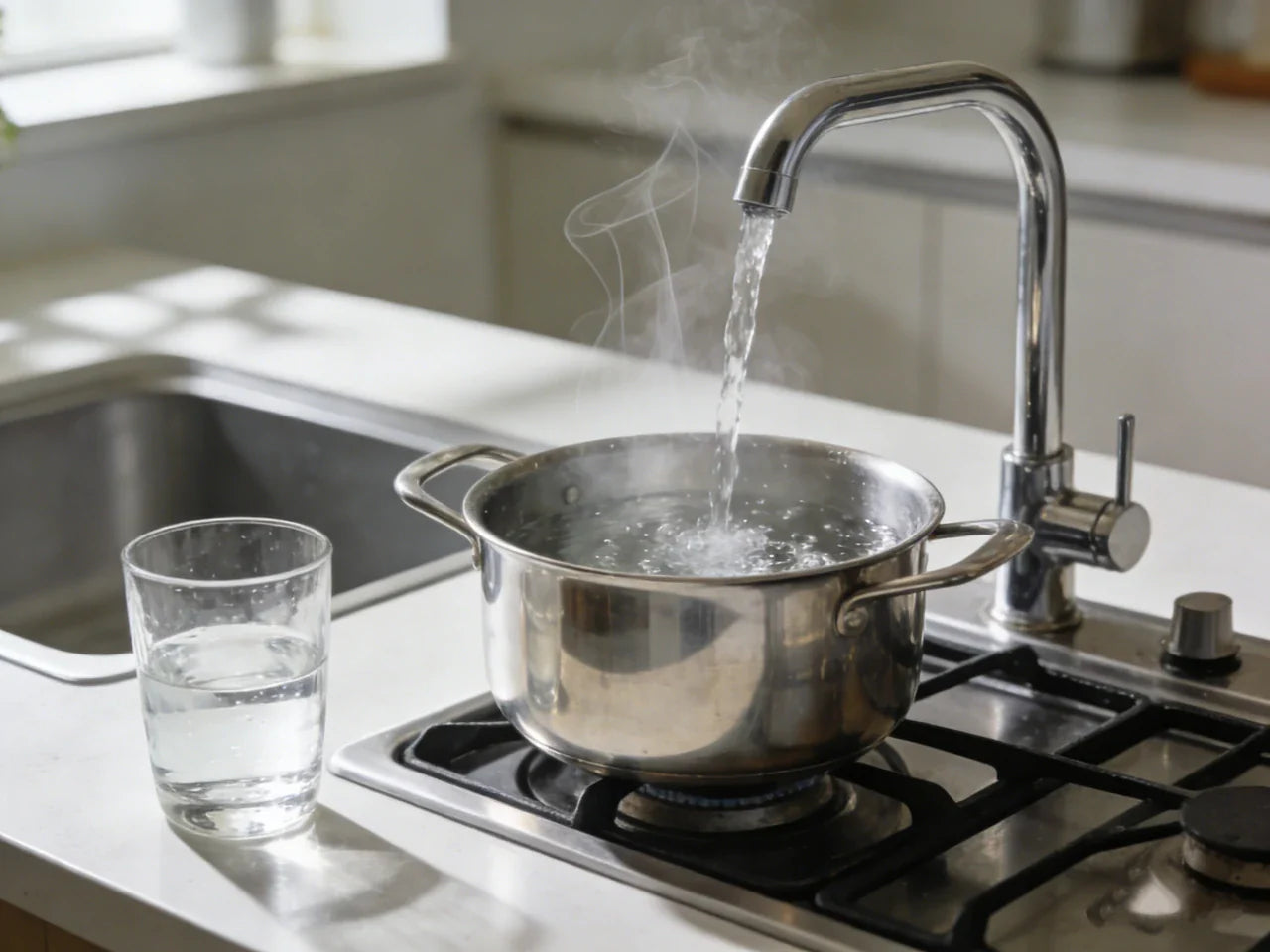
Does boiling tap water purify it? Not completely. Boiling is often seen as a way to make water pure, but it’s actually a basic water treatment method that focuses on boiling water eliminates bacteria. While it’s effective at killing germs like bacteria, viruses, and parasites, it doesn’t address chemicals, heavy metals, or many dissolved substances in tap water. In fact, boiling may even concentrate some contaminants as water evaporates. This guide explains what boiling does and doesn’t remove, and when you need additional water treatment to ensure clean drinking water.
Quick Answer: Does Boiling Tap Water Purify It? What It Removes and Doesn’t
Boiling mainly kills bacteria and other germs in water, helping make tap water safer to drink, but boiling water does not remove chemicals, metals, or dissolved solids that affect water quality. Boiling is a reliable water treatment method for eliminating bacteria, but it does not fully purify water to remove other harmful substances.
Boiling = disinfection, not full purification (definitions that matter for health)
When people ask, “does boiling water purify it” or “will boiling water purify it,” they usually want to know whether boiling truly makes tap water safe for everyday drinking. The key point is that when water is boiled, boiling acts as a short-term water treatment focused on disinfection, not full purification.. That’s disinfection.
Purification is broader. According to the U.S. Environmental Protection Agency (EPA), boiling is primarily effective for killing germs but does not remove chemical contaminants, heavy metals, or other dissolved solids commonly present in tap water (EPA, 2023).A true water purification approach usually means reducing germs and lowering chemical contaminants, metals, and particles. Many home methods do one job well, but not every job.
So if your biggest worry is bacteria in water supplies—such as during a boil water advisory—boiling your water is a reliable way to protect healthy drinking water, but it does not turn tap water into a long-term source of clean drinking water.
At-a-glance table: “Removed / Not Removed / May Concentrate”
| What’s in the water | What boiling does | Examples |
| Removed well (when water is clear) | Heat kills the germs | Many bacteria, many viruses, protozoa like Giardia |
| Not removed | Stays in the water | Lead, PFAS, fluoride, nitrates, many pesticides, most dissolved salts, many particles |
| May concentrate (can increase per cup) | Can become more concentrated if water boils away as steam | Many non-volatile chemicals and metals (for example, lead), dissolved minerals (hardness) |
Boiling is a good “make it safer right now” tool for microbes. It is not a full purify water method for modern chemical concerns.
Key takeaways (fast facts for search intent)
If you want the short, practical answer: boiling can make tap water safer to drink when the risk is germs. It does not “clean out” metals and chemicals, and it does not work like a water filter.
In many public health guidelines, bringing water to a rolling boil at its boiling point for at least one minute is the standard recommendation once water is boiled for emergency disinfection.
“Boil time by altitude” mini-calculator (CDC-based)
You don’t need special math. Use this simple rule:
-
If you are below 6,500 feet (about 2,000 meters): boil for 1 minute at a rolling boil.
-
If you are at or above 6,500 feet: boil for 3 minutes at a rolling boil.
If you’re not sure about your elevation, your phone’s map app usually shows it. When in doubt, using the longer time gives extra safety for germs.
How boiling makes water safer (microbiology & heat science)
Boiling water works by using high boiling temperatures to kill bacteria, viruses, and protozoa, helping make water safe to drink when clean water access is limited. This simple principle makes it effective against most waterborne pathogens.
How heat inactivates pathogens (what “killing germs” really means)
Germs are made of proteins and other parts that need the right shape to work. Heat disrupts those shapes. The World Health Organization (WHO) notes that boiling water is a reliable method for inactivating bacteria, viruses, and protozoa, making it an effective short-term solution for microbial contamination (WHO, 2023).Once the proteins are damaged, the germ can’t function or multiply.

That’s why boiling is so reliable for many waterborne illnesses. You don’t need to guess which germ is in the water. You’re using a broad tool: high heat.
This is also why people commonly ask, “can you drink dirty water if boiled,” especially when access to clean drinking water is limited. If “dirty” means it might have germs, boiling can help a lot—but mind that boiling water does not solve problems caused by chemicals, fuel, or heavy metals.
EPA/WHO-style boil guidance (how to do it safely at home)
Boiling is simple, but small mistakes can undo it. If you’re using boil water as your main safety step, do it like this:
-
If the water is cloudy, let it settle or filter the water first, because cloudy water can reduce the effectiveness of the boiling process. Cloudiness can “hide” germs from heat.
-
Bring the water to a rolling boil (big bubbles that keep coming even when you stir).
-
Keep it at a rolling boil for the right time (1 minute for most places; 3 minutes at high altitude).
-
Turn off heat and let it cool with a lid on.
-
Store it in a clean, covered container. Pour it out instead of dipping cups or hands inside.
That last step matters more than many people think. A lot of “boiled water that still tests unsafe” becomes unsafe again because of storage.
What boiling kills well vs. less reliably (scope and caveats)
Boiling is strong against the most common waterborne pathogens. It is known to inactivate bacteria and viruses that spread through feces and unsafe water supplies. It also inactivates protozoa like Giardia.
The big caveats are not about the boil itself. They are about real life: muddy water, uneven heating, and what happens after the pot comes off the stove.
If you boil the water but then cool it in a dirty bottle, or you dip a used spoon into it, you can add germs right back in. In many homes, that recontamination step is the weak point, not the boiling process.
“Source → boil → cool → store” contamination points (simple diagram in words)
Think of your water safety chain like this:
Source water (tap, well, or emergency supply) → boiling process → cooling → storage container → cup and hands
Germs can enter at every arrow. Boiling protects the middle, but you still need clean storage to keep the water safe.
What boiling does NOT remove (chemicals, metals, and “forever” pollutants)
Boiling water does not remove heavy metals, such as lead, or many chemicals found in tap water. In fact, it can concentrate some of these contaminants as the water evaporates. Boiling does not purify the water the way a filtration system would. If your concern is PFAS, lead, or other chemical contaminants, boiling is not a solution. You’ll need additional treatment like activated carbon filters or reverse osmosis.
Heavy metals & inorganic contaminants: why they persist
Metals like lead do not disappear when you boil water. They don’t get “killed,” and they don’t reliably evaporate away. Instead of helping water remove these contaminants, boiling can concentrate metals and minerals from water as some of the water evaporates.
So when people ask, “does boiling remove lead from water?” the answer is no. Boiling does not remove lead, and boiling can increase the amount of lead per cup if you boil long enough to lose water as steam.
This matters most in older homes with old plumbing, old solder, or certain fixtures. If you have concerns about lead, the safer approach is testing plus a certified filter that is designed for lead reduction, or using a different water source for drinking and cooking.
Arsenic, mercury, and other inorganic contaminants have the same basic issue: heat alone doesn’t “separate” them from water in a normal pot.
PFAS and other emerging contaminants (why “new” pollutants change the answer)
PFAS are often called “forever chemicals” because they can persist in the environment and can be hard to remove. Many people ask whether boiling water will purify it, but for PFAS and similar contaminants, boiling water does not remove chemicals and may even concentrate them.
But PFAS are not living organisms. So the main benefit of boiling (killing germs) does not apply. Boiling also does not reliably remove PFAS, and if you reduce the water volume through evaporation, you may raise the PFAS level per glass.
If PFAS are your concern, you usually need a real water filtration system designed for chemical reduction, such as a system that uses activated carbon certified for PFAS reduction, reverse osmosis, or another treatment designed for these chemicals.
Fluoride, nitrates, and dissolved solids (TDS)
Fluoride is a dissolved chemical. Boiling does not remove it.
Nitrates are also dissolved. Boiling does not remove nitrates, and boiling can make them more concentrated if you lose water as steam. This is one reason public health sources warn against trying to “fix” nitrate issues by boiling.
Dissolved solids (often talked about as TDS) include minerals like calcium and magnesium. If you have hard water, boiling won’t remove hardness or minerals from water, which means the water may look clearer but is not truly pure. You may see scale buildup in a kettle, which is a clue that minerals are present, not proof of danger.
Volatile vs. non-volatile contaminants (why some smells change, but safety may not)
Some chemicals evaporate more easily than others. That can change smell and taste during boiling. But a change in smell doesn’t mean the water is now “pure.”
A simple way to think about it is this: if a contaminant is non-volatile (it doesn’t easily turn into gas), boiling tends to leave it behind in the pot, especially if water evaporates. If it is volatile, some of it may enter the air, which is not always a win.
Physical contaminants & taste: sediment, microplastics, chlorine/chloramine
Boiling doesn’t filter particles or microplastics, and taste may remain unchanged. Filters are better for physical impurities and improving flavor.
Microplastics & particulates: boiling doesn’t filter
Boiling is not the same as filtering. A pot on a stove does not strain out particles. So if your water has sediment, rust flakes, or other visible bits, boiling won’t remove those bits.
Microplastics are even smaller. They are often too small to see, and boiling does not reliably remove them because boiling is not a physical barrier. If you want to reduce particles, you need a filter that physically traps them.
That leads to a practical question people ask: is it better to filter water or boil it? If the main problem is particles, filtering wins. If the main problem is germs, boiling works well. If you want both, you often combine steps: pre-filter, then disinfect (by boiling or another method), and store safely.
Chlorine vs. chloramine (taste and odor realities)
Many cities add disinfectants to keep water safe as it travels through pipes. Two common ones are chlorine and chloramine.
Free chlorine in tap water may reduce slightly during boiling, but boiling water does not reliably remove chloramine or fully purify water. But chloramine is more stable and tends to persist longer.
This is why some people say, “Boiled water tastes better,” while others say, “Boiled water tastes flat or worse.” Taste depends on your water chemistry, your plumbing, and whether boiling concentrates minerals.
Hard water scaling and kettle buildup (signs, not safety)
If your kettle gets a white crust, you’re likely seeing mineral scale from hard water. This is common and usually not a sign of germs. It’s also not proof the water is unsafe. It’s simply the minerals becoming visible when water heats and evaporates.
Still, scale is a good reminder of the concentration effect: if minerals can build up on a kettle, other dissolved substances can also become more concentrated in the remaining water.
Boiled vs. filtered: clarity and taste (quick comparison)
| Goal | Boiling helps? | Filtering helps? |
| Kill germs | Yes | Sometimes (depends on filter type) |
| Remove sediment/particles | No | Yes |
| Reduce chlorine taste | Sometimes | Often (with carbon) |
| Reduce dissolved chemicals | No | Sometimes (depends on method, like RO or certified carbon) |
Real-world evidence & case studies (what happens outside the lab)
In homes, storage and handling affect boiled water safety. Studies show germs can re-enter if containers or utensils aren’t clean. A study published in PubMed observed significant reduction in coliform bacteria after boiling, but recontamination during storage remained a concern, highlighting the importance of clean handling (Lantagne et al., 2009).
A field snapshot: boiled water gets safer, but storage can undo the benefit
In real homes, boiling often improves safety but does not guarantee perfect results because people still have to cool and store the water.
A well-known field study in Guatemala looked at household water and found large reductions in thermotolerant coliforms after boiling. It also found that stored boiled water could still become contaminated again. That’s not because boiling “failed,” but because daily life is messy: cups, hands, lids, and containers can reintroduce germs.
If you’ve ever boiled water during a power outage or after a storm, you may relate to this. You’re tired, you’re trying to help your family, and the last thing you want is a strict lab-style routine. But safe storage is what keeps boiled water safe.
Why boiled water can still test unsafe (the recontamination chain)
Recontamination usually happens in a few predictable ways.

It can happen when boiled water is poured into a container that looks clean but still has a thin film inside. It can happen when someone dips a cup in instead of pouring. It can happen when a child touches the inside of a lid. It can also happen when boiled water sits uncovered and picks up dust or insects.
If you want water safe for consumption, treat storage like part of the treatment.
Boil adviso ries & disasters: where boiling is the right move
During floods, main breaks, or treatment problems, cities may issue a boil water advisory because the main risk is microbial contamination. In those moments, boiling is often the fastest way to protect yourself, especially when bottled water is scarce.
In emergencies, you usually don’t have time to install a new system. Boiling is a “today” tool. Longer-term purification is a “next steps” tool.
“Recontamination risk map” (pot → cup)
If you want a simple mental map, watch these points:
-
The inside of the cooling pot lid
-
The storage container opening and cap
-
The ladle or cup used to serve
-
Hands touching the rim
When those are clean, boiled water stays much safer.
Risks, tradeoffs, and when boiling can make water worse
Evaporation can concentrate chemicals, and some compounds may enter the air. Knowing these risks helps decide when boiling is appropriate.
The concentration effect explained (with easy numbers)
Although boiling is effective for germs, it does not help water remove non-volatile contaminants and can increase their concentration as water turns to steam.
Imagine you boil a pot and lose about one-third of the water as steam. Now you have less water, but almost the same amount of dissolved stuff. So each cup can contain a higher dose.
You don’t need a lab to see this. If you boil soup too long, it tastes saltier. Water can behave the same way with dissolved minerals and certain contaminants.
This is why boiling is not a solution for lead, nitrates, and many chemicals. It can make the “per cup” amount higher if you boil for a long time or simmer uncovered.
Volatile chemicals and indoor air (a small but real consideration)
Some chemicals can move into the air when heated. If your tap water has certain volatile organic compounds, heating can release them into indoor air.
For most people, this is not the main risk compared with drinking unsafe water during an outbreak. But it is a reason to ventilate your kitchen if you are boiling large amounts often. Opening a window or using a vent fan can help.
Energy, cost, and practicality vs. filtration
Boiling works well in short-term needs, but it can be inconvenient as a daily routine.
It takes time to heat the water, then time to cool it, then fridge space to store it. If you have a large family, you may feel like you are always waiting in the kettle.
Energy costs depend on your stove, kettle, and local rates. A rough way to think about it is that heating water every day adds up over months. A filter also has costs, but it can be faster day to day.
So if you’re asking, is it good to boil water for drinking every day, the real answer is: it depends on why you’re doing it. If your water system is under a boil advisory, yes, it’s a smart short-term move. If you’re doing it because you want “purified” water in a home with possible chemical risks, boiling is not the right tool.
“Cost to boil vs. filter” (a simple way to estimate)
If you like quick math, you can estimate boiling energy like this:
Energy (kWh) ≈ kettle power (kW) × minutes used ÷ 60
Then multiply by your electric rate.
This won’t be perfect, but it helps you compare habits. The bigger point is not the exact cents. It’s whether boiling fits your life and your actual water risks.
Best alternatives for true purification (RO, carbon, UV, distillation)
For full water purification—removing bacteria and chemicals—boiling water is not enough, and water purification systems are often needed. Alternative methods like RO, carbon filters, or distillation may be needed.
When people say they want water purified, they usually mean they want protection from both germs and chemicals. No single method is best for every home, but some methods cover a wider range than boiling.
Reverse osmosis (RO) for broad contaminant reduction
A reverse osmosis water filtration system pushes water through a special membrane to remove dissolved contaminants that boiling water cannot. It can reduce many dissolved contaminants, including some metals and other chemicals.
RO is often chosen when people are concerned about things boiling does not address, like lead, nitrates, and PFAS. According to NSF International, certified RO and activated carbon filters can effectively reduce various chemical contaminants, providing safer drinking water beyond what boiling alone can achieve (NSF, 2023). It is not magic, and it needs upkeep, but it targets the “dissolved” problems that boiling cannot fix.
Activated carbon for taste and many organic chemicals
Activated carbon filters are widely used for improving taste and smell. Many are effective at reducing chlorine and some organic chemicals.
But carbon performance depends on the exact filter and how it is tested. If your goal is a specific contaminant (like lead or PFAS), look for a system that is certified for that specific reduction. “Carbon” alone is not a guarantee.
UV purification for microbes (when chemistry is already safe)
UV uses light to inactivate germs. It does not remove chemicals or particles, so it’s best when your main risk is microbial contamination, like with some wells or when you have a history of bacteria issues.
UV also works best when water is clear, because particles can block the light.
Distillation (a different kind of separation)
Distillation boils water and then captures the steam as liquid again. That “separates” water from many dissolved solids better than simple boiling in a pot.
It can reduce many metals and minerals, but it can be slow and energy-heavy. Some chemicals can carry over if they evaporate with the water, so distillation systems often use extra steps to handle that.
Comparison table: what each method is good at
| Method | Good for germs? | Good for chemicals/metals? | Notes you should know |
| Boiling | Yes | No | Best for emergencies; needs safe storage |
| Activated carbon | Not the main job | Sometimes | Great for taste; certification matters for target chemicals |
| Reverse osmosis | Often paired with other steps | Yes (broad) | Good for many dissolved contaminants; needs maintenance |
| UV | Yes | No | Needs clear water; works well for microbial risk |
| Distillation | Yes (with proper process) | Often | Can be slow; may need extra steps for volatile chemicals |
If you’ve been comparing water purification systems, this table helps answer the common “boil vs filter” confusion. Boiling is a disinfection method. Filtration is a separation method. Many homes need separation more than heat.
Decision guide: what to do with your tap water (actionable steps)
Test your water and choose treatment based on risks. Matching the method to the problem keeps your drinking water safe.

Test-first approach (especially for older plumbing or wells)
If you want a calm, long-term plan, start with information.
If you use city water in the U.S., you can read your local Consumer Confidence Report, which shows what was found in the public system. That does not always capture what happens inside your home’s plumbing, but it’s a good start.
If you have a private well, testing matters even more because you are the “water system.” Wells can have bacteria, nitrates, arsenic, and other issues depending on geology and nearby land use.
Testing tap water helps you understand what’s in the water in your home and choose the right method for healthy drinking water, instead of relying on boiling alone. Boiling treats germs. It does not remove chemicals. So testing can save you months of effort.
Scenario playbook (choosing the right tool)
If your city says “boil your water,” that is usually a germ problem. In that case, boil for the right time, cool with a lid, and store clean. That’s making water safe for the situation.
If you’re worried about lead (older home, old pipes, or you have a child in the house), do not rely on boiling. You need a method that reduces lead, plus steps like flushing the tap and using cold water for cooking. Testing is important here.
If PFAS is a concern in your region, boiling is not the fix. You want treatment designed for PFAS reduction.
If your water is cloudy, handle the physical problem first. Let it settle or pre-filter. Then disinfect it if needed. Cloudy water makes any disinfection step less reliable.
People also ask: “Is boiled tap water safe to drink every day?”
Boiled tap water can be safe to drink every day if the only issue is germs and you store it safely. But if you are boiling daily to “purify” water that might have lead, nitrates, or other dissolved contaminants, boiling does not solve that and may raise concentrations if you lose water as steam.
A more realistic daily plan is to match the method to the risk: disinfect for germs, and filter for chemicals and particles.
People also ask: “Does boiling remove lead from water?”
No. Boiling does not remove lead. If anything, longer boiling that reduces water volume can increase lead concentration per cup.
Takeaways
Here’s a quick summary of what boiling can do, what it can’t, and how to decide when other purification steps are needed.
Boiling is a powerful, simple tool for germs, helping make water safe to drink, but it does not make water pure in the full sense. It is not a complete water purification method. If you take one idea from this guide, let it be this: boiling water does not remove most chemicals, metals, or particles. It makes water safer from microbes, not “pure” in the full sense.
Final checklist (quick summary)
-
Use boiling when the main risk is bacteria and other germs, like during a boil water advisory.
-
Bring water to a rolling boil and keep it boiling for 1 minute (or 3 minutes at high altitude).
-
If water is cloudy, settle or pre-filter first.
-
Store boiled water in a clean, covered container to prevent recontamination.
-
Do not rely on boiling to fix chemical risks like lead, PFAS, nitrates, or many pesticides.
-
If you want the healthiest long-term approach, test your water and choose a filter or treatment that targets what’s actually present in the water.
FAQs
1. How long to boil water for purification?
To purify water by boiling and kill bacteria, bring water to a rolling boil for at least one minute under normal conditions. If you’re in a high-altitude area—like 6,500 feet or higher—boil it for 3 minutes, because water boils at a lower temperature there. Keep in mind, boiling kills bacteria, viruses, and parasites, but it does not remove chemicals, heavy metals, or dissolved solids like TDS. So while it’s great for germ safety, it’s not a solution for water with high minerals or contaminants. After boiling, it’s best to let it cool naturally in a clean container before drinking.
2. Is it safe to drink dirty water after boiling it?
It depends on what you mean by “dirty.” If your water has germs, bacteria, or viruses, boiling it can make it much safer to drink. But if “dirty” means the water contains chemicals, metals, or runoff from roads and farms, boiling may not make it safe. In some cases, boiling can even concentrate certain contaminants, like nitrates or salts, because the water evaporates but the dissolved solids remain. So, boiling is a good step for microbiological safety, but for chemical or mineral issues, you’ll want a proper water filter or RO system.
3. Does boiling remove chlorine or chloramine?
Boiling water can help reduce free chlorine a little over time, and some people notice an improvement in taste after boiling. However, chloramine—which is more stable than chlorine—doesn’t break down easily with boiling, so it may still be present. If your goal is to remove these disinfectants for better taste or health, using an activated carbon filter or other chemical-removal method is usually more effective than just boiling.
4. What is the difference between a boil-out and filtering?
A boil-out, or boiling water, uses heat to kill germs, making it microbiologically safe. Filtering, on the other hand, physically removes particles, sediments, and sometimes chemicals, depending on the type of filter you use. For example, a reverse osmosis system can remove dissolved solids and heavy metals, while activated carbon can reduce taste and odor issues. So boiling is great for killing germs, filtering is better for improving taste, removing sediments, and reducing dissolved contaminants—sometimes, the best approach is combining both for clean, safe water.
5. What is the healthiest way to filter tap water?
The healthiest method depends on what’s in your water. If your water has dissolved minerals, metals, or nitrates, a reverse osmosis system is often the most thorough choice. For better taste and chemical removal, like chlorine or chloramine, activated carbon filters work well. If you’re mainly concerned about germs, then UV treatment or boiling works fine when the water is clear. The key is to test your water first, so you know exactly what you’re dealing with, and then choose the method that targets the specific contaminants you need to remove while keeping healthy minerals intact.
Reference