


Finding the best water filter for Los Angeles starts with identifying the problem you want to solve. Los Angeles tap water generally meets federal and California drinking-water standards, but regulatory compliance does not mean every household receives identical water at the faucet. Taste, disinfectant residuals, hardness, dissolved minerals, source-water blends, and building plumbing can all affect the final result.
For many LA households, an under-sink carbon filter is the practical choice for improving chlorine or chloramine-related taste and odor. Reverse osmosis may be a better fit when testing or personal preferences call for broader reduction of dissolved contaminants and total dissolved solids. If the main problem is scale on fixtures or appliances, a water softener—not a standard drinking-water filter—is the relevant technology.
This guide explains how to choose a Los Angeles tap water filter without assuming that one system is right for every apartment, house, or neighborhood.
What Is the Best Type of Water Filter for Los Angeles Tap Water?
The best filter depends on whether your priority is taste, broader contaminant reduction, or hard-water control:
- Choose under-sink carbon filtration when the main concerns are disinfectant taste, odor, and convenient filtered water for drinking and cooking.
- Choose reverse osmosis when you want broader treatment of dissolved substances, particularly when supported by local reports or tap-specific testing.
- Choose a water softener when mineral scale is the primary problem throughout the home.
- Choose whole-house carbon or sediment treatment when chlorine, chloramine, odor, or particulate concerns affect multiple fixtures.
- Choose a countertop or other nonpermanent system when renting, working with limited cabinet space, or avoiding plumbing modifications.
No filter should be selected solely by the number of stages it advertises. The right water filter for LA tap water is one with verified claims for the substances you actually want to reduce.
Decision Snapshot: Under-Sink Carbon for Taste and Disinfectants, Reverse Osmosis for Broader Dissolved Contaminants, and Softening for Scale
For most households using municipal water, the decision can be reduced to three questions:
-
Does the water mainly taste or smell unpleasant?
Start with a carbon-based drinking-water filter. Confirm that the model has a relevant chlorine or chloramine reduction claim because those disinfectants do not behave identically. -
Are you concerned about TDS, arsenic, chromium, lead from plumbing, or a wider range of dissolved substances?
Consider an under-sink reverse-osmosis system with verified performance for the specific contaminants of concern. RO is not automatically necessary for every LA household. -
Is white scale the main complaint?
Measure hardness and consider softening. Carbon filtration generally does not remove the calcium and magnesium responsible for hard-water scale.
Some homes need two technologies. A homeowner may use a softener for whole-house scale control and a point-of-use carbon or RO system for drinking water.
Why California Tap Water Feels Like One Problem Even When It Is Many Different Problems
“California water” is often discussed as if it were a single, consistent supply. In practice, California has numerous water districts, groundwater basins, imported supplies, treatment facilities, and local distribution systems. Even within Los Angeles, source blends can change over time.
The City of Los Angeles receives water from multiple sources, including imported water and local groundwater. Changes in that blend can influence hardness, mineral taste, TDS, and treatment characteristics. The water can also change after it leaves the public distribution system. Older pipes, solder, fixtures, faucet components, and periods of stagnation may affect what comes from a specific kitchen tap.
That is why two residents can describe LA water differently without either being wrong. One may be reacting to disinfectant taste, another to mineral content, and a third to scale caused by hardness. A resident in an older multifamily building may also have plumbing-related concerns that do not appear in a citywide water-quality report.
A useful filter decision therefore separates four categories:
- Aesthetic issues: taste, odor, visible particles, or cloudiness
- Dissolved contaminants: substances that may require specifically certified carbon media or RO
- Hardness: calcium and magnesium that create scale
- Premise-plumbing issues: contaminants introduced between the utility connection and the faucet
Los Angeles Tap Water Filter Decision Table
|
Primary concern |
Best-fit technology |
Important limitation |
Typical installation |
Good household fit
|
|---|---|---|---|---|
|
Chlorine-related taste or odor |
Activated-carbon filtration with a verified chlorine claim |
Does not automatically reduce chloramine, hardness, metals, or every organic compound |
Pitcher, countertop, faucet, or under sink |
Renters and homeowners seeking a straightforward taste improvement |
|
Chloramine-related taste or odor |
Carbon system specifically evaluated for chloramine reduction |
Performance depends on media, contact time, flow, and cartridge condition |
Under sink or whole house |
Homes where the local utility uses chloramine and taste is the main concern |
|
Broader dissolved-contaminant and TDS reduction |
Reverse osmosis with model-specific performance evidence |
Produces a reject-water stream, removes minerals, and requires maintenance |
Usually under sink |
Homeowners or renters permitted to make the necessary installation |
|
Lead potentially introduced by building plumbing |
Point-of-use filter with a verified lead reduction claim |
A citywide report cannot determine lead at an individual faucet |
Faucet, countertop, or under sink |
Older buildings, especially when tap testing finds lead |
|
Scale on fixtures and appliances |
Ion-exchange water softener or another verified scale-control technology |
A softener is not a substitute for contaminant filtration |
Point of entry |
Homeowners with measured hard water and whole-home scale problems |
|
Sediment at several fixtures |
Sediment prefilter after identifying the source |
Does not address dissolved contaminants, disinfectants, or hardness |
Point of entry |
Homes with recurring particulate problems |
|
Chlorine or chloramine concerns throughout the home |
Whole-house carbon treatment designed for the applicable disinfectant |
Does not necessarily soften water or reduce all dissolved contaminants |
Point of entry |
Homeowners who want treatment at showers, laundry, and sinks |
|
Microbiological concern in a private supply |
Testing followed by appropriate disinfection, potentially including UV |
Usually unnecessary for normally treated municipal water; UV does not remove dissolved chemicals |
Point of entry or point of use |
Private-well users or properties with a confirmed microbial issue |
Los Angeles Tap Water Quality: Safety, Contaminants, and Local Variation
A filter recommended for one California city, water district, or private well may be unnecessary or insufficient elsewhere. Statewide discussions can identify common themes, but they cannot replace the current consumer confidence report for the serving utility or testing at the household tap.
Is Los Angeles Tap Water Safe to Drink in 2026?
For LADWP customers, current utility reporting states that Los Angeles drinking water meets applicable federal and California standards. That does not mean water is identical at every faucet: source blends can vary, and building plumbing may affect tap-specific results. Los Angeles County residents served by another utility should consult that provider’s current water-quality report, while private-well users need site-specific testing.
That supports a calm distinction:
- Regulatory compliance: Water meets enforceable standards monitored by the utility.
- Individual preference: A household may still want to improve taste, odor, mineral content, or exposure to certain detectable substances.
- Tap-specific conditions: A utility report may not show what older building plumbing introduces after water enters a property.
- Health-based goals: California Public Health Goals and other advisory benchmarks may be lower than enforceable maximum contaminant levels. Exceeding a nonenforceable goal is not the same as violating a legal standard.
For most LA municipal customers, filtration is an optimization decision rather than a response to an emergency. Anyone receiving a boil-water notice or another official advisory should follow the instructions from the utility or public-health authority; an ordinary household filter should not be treated as a substitute.
What Water-Quality Issues Are Common in Los Angeles Tap Water?
Common LA concerns include:
- Chlorine or chloramine taste and odor
- Regulated disinfection byproducts
- Hardness and mineral scale
- Variable TDS and mineral taste
- Low-level, source-dependent inorganic substances such as arsenic
- Potential lead introduced by older building plumbing or fixtures
- Localized or time-dependent concerns not captured by broad system averages
The presence of a substance does not by itself establish that the water violates a safety standard. Concentration, exposure, regulatory limits, sampling location, and test method all matter.
Chlorine, Chloramine, Taste, and Odor Concerns
Public utilities disinfect water to control microorganisms as it moves through treatment and distribution. Chlorine and chloramine can leave a noticeable taste or odor even when their levels comply with regulations.
Activated carbon is commonly used for chlorine reduction. Chloramine is more persistent and may require media, sufficient contact time, and system design specifically intended for chloramine reduction. A generic “carbon filter” label is not enough to verify this capability.
If disinfectant taste returns after a period of good performance, the first step is usually to check the cartridge status and installation—not assume that the municipal supply suddenly became unsafe.
Disinfection Byproducts in Treated Municipal Water
Disinfection can react with naturally occurring organic matter to form byproducts, including total trihalomethanes and haloacetic acids. These compounds are regulated, and LA’s reported levels remain within applicable legal limits. Some independent organizations compare detected levels with more conservative, nonregulatory benchmarks, which can produce different interpretations of the same results.
Certain carbon and RO systems may reduce specific disinfection byproducts, but effectiveness is product-specific. Look for the precise claim in a certification listing or performance data sheet rather than relying on a broad “removes chemicals” statement.
Low-Level Arsenic, Chromium-6, and Other Source-Dependent Contaminants
Low concentrations of naturally occurring inorganic substances can appear in California source water. Los Angeles reports have included arsenic within applicable standards, although detectable values can be higher than California’s nonenforceable Public Health Goal.
Chromium-6 is often discussed separately in consumer water reports, but buyers should avoid assuming that every carbon filter or every RO system reduces it. Arsenic performance can also depend on chemical form and water chemistry. If either substance is a priority, use certified laboratory testing and choose a system with an exact, applicable reduction claim.
Citywide summaries cannot predict the concentration at every address because water sources and blends can vary.
Lead From Older Building Plumbing, Solder, and Fixtures
LADWP states that it does not detect lead in its water sources or distribution system. Nevertheless, lead may enter water through premise plumbing, including older pipes, solder, fixtures, and faucet components.
This distinction matters because a utility report alone cannot rule out lead at a specific kitchen tap. Buildings with older plumbing, recent plumbing work, or prolonged stagnation may warrant tap-specific testing.
If testing detects lead:
- Use a point-of-use system with a verified lead reduction claim.
- Follow the filter’s replacement instructions.
- Use cold water for drinking and cooking.
- Consider having the plumbing source identified and corrected.
- Do not rely on boiling; boiling does not remove lead and can concentrate dissolved substances as water evaporates.
PFAS Findings: Why System-Level Results May Not Represent Every Location
LADWP reports that six key PFAS compounds have not been detected in the City of Los Angeles distribution system. That is useful system-level evidence, but it should not be generalized to every water system in California, every private well, or every historical sampling period.
PFAS data can vary by:
- Water district
- Source water
- Sampling date
- Compounds included in the analytical panel
- Laboratory detection limits
- Localized contamination conditions
Residents outside LADWP service, those using private wells, or anyone with a site-specific reason for concern should review local data and consider certified laboratory testing. If PFAS reduction is a purchasing priority, verify that the exact filter model has a relevant claim; neither carbon nor RO should be assumed to reduce every PFAS compound simply because of its technology category.
Hardness and TDS Differences Across Los Angeles Neighborhoods and Source Blends
Hardness and TDS are related but not interchangeable:
- Hardness mainly reflects calcium and magnesium and predicts scale formation.
- TDS estimates the total concentration of dissolved ionic substances.
- High TDS does not identify which substances are present.
- Low TDS does not automatically prove microbiological or chemical safety.
A handheld TDS meter can show relative changes, including whether an RO membrane appears to be reducing dissolved ions, but it cannot identify lead, arsenic, PFAS, or chromium. Use a hardness test for scale decisions and a qualified laboratory for specific contaminants.
Common California Water Filtration Misconceptions: Hard Water, RO, and Tap Water
Many poor filter choices come from treating purification, softening, and taste improvement as interchangeable goals. They are not.
Hard Water Is Not the Same as Contaminated Water
Hard water contains elevated calcium and magnesium. These minerals can cause scale, spots, reduced lather, and deposits in water-using equipment, but hardness alone does not mean the water is unsafe.
Likewise, soft water is not necessarily contaminant-free. A softener exchanges ions to address hardness; it is not designed as a universal solution for lead, PFAS, disinfection byproducts, arsenic, or microorganisms.
If the complaint is white crust around faucets, test hardness first. If the concern is a particular contaminant, test for that contaminant and select a filter with a matching claim.
Is Reverse Osmosis a Good Option for Drinking Water in Los Angeles?
Yes. Reverse osmosis can be a good option for Los Angeles drinking water when the goal is substantial TDS reduction or broader treatment of dissolved substances. It is especially relevant when a laboratory result identifies a contaminant that the complete RO system is specifically verified to reduce.
RO is likely to be a good fit when:
- A tap-specific test identifies a dissolved contaminant covered by the system’s documented claims.
- The household wants substantial TDS reduction or prefers the taste of RO water.
- The user accepts membrane maintenance, mineral reduction, and production of a reject-water stream.
RO may be more than necessary when taste or disinfectant odor is the only complaint, cabinet or drain access is limited, or the chosen model lacks verification for the concern driving the purchase. In those cases, an appropriately evaluated carbon filter may be simpler and may preserve more of the source water’s mineral content.
Compare complete systems rather than membrane or stage count alone. Prefilters, postfilters, feed-water pressure, maintenance, plumbing layout, efficiency, and model-specific performance claims all affect suitability. For a tap-specific lead concern, either a non-RO filter or an RO system may be appropriate if the exact model has a verified lead reduction claim.
Why RO Efficiency Matters When Choosing a California Water Filtration System
Reverse osmosis separates a purified-water stream from a reject-water stream. The ratio varies by system design, incoming pressure, temperature, membrane condition, and other operating factors.
Water conservation makes this especially relevant in California. Compare model-specific documentation for:
- Pure-water-to-drain ratio
- Operating pressure requirements
- Whether a pump is used
- Rated production under specified conditions
- Performance under the household’s likely conditions
Do not assume that a marketing ratio will apply under every installation condition. Hardness scale, low pressure, cold feed water, and overdue maintenance may affect performance.
Why a Water Softener Does Not Replace a Drinking-Water Filter
A softener solves a different problem. It can reduce hardness minerals and help manage scale, but it does not provide comprehensive contaminant filtration. Conversely, most carbon filters do not soften water.
Homes with both very hard water and drinking-water concerns may benefit from a combined approach. The whole-house softener protects fixtures and water-using equipment, while a kitchen filter treats water used for drinking and cooking.
Why a Basic Carbon Filter Should Not Be Assumed to Reduce Every Contaminant
Carbon performance depends on the media, contaminant, flow rate, contact time, water chemistry, cartridge capacity, and system design. A filter promoted for chlorine taste should not automatically be treated as a lead, PFAS, arsenic, or chromium filter.
Review the exact model documentation. Statements such as “tested to a standard” or “uses certified components” are not equivalent to certification of the complete system for a named contaminant.
Should Los Angeles Homes Use a Whole-House Filter or an Under-Sink System?
An under-sink system is usually the more focused choice when the priority is water for drinking, beverages, and cooking. Whole-house treatment is more appropriate when an issue affects showers, laundry, multiple sinks, water heaters, or appliances.
Choose an Under-Sink System When the Priority Is Cooking and Drinking Water
Point-of-use filtration treats a smaller volume of water at the fixture where it matters most. This can reduce equipment size, maintenance burden, and unnecessary treatment of water used for toilets or outdoor irrigation.
Under-sink systems are well suited to:
- Drinking-water taste and odor improvement
- Tap-specific lead concerns
- Broader RO treatment at the kitchen
- Households that do not need filtered shower or laundry water
- Renters who have approval for a reversible installation
To compare configurations, review Frizzlife’s under-sink water filtration systems and kitchen sink filtration options, then check the installation requirements, performance data, and model-specific claims before choosing.
Explore Under-Sink RO Options and Filter Care
If reverse osmosis fits your Los Angeles tap-water needs, compare these under-sink systems by installation setup, water output, and ongoing maintenance. The right choice depends on your water-quality results and the specific reduction claims documented for each model.
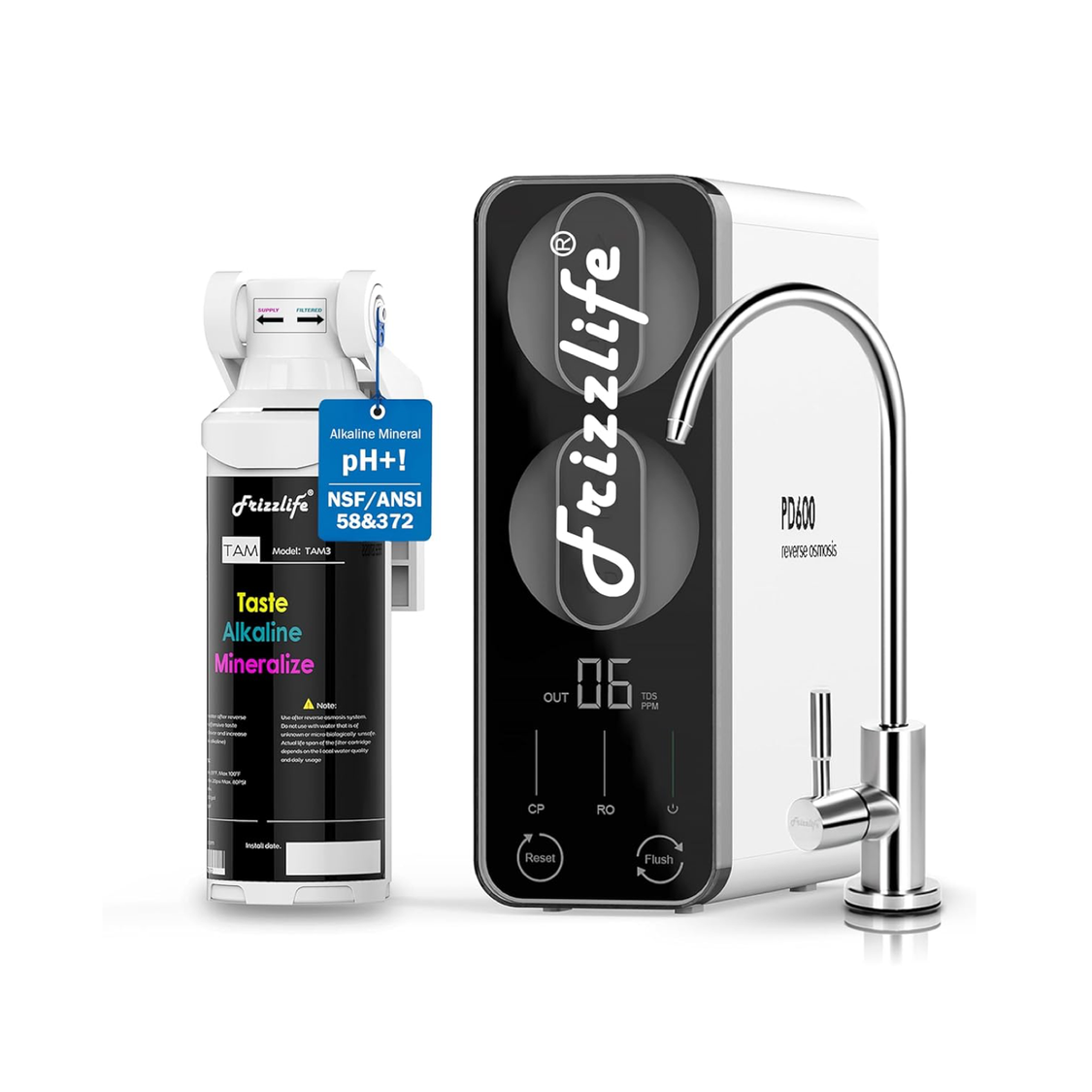 Everyday under-sink RO
Frizzlife PD600-TAM3
A 600 GPD tankless RO system with alkaline remineralization and a TDS display, designed for daily drinking and cooking water.
Explore PD600-TAM3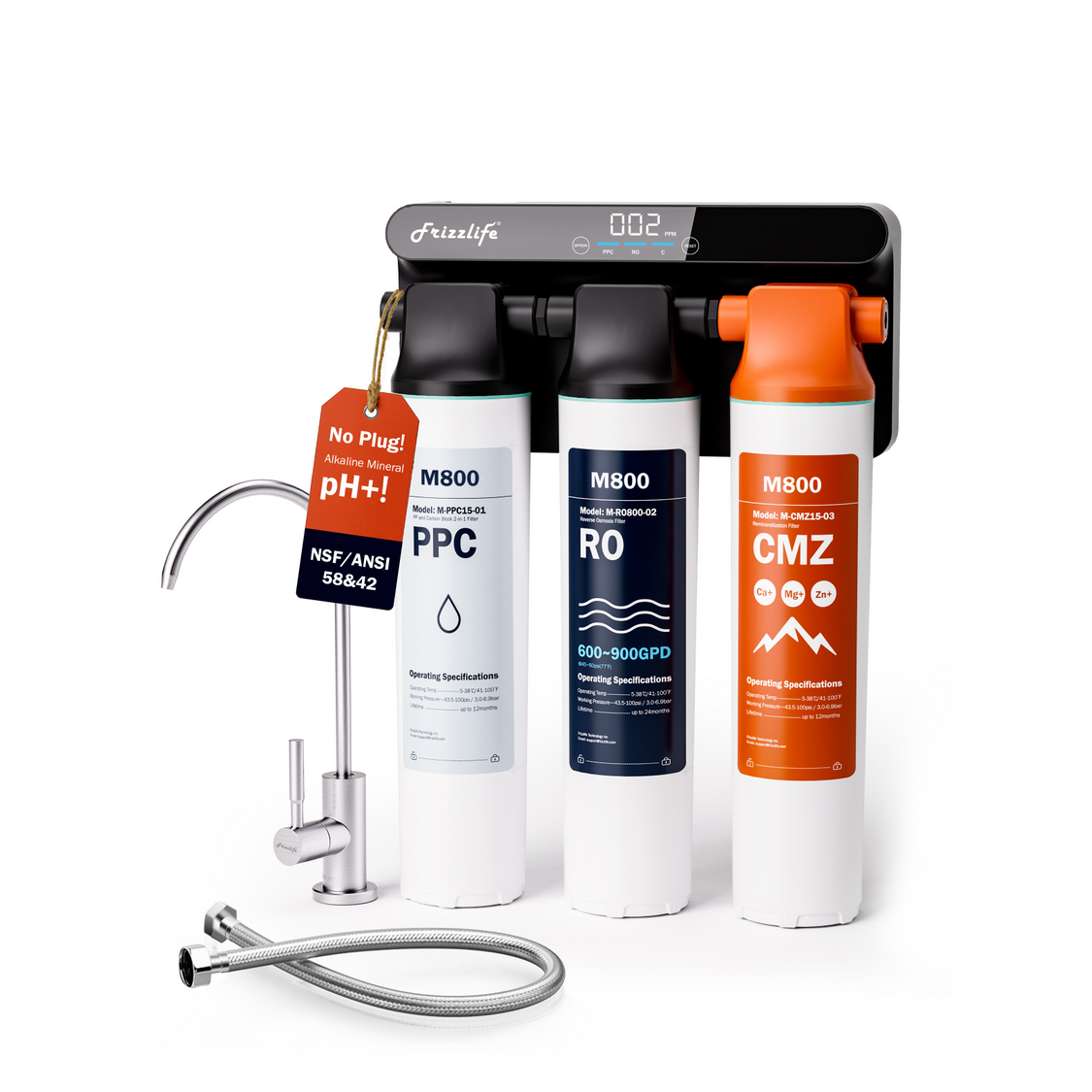 Higher-output under-sink RO
Frizzlife M800
A non-electric tankless RO option with up to 900 GPD rated output and remineralization for kitchens that prioritize higher water flow.
Explore M800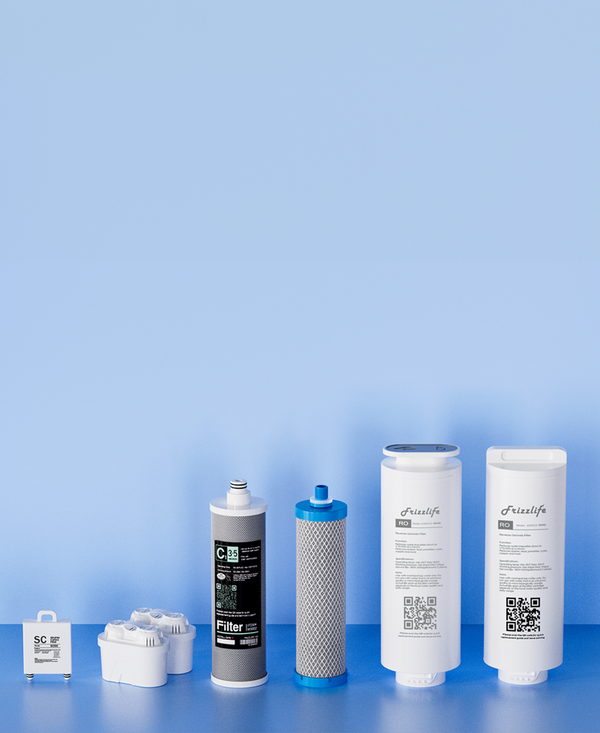 Ongoing filter maintenance
Replacement Filters
Already own a Frizzlife system? Find compatible replacement cartridges and check the recommended maintenance schedule for your model.
Find Replacement FiltersCheck each system's installation requirements and documented reduction claims before buying. RO filtration is not a substitute for whole-house water softening when hardness and scale are the main concerns.
Choose Whole-House Treatment When Chlorine, Sediment, or Scale Affects Multiple Fixtures
A point-of-entry system treats water before it branches to household fixtures. It may be appropriate when:
- Disinfectant taste or odor is noticeable throughout the home.
- Sediment repeatedly appears at several fixtures.
- Measured hardness is causing scale across the plumbing system.
- The household wants treatment for shower, bath, or laundry water.
The treatment must still match the problem. Whole-house carbon and sediment filtration do not automatically soften water, while a softener does not replace carbon or contaminant-specific filtration.
Whole-house systems also require suitable installation space, drainage where applicable, adequate service flow, and a maintenance plan. Outdoor irrigation lines may need to remain untreated depending on the system and property layout.
Pair Softening With Point-of-Use Filtration When Concerns Overlap
For homes with significant hardness and separate drinking-water concerns, pairing systems can be more precise than expecting one unit to do everything.
A typical treatment sequence may include:
- Sediment pretreatment if testing or inspection shows a particulate problem
- Whole-house softening for measured hardness
- Under-sink carbon or RO filtration for drinking and cooking
The correct order and compatibility depend on the equipment. Follow model-specific instructions and consult a qualified installer when combining treatment technologies.
Consider Countertop or Nonpermanent Filtration When Renting or Working With Limited Cabinet Space
Countertop and faucet-connected systems can be practical when drilling, permanent drain connections, or whole-house modifications are not allowed. Their limitations may include reduced counter space, faucet compatibility, lower capacity, or slower dispensing.
Before choosing one, decide whether the goal is only taste improvement or reduction of a particular contaminant. Portability does not determine performance; certification and model-specific evidence do.
Check Cabinet Dimensions, Plumbing Access, Water Pressure, and Faucet Requirements Before Buying
Measure and inspect before ordering:
- Cabinet width, height, and depth
- Space occupied by the drain, garbage disposal, and stored items
- Cold-water shutoff valve condition
- Electrical outlet availability if the system requires power
- Drain access for RO
- Space for a storage tank, if used
- Faucet-hole availability
- Incoming water pressure and any model-specific limits
- Ease of reaching cartridges for future replacement
A system that technically fits but cannot be serviced easily often becomes difficult to maintain. Leave enough room to remove housings or cartridges without dismantling the cabinet.
What Should I Test in My Los Angeles Tap Water Before Choosing a Filter?
Testing prevents two common mistakes: buying an overly complex system for a taste problem and buying a simple aesthetic filter for a contaminant it is not verified to reduce.
Start With the Current Report From LADWP or Your Local Water District
Find the consumer confidence report for the utility named on the water bill. Review:
- Source-water information
- Disinfectant used
- Reported hardness or mineral information, if included
- Detected regulated contaminants
- Any violations or official notices
- PFAS monitoring results
- Contact details for neighborhood-specific questions
Residents in Los Angeles County are not necessarily served by LADWP. Use the report from the actual serving district.
Test Tap-Specific Lead When the Building Has Older Plumbing or Fixtures
Lead is a premise-plumbing issue in many situations, so testing should occur at the faucet used for drinking. Consider testing when:
- The building or plumbing is older.
- Fixtures or solder have an uncertain history.
- Water has a metallic taste, although taste cannot confirm lead.
- Plumbing work has disturbed existing lines.
- The household includes people for whom minimizing lead exposure is particularly important.
Use a certified laboratory and follow its sampling instructions. An inaccurate collection method can make the result difficult to interpret.
Check Hardness and TDS When Scale or Mineral Taste Is the Main Complaint
A hardness test helps determine whether scale control is warranted. TDS testing can provide a general measure of dissolved ionic content, but it cannot identify individual contaminants.
Use these tests for different purposes:
- Hardness test: selecting or sizing scale-control treatment
- TDS meter: tracking broad dissolved-solids changes
- Laboratory panel: identifying specific substances and concentrations
Do not buy an RO system solely because a TDS number seems high without understanding what contributes to that number.
Use Certified Laboratory Testing for PFAS, Arsenic, Chromium, or Other Specific Concerns
Specialized contaminants require appropriate collection containers, analytical methods, and detection limits. Home strips and standard TDS meters cannot verify PFAS, arsenic, chromium-6, or lead.
Before ordering a test, confirm that the laboratory panel includes the exact substances of concern. “Metals test” or “PFAS test” can refer to different analyte lists.
Test Both First-Draw and Flushed Water When Investigating Premise-Plumbing Problems
A first-draw sample represents water that has been sitting in the plumbing. A flushed sample can help distinguish between contributions from household plumbing and water entering the property.
Follow laboratory or public-health instructions because sampling protocols differ by investigation. Do not improvise the flushing time or collection sequence if the results may guide a health-related decision.

Match the Test Result to a Treatment Technology Instead of Buying by Stage Count
A six-stage system is not automatically more effective than a two-stage system. What matters is whether the complete model has evidence supporting reduction of the substance at the measured concentration and under specified operating conditions.
Use this sequence:
- Identify the concern through a report, observation, or test.
- Determine whether it is an aesthetic issue, hardness problem, or specific contaminant.
- Select an appropriate technology category.
- Verify the exact model’s claims and certification.
- Confirm installation and maintenance requirements.
- Retest when appropriate to confirm treatment performance.
Which Certifications Should a Water Filter for Los Angeles Have?
Certification is not a universal seal stating that a filter removes everything. Standards cover specific categories, and certification listings identify the exact claims evaluated for a model.
NSF/ANSI 42 for Verified Aesthetic Claims
NSF/ANSI 42 commonly covers aesthetic effects such as chlorine reduction, taste, odor, and particulate claims. It is a logical starting point when the primary complaint is unpleasant-tasting water.
A Standard 42 certification does not automatically verify lead, arsenic, PFAS, or other health-related reduction claims.
NSF/ANSI 53 for Specific Health-Related Contaminant Claims
NSF/ANSI 53 addresses health-effect reduction claims, but a filter certified under the standard is not necessarily certified for every contaminant covered by it. Check the listing for the exact claim, such as lead reduction where relevant.
NSF/ANSI 58 for Verified Reverse-Osmosis System Performance Claims
NSF/ANSI 58 applies to point-of-use reverse-osmosis systems and can include material safety, structural integrity, TDS reduction, efficiency, recovery, and contaminant-reduction claims. The exact scope varies by model.
A system’s listing—not the general fact that it uses RO—shows which claims were evaluated.
How to Distinguish Certified, Tested To, and Manufacturer-Claimed Performance
These phrases are not interchangeable:
- Certified: An independent certification organization has evaluated the listed model for defined requirements and claims.
- Tested to: Testing may have used part or all of a standard, but the statement does not necessarily mean the product holds certification.
- Certified components: Individual materials or parts may be certified without the complete system carrying the same claims.
- Manufacturer claim: The manufacturer states a capability, which should be supported by accessible documentation.
How to Verify the Exact Contaminant Claim
Before buying:
- Find the exact model number.
- Locate the certification body’s official listing, if certification is claimed.
- Confirm that the complete system—not only a component—is listed.
- Find the named contaminant and reduction claim.
- Review operating conditions and capacity.
- Compare the listing with the current product configuration.
Certification applies to specific models and claims, not to an entire brand or every filter in a product category.
Maintenance and Troubleshooting for a Water Filter for LA Tap Water
Even an appropriately selected system can perform poorly when cartridges are overdue, scale affects the equipment, or installation conditions fall outside specifications.

Set Replacement Timing by Instructions, Water Use, and Local Conditions
Follow the manufacturer’s schedule and capacity limits. Actual service demand can vary with:
- Household water consumption
- Sediment loading
- Disinfectant concentration
- Hardness
- Feed-water quality
- Long periods of nonuse
Do not extend cartridge use simply because the water still looks clear. Many dissolved substances are invisible.
Diagnose Declining Flow Before Assuming the Water Supply Has Changed
Low flow can result from:
- A loaded sediment or carbon cartridge
- A partially closed shutoff valve
- Kinked tubing
- Low household pressure
- A clogged faucet aerator
- Incorrect cartridge installation
- RO tank or membrane issues
- Hardness scale
Compare current operation with the system instructions before replacing unrelated parts.
Check for Hardness Scale When an RO System Loses Efficiency or Flow
Hard water can contribute to membrane scaling and reduced performance. If an RO system shows declining production or an unusual TDS trend, review pretreatment, pressure, membrane condition, and maintenance history.
Do not use household chemicals to clean the membrane unless the manufacturer specifically authorizes that procedure.
Replace Overdue Cartridges When Chlorine Taste or Odor Returns
The return of disinfectant taste often signals exhausted carbon media, increased demand, channeling, or an installation issue. Replace the cartridge according to instructions and check that it is seated correctly.
If the problem persists after maintenance, confirm whether the utility changed disinfectants or source blends and whether the filter is designed for the disinfectant being used.
Sanitize Applicable Housings and Components According to Instructions
Reusable housings, storage tanks, tubing, and faucets may require periodic sanitation. Use only approved procedures and materials. Improvised concentrations or incompatible cleaners can damage components or leave residues.
Sanitation is particularly important after extended nonuse, certain repairs, or filter changes when the system instructions require it.
Compare Lifetime Cartridge, Membrane, Installation, and Water-Use Costs
Purchase price is only one part of ownership. Compare:
- Replacement cartridge availability
- Number of consumable components
- Membrane requirements
- Professional installation needs
- Water use associated with RO
- Softener salt and discharge considerations
- Ease of servicing the system
- Potential need for follow-up laboratory testing
The best water filter for Los Angeles is ultimately the system that addresses verified household concerns, fits the property, and can be maintained correctly. Start with a carbon under-sink filter for straightforward taste and disinfectant concerns, consider RO for broader dissolved-contaminant treatment, and use softening when measured hardness—not drinking-water contamination—is the real problem.
References
- Los Angeles Department of Water and Power, Water Quality FAQs: https://www.ladwp.com/who-we-are/water-system/water-quality/water-quality-faqs
- Los Angeles Department of Water and Power, Drinking Water Quality Report: https://www.ladwp.com/sites/default/files/2026-07/2026_DWQR_Print_Rev2_Digital-remediated.pdf
- Los Angeles Department of Water and Power, “2025 Water Quality Report Now Available”: https://www.ladwp.com/newsletters/articles/2025-water-quality-report-now-available