


A typical reverse osmosis filter replacement schedule calls for sediment and carbon pre-filters every 6–12 months, a post-carbon or polishing filter around every 12 months, and the RO membrane according to a model-specific multi-year or gallon-based interval. Depending on the system, membrane guidance may range from 1–2 years to 3–5 years or may be based on total water production.
These ranges are starting points, not universal deadlines. Feed-water quality, household consumption, sediment, chlorine exposure, hardness, system pressure, and maintenance history can all affect reverse osmosis filter change frequency. The correct schedule for your system is always the one in its owner’s manual.
More importantly, an RO system does not contain just one filter. Each stage performs a different job and may need attention at a different time. Understanding those stages helps you avoid replacing a costly membrane too early—or leaving an exhausted pre-filter in service too long.
RO System Maintenance: What Filters Need Replacement
Most residential reverse osmosis systems include some combination of the following components:
- A sediment pre-filter
- One or more carbon pre-filters
- An RO membrane
- A post-carbon or polishing filter
- Optional remineralization, alkaline, or specialty filters
Tankless systems may package these functions differently or combine multiple filtration stages into a single cartridge. Stage names, cartridge arrangements, and service intervals vary by model, so identify your system before ordering or installing replacement parts.

Typical RO Filter Replacement Schedule at a Glance
Use this table as a general planning guide. If your manual gives a different time or gallon rating, follow the manual.
|
RO filter or component |
Typical replacement interval |
Replace sooner when |
Main maintenance purpose
|
|---|---|---|---|
|
Sediment pre-filter |
Every 6–12 months |
Flow falls, sediment loads are high, or the filter begins to plug |
Captures particles and protects downstream stages |
|
Carbon pre-filter |
Every 6–12 months |
Chlorine-related taste returns, usage is heavy, or the rated capacity is reached |
Reduces chlorine exposure and helps protect the membrane |
|
Post-carbon or polishing filter |
Often around 12 months |
Taste or odor changes, or the model’s gallon limit is reached |
Provides final taste and odor polishing |
|
RO membrane |
Model-specific; often multi-year or gallon-based |
Product-water TDS rises meaningfully, rejection performance declines, or output remains poor after other causes are checked |
Separates many dissolved substances from product water |
|
Remineralization or specialty filter |
Model-specific |
Taste changes, rated capacity is reached, or the manual directs replacement |
Performs a model-specific finishing function |
|
Integrated tankless cartridge |
Model-specific |
The indicator activates, rated gallons are reached, or system performance declines |
May combine several filtration functions |
Do not assume every cartridge must be replaced together. A system may need new pre-filters several times during the usable life of its membrane.
Sediment Pre-Filters: Typically Every 6–12 Months
The sediment filter is generally the first treatment stage. It captures suspended particles that could clog carbon filters, restrict water flow, or foul the membrane.
For many residential systems, a 6–12-month schedule is typical. Shorten that interval when the feed water carries substantial sediment or turbidity. This may be more likely with certain well-water supplies, older plumbing, recent water-main work, or visible particulate in the incoming water.
A sediment cartridge can become restrictive before the expected date. Possible signs include:
- Lower flow at the RO faucet
- Slower storage-tank refill
- A noticeable pressure drop through the system
- Heavy sediment discoloration
- A filter that reaches its model-specific capacity early
Visible discoloration can support a replacement decision, but appearance is not a complete measure of remaining performance. A cartridge may look relatively clean while still becoming restrictive internally.
Carbon Pre-Filters: Typically Every 6–12 Months
Carbon pre-filters commonly follow the sediment stage. Their role may include reducing chlorine and addressing taste- or odor-causing substances before water reaches the membrane.
Chlorine protection is particularly important because many common residential RO membranes depend on effective pretreatment. If a carbon pre-filter remains in service beyond its useful capacity, chlorine breakthrough may expose the membrane and shorten its service life.
A typical carbon pre-filter range is also 6–12 months, but the actual interval depends on factors such as:
- The chlorine level in the feed water
- Total water use
- Cartridge capacity and design
- The number of carbon stages
- Sediment loading ahead of the carbon filter
- The schedule specified for the system
Do not wait for an obvious chlorine taste before taking action. Taste perception varies, and carbon capacity can decline without producing an immediate, unmistakable flavor change.
Post-Carbon or Polishing Filters: Often Around 12 Months
The final carbon stage is commonly called a post-filter, polishing filter, final carbon filter, or post-carbon filter. It treats water near the point of dispensing and is intended primarily to improve final taste and odor.
Many systems use an interval around 12 months for this stage. However, some use a different time or gallon limit, so confirm the requirement for your model.
A post-filter deserves attention when the water develops an unusual taste or odor but the product-water TDS remains close to its established baseline. In that situation, the membrane may still be functioning normally while the final polishing stage needs service.
When replacing this stage, confirm the filter’s connection type, flow direction, stage position, and model compatibility. Frizzlife owners can review available RO post-filter replacements, but the system model and manual should determine the correct part.
How to Know When the RO Membrane Needs Replacement
The membrane usually lasts longer than the pre-filters, but there is no single interval that applies to every residential RO system. Manufacturer schedules may specify 1–2 years, 2–3 years, 3–5 years, or a defined gallon capacity.
That variation is expected. Membrane life is affected by:
- Feed-water quality
- Hardness and scaling potential
- Dissolved-solids load
- Chlorine protection
- Water pressure
- Daily production
- Timeliness of pre-filter replacement
- The membrane and system design
Use the manual’s interval as the primary RO membrane replacement schedule, then monitor performance over time. A meaningful, sustained increase in product-water TDS relative to the system’s normal baseline can indicate declining membrane performance. Slow production may also be relevant, but it should not be treated as proof of membrane failure by itself.
Before replacing a membrane because of low flow, check the pre-filters, feed pressure, valves, tubing, storage tank, and recent water use. A clogged pre-filter or underperforming pressure tank can resemble a membrane problem.
Which RO Filters Need to Be Replaced Most Often?
In a conventional multi-stage RO system, the sediment and carbon pre-filters usually need replacement more often than the membrane. These filters receive untreated feed water first and absorb much of the particulate and chlorine load.
The usual service order is:
- Pre-filters: Replaced most frequently, commonly every 6–12 months.
- Post-filter: Often replaced around once a year.
- RO membrane: Evaluated on a longer, model-specific time or gallon schedule.
- Specialty stages: Replaced according to their own instructions.
This is why “change all filters every year” is not a reliable universal rule. It may work for selected filter sets, but it can also lead to replacing the membrane too soon or overlooking a specialty stage with a different schedule.
Why Timely Pre-Filter Changes Help Protect the RO Membrane
Pre-filter maintenance has a direct effect on the membrane’s working conditions.
A loaded sediment filter can restrict feed flow and reduce the pressure available to the membrane. An exhausted carbon pre-filter may allow chlorine to reach a membrane that relies on carbon pretreatment. Hardness and other dissolved material can also contribute to scaling or fouling.
Replacing pre-filters on time does not guarantee a particular membrane lifespan. It does, however, help prevent avoidable stress and allows the system to operate closer to its intended conditions.
If pre-filter maintenance has been neglected, do not automatically replace the membrane at the same time. Install the correct pre-filters, flush the system as directed, and reassess flow and TDS. Replace the membrane if performance remains outside its normal range or the model’s replacement limit has been reached.
Additional Remineralization, Specialty, and Tankless RO Filters
Extra treatment stages require their own schedules. Examples may include remineralization cartridges or other finishing filters. Their useful life cannot be inferred from the sediment, carbon, or membrane interval.
Tankless RO systems also require model-specific planning. They may use integrated cartridges rather than separate standard housings, and different cartridges within one system may still have different capacities. Some systems provide filter-life indicators, but an indicator does not eliminate the need to watch for unusual flow, taste, leakage, or TDS trends.
If you are comparing maintenance requirements before selecting a system, review the replacement arrangement and manual for the specific model in the Frizzlife reverse osmosis system collection. Do not apply the schedule from one model to another simply because both are tankless or use the same number of stages.
Time-Based Versus Gallon-Based Replacement Intervals
A time-based schedule tells you to replace a filter after a specified number of months. It is convenient for routine planning and helps prevent a cartridge from remaining installed indefinitely.
A gallon-based schedule reflects actual water use more directly. This can be useful in high-use households, but only if the system tracks production accurately or the owner maintains a reliable usage estimate.
When a manual provides both a time and gallon limit, follow its instructions for whichever limit applies first. A filter is not necessarily suitable for indefinite service just because the household has used fewer gallons than expected. Age, water conditions, and hygiene considerations still matter.
Common RO System Maintenance Mistakes
A good RO filter replacement schedule can fail if it is based only on taste, visual inspection, or one symptom. Avoid the following mistakes when deciding when to change RO filters.
Waiting for Bad Taste Before Changing RO Filters
Taste changes can indicate a post-filter or carbon-stage issue, but taste should not be the only replacement trigger. Sediment loading, declining carbon capacity, and membrane performance changes may develop before the water tastes noticeably different.
Use the calendar or gallon rating as the foundation. Treat taste as an additional condition-based warning—not permission to keep using an overdue filter until the water becomes unpleasant.
Assuming Every RO Stage Should Be Replaced at the Same Time
RO stages have different jobs and capacities. Pre-filters may be due while the membrane is still functioning well. Conversely, a membrane can eventually require replacement even though a recently installed post-filter is still within its service interval.
Label each stage separately in your maintenance log. If the system uses a replacement kit, verify exactly which cartridges the kit contains and whether the membrane is included.
Judging Filter Condition by Appearance Alone
Sediment filters often darken as they capture particles, but visual condition is not a reliable measurement for all filters. Carbon capacity and membrane separation performance cannot be evaluated simply by looking at the cartridge.
A filter that looks clean may still have:
- Reached its time or gallon limit
- Become restrictive internally
- Lost effective carbon capacity
- Developed performance problems that require flow or TDS monitoring
Use appearance as one observation among several—not the final decision rule.
Using a Replacement Filter Without Confirming Model and Stage Compatibility
Cartridges that appear similar may differ in dimensions, fittings, stage function, capacity, or flow direction. Confirm:
- System model
- Cartridge or filter code
- Stage position
- Connection style
- Flow-direction markings
- Time or gallon rating
- Required flushing instructions
The Frizzlife replacement filter collection can help owners locate available parts, but the model label and manual should be used to confirm compatibility before purchase or installation.
Keep Your RO System Running Smoothly
Whether you're replacing an existing filter or exploring a different reverse osmosis setup, choosing the right components and understanding each system's maintenance requirements can help you plan with confidence.
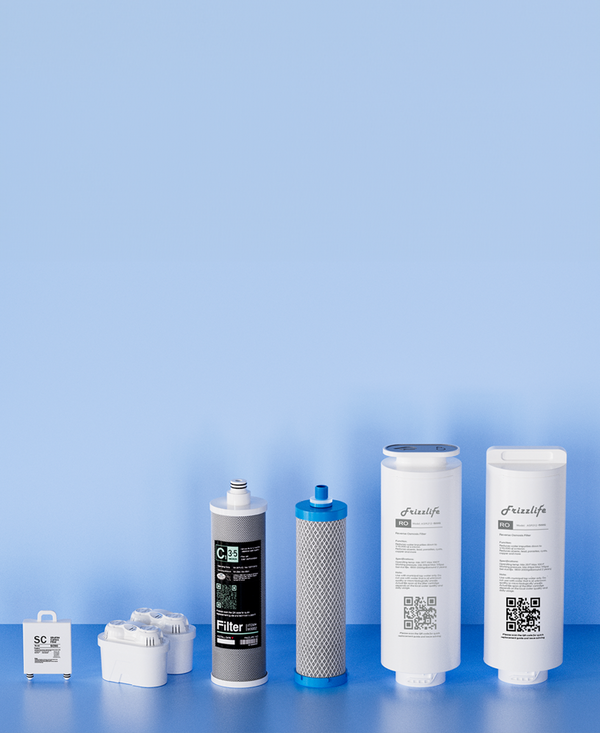
Frizzlife Replacement Filters
Find replacement cartridges for your Frizzlife filtration system. Check the model number, filter stage, and compatibility information before selecting the correct replacement.
Find Replacement Filters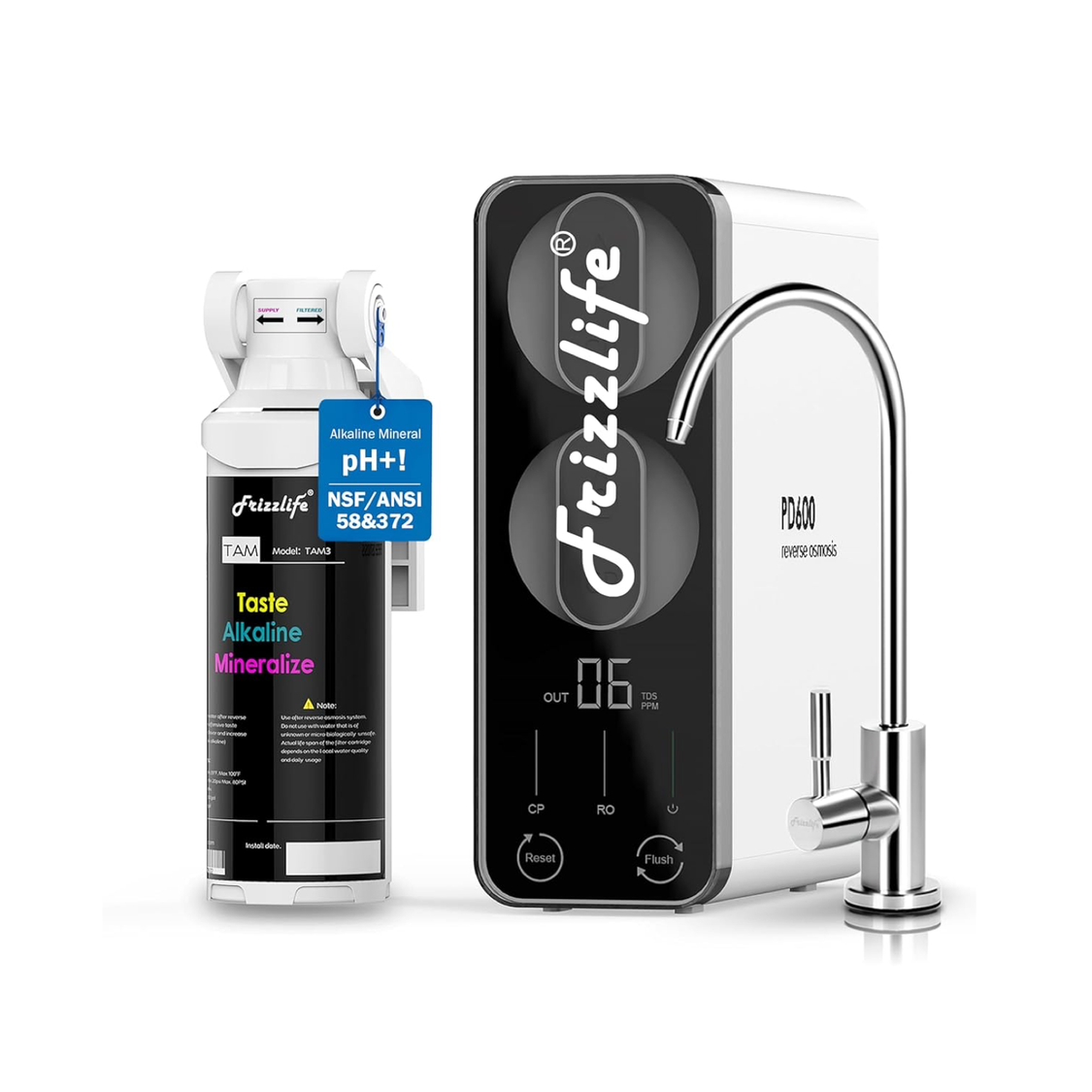
Frizzlife PD600-TAM3
A tankless reverse osmosis system with alkaline remineralization, quick-change filter cartridges, and a display that helps track filter status and routine maintenance needs.
Explore PD600-TAM3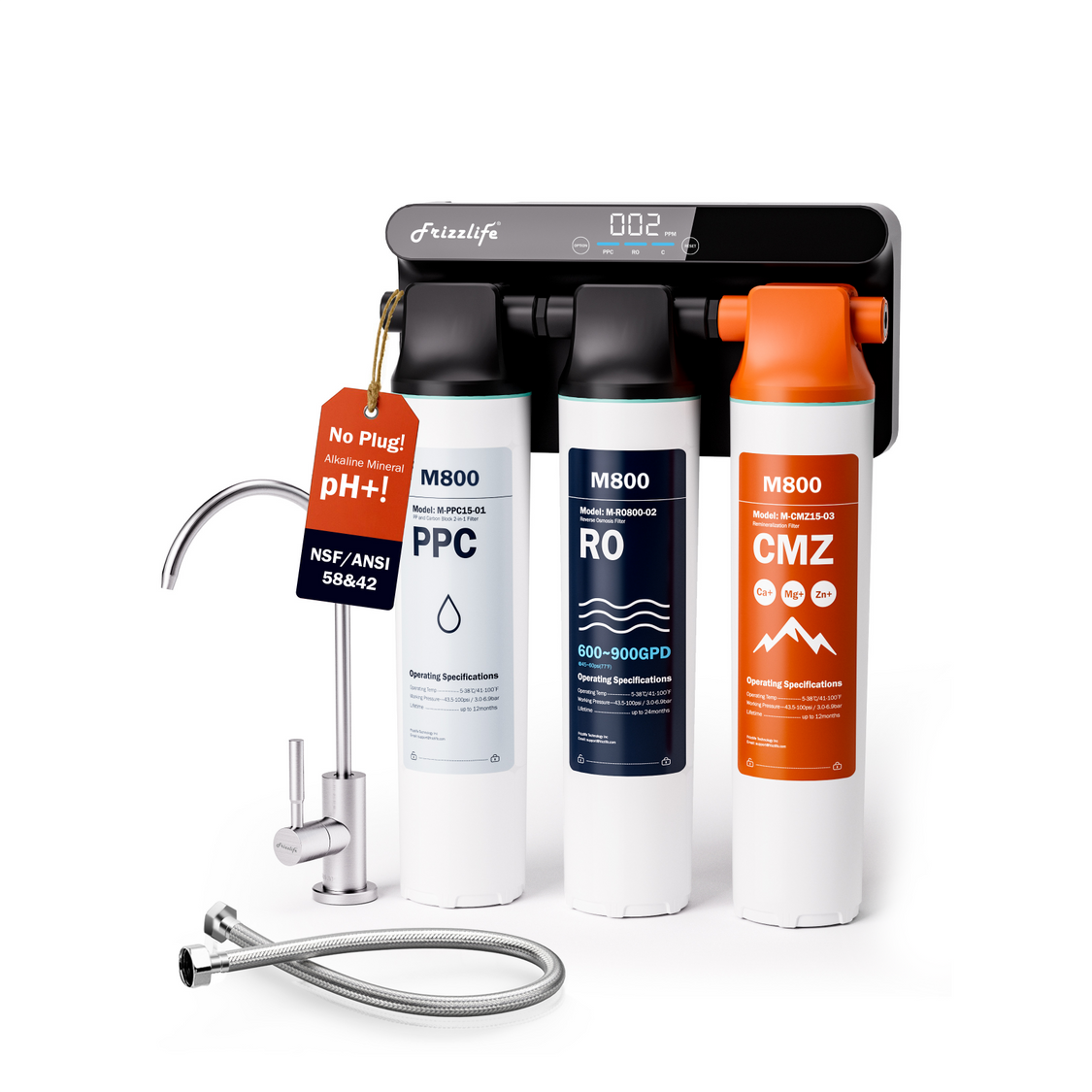
Frizzlife M800 RO System
Explore a non-electric tankless reverse osmosis design with multi-stage filtration. Compare its cartridge arrangement and maintenance requirements when considering an RO system upgrade.
Explore M800Maintenance reminder: Filter replacement intervals, cartridge compatibility, and flushing requirements vary by system and model. Always consult the manufacturer's instructions before ordering or replacing RO filters.
Should New RO Filters Be Flushed After Installation?
Yes—new RO filters generally need to be flushed according to the system’s instructions before the water is used for drinking. Flushing can clear carbon fines, trapped air, or manufacturing residue and condition the replacement stages for normal service.
The required process varies by model and filter type. It may involve discarding one or more batches of water or running the faucet for a specified period. Do not invent a universal flushing duration or assume all stages use the same procedure.
During flushing, temporary cloudiness may be caused by trapped air. Dark particles can sometimes be associated with carbon fines. Continue only according to the manual, and contact support if discoloration, odor, leakage, or other abnormal conditions persist after the required flush.
Skipping Housing Hygiene, O-Ring Checks, and Post-Service Leak Inspection
Filter service involves more than swapping cartridges. For systems with reusable housings:
- Shut off the feed water.
- Relieve system pressure before opening a housing.
- Keep replacement components and contact surfaces clean.
- Inspect O-rings for damage, twisting, or improper seating.
- Clean or sanitize components only as instructed by the manufacturer.
- Reassemble housings without cross-threading or overtightening.
- Restore water slowly and inspect every serviced connection.
Check again after the system has refilled and operated. A connection that appears dry initially may begin dripping once full pressure is restored.
Factors That Affect Your Reverse Osmosis Filter Replacement Schedule
Two identical systems can require different maintenance because their incoming water and usage patterns are different. These factors explain why generic replacement intervals are given as ranges.
Feed-Water Sediment and Turbidity
High sediment loads shorten the life of the first-stage filter and may reduce flow through downstream components. Water can carry more particulate after plumbing work, seasonal well changes, or disturbances in a municipal distribution system.
If a sediment cartridge repeatedly plugs well before six months, simply replacing it more often may not address the underlying issue. The feed-water condition, plumbing, and any needed pretreatment should also be evaluated.
Chlorine Exposure and Carbon Pre-Filter Condition
Carbon pre-filters have finite capacity. Higher chlorine exposure or greater water use can exhaust them sooner.
Maintaining the carbon stage is especially important when it protects a chlorine-sensitive membrane. Follow the specified interval even if the water still tastes normal. If chlorine breakthrough is suspected, consult the system instructions or a qualified water-treatment professional rather than relying on taste alone.
Hardness, Scaling Potential, and Overall Dissolved-Solids Load
Hardness and other dissolved constituents can increase scaling or fouling pressure on an RO membrane. Higher feed-water TDS also gives the membrane a larger dissolved-solids load to separate.
A TDS reading does not identify individual substances and is not, by itself, a complete water-safety test. It is most useful here as a trend-monitoring tool for comparing feed water with RO product water over time.
If the feed supply has severe hardness, iron, or other challenging conditions, appropriate pretreatment and professional water testing may be needed. Do not assume that replacing filters more frequently will correct every feed-water problem.
Household Size and Daily Water Consumption
A larger household typically sends more water through the filters than a smaller household using the same system. Cooking, beverage preparation, ice production, and connection to additional fixtures can all increase demand.
Under heavy use, gallon-based limits may arrive before the calendar date. Under light use, a cartridge may remain below its gallon capacity, but that does not automatically make unlimited time extensions appropriate.
Municipal Water Versus Well Water Conditions
Municipal supplies often contain disinfectant residuals that place demand on carbon pre-filters. Well water may have no chlorine residual but can present higher sediment, hardness, iron, or seasonal variability.
Neither source type guarantees a longer filter life. The relevant question is what is actually in the feed water and how that condition affects the system. Well-water users should be especially alert to sudden changes in turbidity, odor, color, or flow and should address source-water problems rather than expecting the RO unit to handle every condition without pretreatment.
Water Pressure, Installation Condition, and System Type
RO performance depends partly on adequate feed conditions and an unrestricted installation. Low pressure can reduce water production and may be mistaken for a clogged filter or failing membrane. Partially closed valves, pinched tubing, incorrect connections, and storage-tank problems can create similar symptoms.
System type also matters. A conventional tank-based unit stores product water, so faucet flow depends partly on tank performance. A tankless system produces water differently and may use integrated filter-life monitoring. Troubleshooting should match the design.
Does Low Water Use Extend RO Filter Life?
Low use may delay a gallon-based capacity limit, but it does not necessarily extend every filter’s time-based service interval. Filters still remain wet and installed, while carbon media, seals, housings, and water pathways continue to age.
For a lightly used or seasonally occupied home:
- Follow the maximum time limit in the manual.
- Use shutdown and restart procedures specified for the system.
- Flush as instructed after an extended period without use.
- Do not assume normal taste proves every stage remains effective.
- Inspect for leakage and unusual odor when service resumes.
When to Shorten the Standard RO Filter Replacement Schedule
Consider earlier inspection or replacement when:
- Sediment filters repeatedly become loaded before the planned date.
- Faucet flow or tank refill slows significantly.
- Household water consumption increases.
- Feed-water turbidity, hardness, or dissolved-solids load rises.
- A municipal water event or plumbing project changes water appearance.
- Taste or odor returns unexpectedly.
- Product-water TDS rises meaningfully above its established baseline.
- The system reaches its rated gallon limit early.
- The manual specifies a shorter interval for the water conditions.
Do not shorten every stage automatically. Identify which component is affected and verify whether another system issue is responsible.
Reverse Osmosis Water Filter Care Over Time
The most dependable maintenance plan combines the manufacturer’s schedule with flow, taste, TDS trends, water conditions, and service records.
How to Compare Feed-Water and RO-Water TDS Trends
To monitor membrane performance, record both feed-water and RO-water TDS. Comparing the two is more useful than judging the product-water number in isolation because feed-water TDS can vary.
A simple rejection calculation is:
Rejection rate (%) = [(feed-water TDS − RO-water TDS) ÷ feed-water TDS] × 100
Use the calculation as a trend, not as a universal pass-or-fail threshold. The expected range depends on the membrane, system design, pressure, temperature, and feed-water conditions.
For more consistent comparisons:
- Test after the system has operated normally.
- Use the same meter and sampling method.
- Record both readings at the same maintenance check.
- Look for a repeated pattern rather than one unusual result.
- Compare current readings with the system’s original or established baseline.
A TDS meter cannot identify specific contaminants or confirm that water is microbiologically safe. If there is a specific water-quality concern, use appropriate testing rather than relying on TDS alone.

Troubleshooting Low Flow: Filter, Membrane, Tank, or Pressure?
Use the symptom pattern to narrow down the cause:
|
Observation |
Possible cause |
What to check first
|
|---|---|---|
|
Flow declined gradually and pre-filters are overdue |
Loaded sediment or carbon filter |
Replace the due pre-filters and reassess |
|
Flow is low immediately after service |
Closed valve, trapped air, incorrect installation, or tubing restriction |
Review installation and flushing steps |
|
Faucet starts strong, then quickly weakens |
Storage-tank pressure or fill issue |
Check tank behavior and follow the manual |
|
Tank refills unusually slowly |
Pre-filter restriction, low feed pressure, or membrane issue |
Check pre-filters and feed conditions before the membrane |
|
Flow remains low with new pre-filters |
Pressure, tank, valve, tubing, or membrane problem |
Continue system-specific troubleshooting |
|
Tankless flow falls and an indicator is active |
Cartridge capacity or system fault |
Follow the model’s indicator and diagnostic instructions |
Avoid diagnosing the membrane from faucet flow alone. Flow is a system-level result, not a membrane-only measurement.
Troubleshooting Taste or Odor Changes: Pre-Filter, Post-Filter, or Other Cause?
Taste and odor changes are often associated with carbon stages, but the timing helps narrow the cause.
- Water tastes normal at first but develops an off taste after storage: Check the tank, lines, sanitation history, and final post-filter.
- Chlorine-like taste appears: Review the carbon pre-filter schedule and feed-water conditions.
- Taste changes while TDS remains stable: The post-filter or another finishing stage may be due.
- Taste changes immediately after installing a filter: Confirm compatibility, flow direction, and flushing.
- Odor persists after correct filter replacement and flushing: Stop using the system until the source is identified according to the manual or by a qualified professional.
Do not use taste as a substitute for water testing when there is a specific safety concern.
What to Do When Taste Is Normal but TDS Is Rising
Normal taste does not prove that the membrane is maintaining its previous separation performance. If product-water TDS is increasing:
- Retest both feed and product water.
- Compare the results with earlier records.
- Confirm that the system has returned to normal operation after any filter change or shutdown.
- Check feed pressure and pre-filter condition.
- Review the membrane’s age and gallon history.
- Evaluate membrane replacement if the rise is sustained and other causes have been addressed.
A small one-time change may reflect feed-water variation. A repeated upward trend is more useful for a replacement decision.
Create a Maintenance Log With Dates, Usage, TDS, and Observed Changes
A basic log removes guesswork from an RO filter replacement schedule. Record:
- System model
- Filter names or part numbers
- Installation and replacement dates
- Rated time or gallon limits
- Approximate household use
- Feed-water TDS
- Product-water TDS
- Taste, odor, or flow changes
- Leaks or service observations
- Flushing and sanitization dates
Write the installation date on the cartridge label or nearby service tag when appropriate. For multi-stage systems, list every stage separately.
Set Calendar Reminders and Keep the Correct Replacement Parts Available
Set one reminder before the expected replacement date and another on the due date. An annual maintenance review can cover pre-filters, the post-filter, O-rings, connections, flow, and TDS even when not every component needs replacement.
Keeping the correct parts available can prevent an overdue cartridge from remaining in service while you wait for a replacement. Confirm compatibility before storing spares, and protect them according to the packaging instructions.
Follow the Model Manual for Filter Changes, Flushing, and Sanitization
Generic maintenance guidance cannot replace model-specific instructions. Before opening the system:
- Identify each filtration stage.
- Confirm the replacement part.
- Review shutdown and pressure-relief steps.
- Follow the required installation orientation.
- Use the specified flushing procedure.
- Follow only approved cleaning or sanitization directions.
- Inspect for leaks after restoring water.
If the manual and a general online schedule disagree, use the manual. Model-specific time and gallon limits take priority.
When to Stop Troubleshooting and Contact a Qualified Service Professional
Professional assistance is appropriate when:
- A leak continues after correct reassembly.
- A housing, fitting, tube, valve, or tank appears damaged.
- TDS continues rising after routine maintenance.
- Flow remains abnormally low after basic checks.
- There is suspected contamination or an unresolved odor.
- Feed-water conditions appear outside the system’s intended use.
- The correct replacement part or service procedure cannot be confirmed.
- You are not comfortable depressurizing, opening, or sanitizing the system.
A practical RO filter replacement schedule is therefore both calendar-based and condition-based: replace sediment and carbon pre-filters commonly within 6–12 months, service the post-filter around its model-specific annual or gallon limit, and evaluate the membrane over its longer specified lifespan using TDS and performance trends. Following the manual, documenting each stage, and responding to changes early will make maintenance more predictable and help avoid unnecessary replacements.