


PFAS can occur in both bottled water and tap water, although the amount varies by source, treatment method, location, and testing sensitivity. These persistent compounds are often called “forever chemicals” because many of them break down very slowly in the environment.
Recent testing shows that bottled water should not automatically be considered PFAS-free. At the same time, a PFAS detection does not necessarily mean that the water exceeds a current drinking-water limit. The most useful approach is to review reliable test data, understand where the water comes from, and verify how it is treated.
This guide explains what recent bottled-water testing found, whether bottled water is safer than tap water, how PFAS testing works, and which treatment methods can reduce exposure. Households considering point-of-use treatment can also compare Frizzlife reverse osmosis water filter systems designed for different installation and daily water needs.
Key Findings on PFAS in Bottled Water
Recent bottled-water studies do not all report the same detection rate, but that does not necessarily mean the findings conflict. Laboratories may test for different PFAS compounds, use different detection limits, and analyze samples collected from different countries, sources, and treatment systems.
The FDA reported that 10 of 197 bottled-water samples collected during 2023–2024 had detectable PFAS. None of the detected levels would have exceeded the applicable EPA maximum contaminant levels if the samples had been public drinking water.
A separate international study of 112 bottled-water samples from 87 brands and sources in 15 countries detected PFOA and PFOS in more than 99% of the samples. The study also found that natural mineral water generally had higher PFAS concentrations than purified water, while bottle material was not a significant predictor.
The practical takeaway is not that all bottled water is unsafe or that every bottle contains the same amount of PFAS. It is that source, treatment, test sensitivity, and product-specific data matter more than broad label assumptions.
What the FDA’s 2023–2024 Bottled-Water Testing Found
The FDA collected 197 domestic and imported bottled-water samples from U.S. retail locations during 2023 and 2024 and published the final results in 2025. The samples included purified, spring, mineral, and artesian water.
Ten samples had detectable PFAS. None of the detected levels would have exceeded the EPA maximum contaminant levels that applied to the regulated PFAS if the samples had been public drinking water.
At-a-glance FDA results:
• Total samples tested: 197
• Samples with detectable PFAS: 10
• Samples without detectable PFAS: 187
• Samples exceeding applicable EPA MCLs: 0
These results are reassuring for the samples tested, but they do not prove that every bottled-water brand, source, facility, or future production batch is PFAS-free. The FDA also tested for 18 selected PFAS, not every compound within the broader PFAS family.
What Global Bottled-Water Testing Shows
A peer-reviewed international study analyzed 112 bottled-water samples representing 87 brands and water sources from 15 countries. PFOA and PFOS were detected in more than 99% of the bottled-water samples tested.
This detection rate should not be compared directly with the FDA’s 5% result without considering differences in laboratory sensitivity, PFAS panels, sample selection, and reporting thresholds. A result reported as non-detect means the concentration was below that laboratory’s reporting limit; it does not necessarily prove absolute zero.
The study also found that natural mineral water generally contained higher PFAS concentrations than purified water. However, the results do not mean every purified-water product is lower than every mineral-water product. Product-specific treatment and testing remain more useful than relying on the label alone.
Mineral vs. purified: which bottled-water type trends lower?
| Type of bottled water | Average PFAS (ng/L) | What this usually means |
| Natural mineral water | ~0.82 | Often less processing; more dependent on the natural water source |
| Purified water | ~0.47 | Often treated (commonly including reverse osmosis), which can reduce PFAS |
Is bottled water safer than tap water for PFAS?
| Water choice | Potential PFAS advantage | Main limitation | What to verify |
|---|---|---|---|
| Purified bottled water | May use RO or other treatment that reduces PFAS | Treatment and testing vary by brand and facility | Treatment method, PFAS test report, test date and reporting limits |
| Spring or mineral water | May come from a protected natural source | Depends heavily on local source-water contamination | Source location and recent PFAS results |
| Municipal tap water | Public monitoring data may be available | PFAS levels vary by system and location | Consumer confidence report and UCMR data |
| Tap water with a verified filter | Gives the household more control over treatment and maintenance | Performance depends on certification and timely replacement |
PFAS-specific reduction claim and replacement schedule |
Neither “bottled” nor “tap” automatically means safer. The better-supported choice is the one backed by current local data, transparent treatment information, and a verified PFAS reduction method when treatment is needed.
PFAS in Bottled Water & Tap Water: What You Need to Know
Why PFAS in drinking water and forever chemicals Matte?
Health Effects Associated with PFAS Exposure
Research has found associations between exposure to certain PFAS and increased cholesterol levels, lower antibody responses to some vaccines, changes in liver enzymes, pregnancy-induced hypertension or preeclampsia, and kidney or testicular cancer.
These findings do not mean that every PFAS exposure will cause a health problem. Risk depends on the specific PFAS compound, exposure level, frequency, duration, and individual health factors. A drinking-water result also cannot predict whether a particular person will develop a disease.
Most people do not experience immediate symptoms after drinking water with low PFAS concentrations. PFAS concerns generally relate to repeated or long-term exposure rather than a reaction after one glass of water.
Risk is cumulative: bottled water as one source among many
What are symptoms of PFAS exposure?
Where PFAS in Bottled Water Comes From

Source Water Contamination
Processing and Treatment Differences
Packaging & Bottling Environment
Does Reverse Osmosis Remove PFAS?
Yes, reverse osmosis can substantially reduce many PFAS in drinking water when the system is properly designed, tested, and maintained. RO forces water through a semipermeable membrane, separating many dissolved chemicals from the treated water stream.
Performance can vary by PFAS compound, membrane condition, incoming water quality, system configuration, and replacement schedule. For that reason, consumers should not assume that every product using an RO membrane has identical PFAS performance.
When comparing systems, look for an NSF/ANSI 58 certification that specifically includes a PFAS reduction claim or review product-specific third-party test data showing which compounds were tested, the incoming and treated concentrations, and the test conditions. A general NSF/ANSI 58 or NSF/ANSI 372 statement alone does not confirm every PFAS reduction claim.
Does Boiling Water Remove PFAS?
Boiling is not a reliable household treatment for PFAS. Some controlled studies have reported reductions in certain PFAS under specific water and heating conditions, but the results are not consistent enough to treat boiling as a verified PFAS solution.
Boiling does not physically separate contaminants through an approved filter medium, and evaporation can change the concentration of substances remaining in the water. Households concerned about PFAS should rely on verified treatment methods such as activated carbon, ion exchange, or reverse osmosis rather than boiling alone.
PFAS Bottled Water Guide: How to Reduce Exposure Safely
How to Interpret “Spring,” “Mineral,” “Artesian,” and “Purified” Labels for PFAS Risk
What independent tests can and can’t tell you about “PFAS-free” claims
Which bottled water brands have PFAS?
- Look for a batch-specific certificate of analysis from a certified lab, showing PFAS tested and detection limits.
- Use type-based signals: purified water with RO treatment tends to be lower on average.
- Reduce exposure by filtering your tap water when possible, which helps get rid of PFAS in water effectively.
Sortable “Bottled Water Type vs PFAS Risk Signals” Matrix
| Type on label | Likely source | Typical treatment | PFAS risk signals | What to ask for |
| Purified | Municipal or groundwater | Often RO + carbon | Better odds when treatment is documented | PFAS test panel, date, detection limits |
| Spring | Spring source | Often minimal | Depends heavily on local contamination | Spring location + PFAS test report |
| Natural mineral | Mineral source | Often minimal | Global data average higher than purified | PFAS report + how often they test |
| Artesian | Confined aquifer | Varies | “Artesian” doesn’t mean PFAS-proof | Source location + treatment details |

U.S. PFAS Drinking-Water Rules: 2024–2026 Update
In 2024, the EPA finalized the first national drinking-water regulation covering six PFAS individually or through a mixture-based Hazard Index. The rule established maximum contaminant levels for PFOA, PFOS, PFHxS, PFNA, HFPO-DA, and certain mixtures that include PFBS.
In May 2026, the EPA proposed keeping the 4 ppt limits for PFOA and PFOS while allowing qualifying public water systems additional time, potentially until 2031, to comply. The agency also proposed rescinding the separate requirements for PFHxS, PFNA, HFPO-DA, and the Hazard Index mixture.
Because the 2026 actions are proposed rules, the article should distinguish between the 2024 final regulation and changes that have been proposed but not yet finalized.
| PFAS | 2024 final MCL | Status as of July 2026 |
|---|---|---|
| PFOA | 4 ppt | EPA proposes retaining the limit |
| PFOS | 4 ppt | EPA proposes retaining the limit |
| PFHxS | 10 ppt | EPA has proposed rescinding the separate regulation |
| PFNA | 10 ppt | EPA has proposed rescinding the separate regulation |
| HFPO-DA / GenX | 10 ppt | EPA has proposed rescinding the separate regulation |
| Selected PFAS mixtures | Hazard Index of 1 | EPA has proposed rescinding the mixture requirement |
How Bottled Water Is Regulated in the U.S.
Public drinking-water systems are regulated by the EPA under the Safe Drinking Water Act, while bottled water is regulated by the FDA as a packaged food product.
When the EPA establishes a new drinking-water MCL, federal law requires the FDA to establish a corresponding bottled-water standard or determine that a separate standard is not necessary. If neither action occurs within the required period, the EPA level may become the applicable bottled-water standard.
The FDA’s 2023–2024 bottled-water testing found detectable PFAS in 10 of 197 samples, but none of the detected levels would have exceeded the applicable EPA MCLs if the samples had been public drinking water.
UCMR5 monitoring: why municipal detections still matter for bottled water
Real-World Case Studies & Exposure Hotspots
Case study: what the global bottled-water survey implies for monitoring
Case Study: FDA 2025 Retail Sampling—Method Matters
Case Study: Communities with Elevated PFAS in Water Systems
Activated Carbon vs. Reverse Osmosis vs. Ion Exchange for PFAS
Filtration effectiveness: activated carbon vs RO vs ion exchange
- Activated carbon: Can remove PFAS effectively (~81–96%) when designed and maintained properly.
- Boiling water: Often mentioned but not reliable—can reduce some PFAS (~55%) while concentrating others.
- Reverse osmosis: High reduction potential (often ≥90%), depending on membrane quality, system design, and maintenance.
- Combined systems (carbon + RO): Can achieve up to ~99% reduction in some studies.

| Treatment method | How it may reduce PFAS | Main limitations | What consumers should verify |
|---|---|---|---|
| Granular activated carbon | Adsorbs PFAS as water passes through carbon media | Performance varies by PFAS chain length, flow rate, media quantity and filter age | PFAS-specific certification and replacement capacity |
| Ion exchange | Uses specialized resin to attract and retain PFAS | Resin type and operating conditions affect performance | Tested PFAS compounds and service life |
| Reverse osmosis | Separates many PFAS through a semipermeable membrane | Requires membrane maintenance and produces a reject-water stream | NSF/ANSI 58 PFAS claim or product-specific test data |
| Boiling | Not considered a dependable point-of-use PFAS treatment | Results vary and it does not provide verified separation | Use a recognized filtration method instead |
No treatment method should be judged by technology name alone. The most useful evidence is a product-specific certification or laboratory report showing the exact PFAS tested, reduction performance, test conditions, and expected filter life.
Maintenance is equally important. A system that performed well during testing may not provide the same reduction if filters are used beyond their recommended life or if the system is operated outside its specified conditions.
Step-by-step: choosing a PFAS filter with credible certifications
-
Check your water data: Review local water quality reports, EPA datasets, or PFAS water testing if you use a private well.
-
Pick the right filter: RO systems for maximum removal; high-quality activated carbon for easier maintenance.
-
Verify performance: Look for NSF/ANSI certifications or third-party lab results showing influent and effluent PFAS concentrations.
-
Maintain your system: Replace cartridges on schedule—filters not maintained may contaminate water instead of cleaning it.
-
Re-check when conditions change: If your utility changes sources or your filter setup changes, repeat testing and review your plan.
What filter removes PFAS best?
Compare Reverse Osmosis Systems for Home Water Treatment
Reverse osmosis systems vary in flow rate, installation type, remineralization, filter configuration, and product-specific contaminant testing. Compare Frizzlife reverse osmosis water filter systems before choosing a model for your household.
Explore Reverse Osmosis Systems →Reverse Osmosis Systems to Consider for PFAS Reduction
Reverse osmosis can substantially reduce many PFAS, but performance varies by product, compound, water conditions, and maintenance. Compare the product-specific test information, system design, flow rate, and replacement requirements before choosing a model.
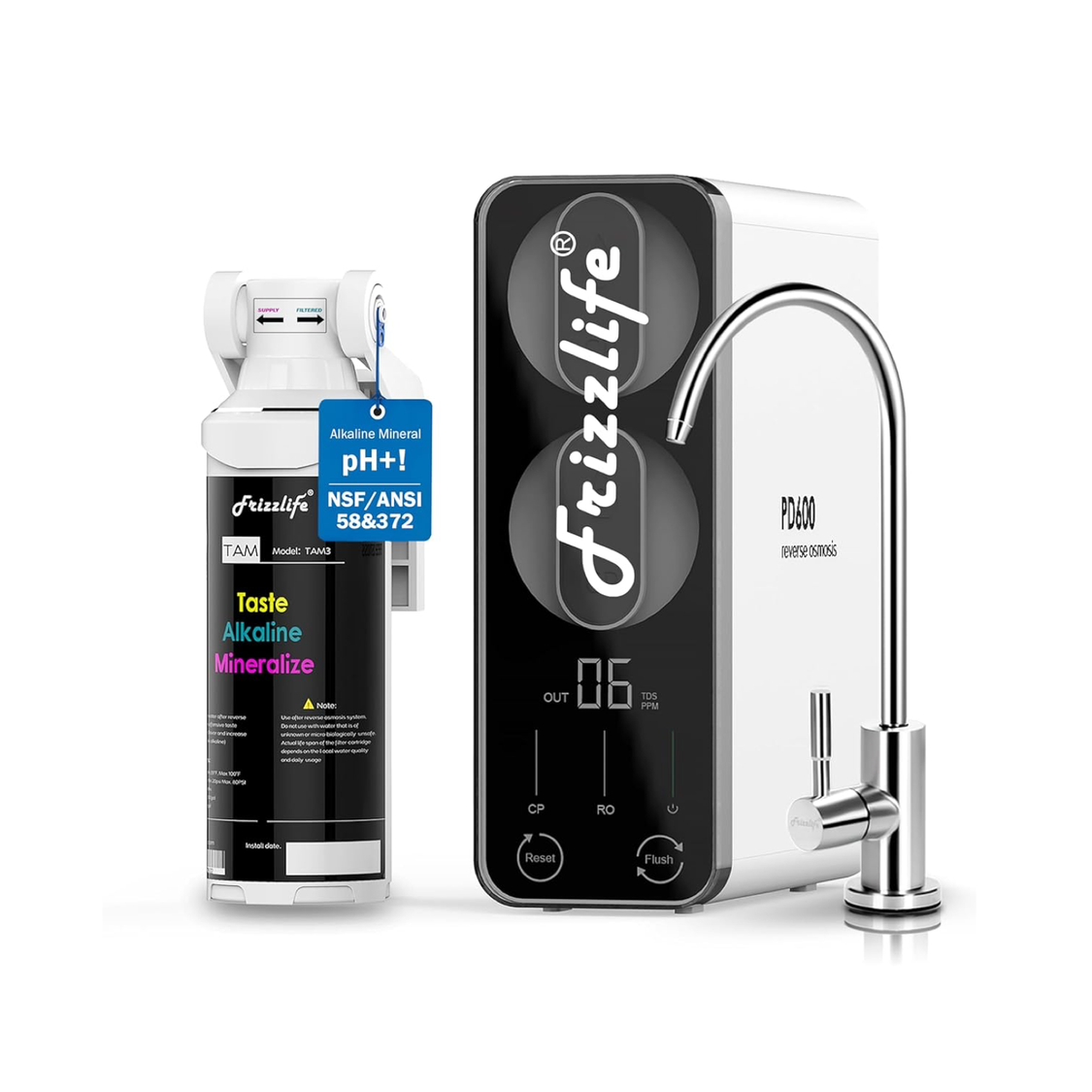
A 600 GPD tankless under-sink RO system with alkaline remineralization and real-time TDS monitoring. The product page lists SGS testing under NSF/ANSI 42, 53, and 58 and includes PFAS among the tested substances.
- 600 GPD tankless flow
- 2:1 pure-to-drain ratio
- Alkaline remineralization stage
- Review the product test report for specific PFAS details
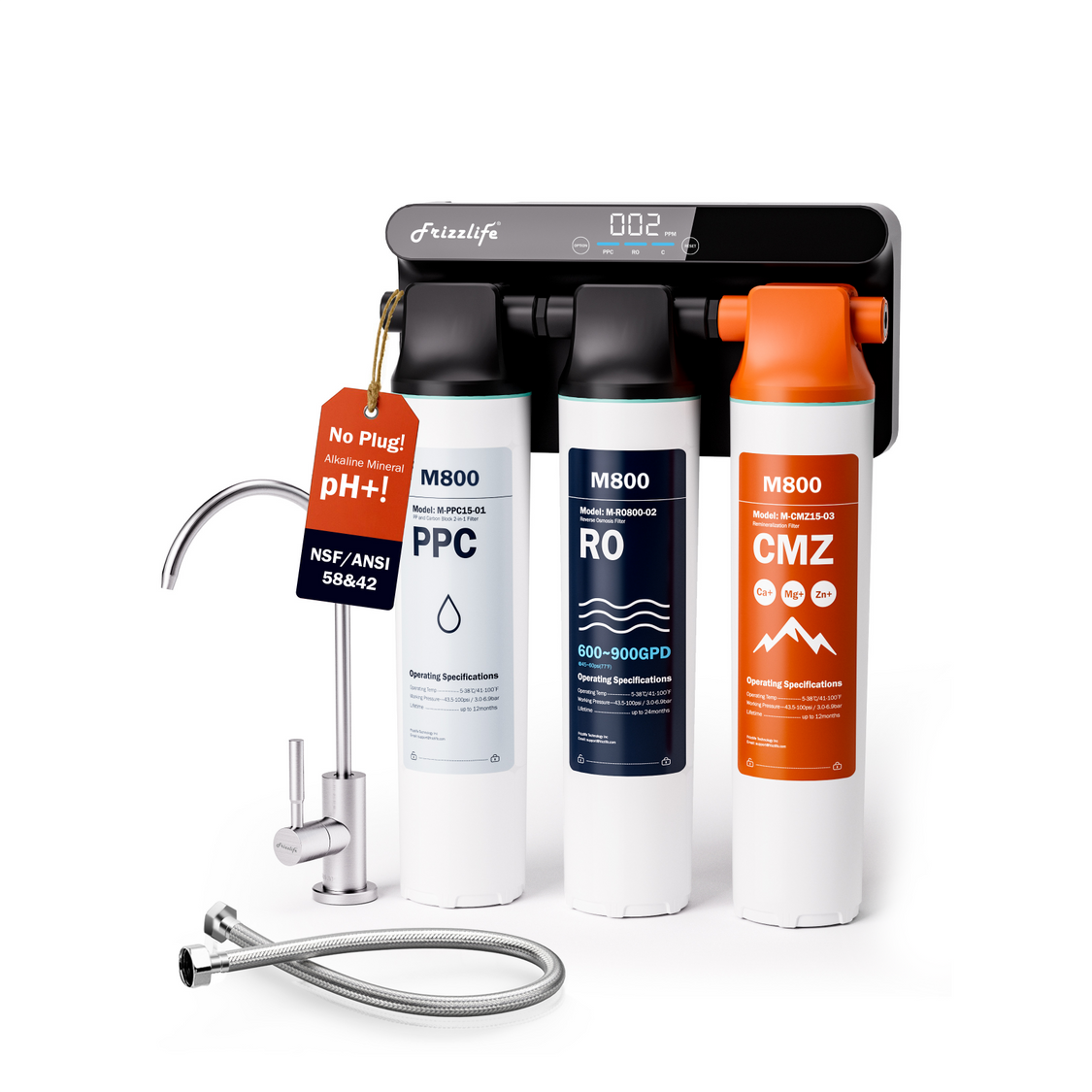
A 900 GPD tankless reverse osmosis system that operates using existing water pressure. The product page describes an eight-stage filtration process and includes PFOA and PFOS among its reduction claims.
- No electricity or storage tank required
- 900 GPD rated flow
- Eight-stage RO filtration
- Check product documentation for claim scope and conditions
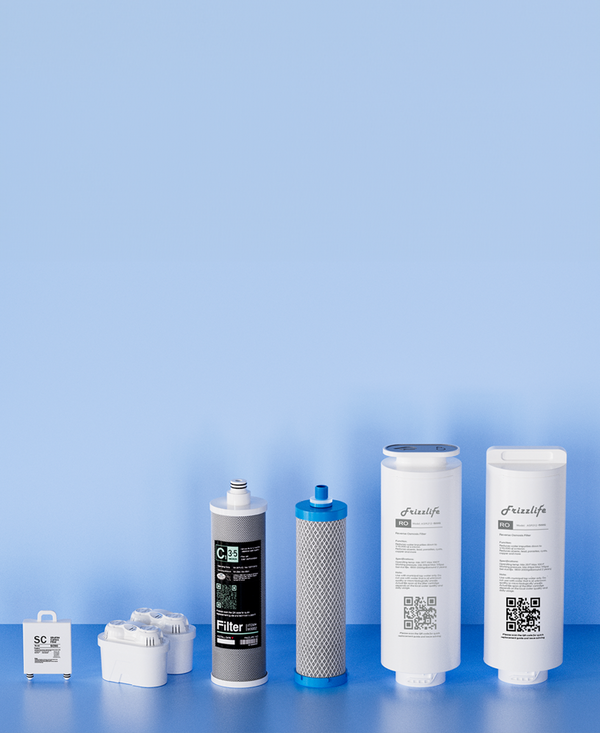
PFAS reduction performance depends on proper system maintenance. Use the model-specific replacement cartridges recommended for your system and follow the stated replacement schedule.
- Find filters by system model
- Replacement options for PD600-TAM3 and M800
- Check cartridge type and expected service life
- Avoid using unverified substitute filters
Product claims and test coverage vary by model. Review the current product specifications, certification scope, performance report, installation requirements, and replacement schedule before selecting a system for a specific PFAS concern.
PFAS Testing & Brand Transparency
How PFAS Testing Works: LOD, LOQ, Targeted vs Total Organofluorine
Finding Local PFAS Data (Tap Water) and Comparing Bottled Water
Home PFAS testing options
-
Decide if you’re testing tap, filtered, bottled water, or all three.
-
Use a certified lab and confirm which PFAS panel they test.
-
Follow sampling instructions exactly (timing, flushing, container handling).
-
Review results with detection limits in mind (non-detect isn’t zero).
-
If results are elevated, confirm with a second sample, then plan treatment.
Step-by-Step: Questions to Ask Bottled-Water Companies (COA & Sourcing Checklist)
-
Source location and type (spring, well, municipal).
-
Treatment steps used (e.g., reverse osmosis, activated carbon).
-
Most recent PFAS test report and full list of PFAS tested.
-
Lab name and accreditation for PFAS testing.
-
Reporting limits and batch/date the report applies to.

Final Takeaways
PFAS can occur in both bottled and tap water, and a product label alone cannot confirm whether water is PFAS-free. Recent FDA testing found relatively few detections in the bottled-water samples analyzed, while international research shows that more sensitive testing can detect low PFAS concentrations across many sources.
For households concerned about exposure, start with local water data or laboratory testing. When treatment is needed, compare verified activated carbon, ion exchange, and reverse osmosis options, and maintain the selected system according to its replacement schedule.
The most reliable decision is based on current testing, transparent source information, and product-specific reduction evidence—not broad claims about bottled, purified, spring, or filtered water.
Short FAQs
Are there PFAS in bottled water?
Yes, bottled water can contain PFAS. The amount can vary between brands, water sources, treatment facilities, and even production batches. A “spring,” “mineral,” or “purified” label does not by itself confirm that the water is PFAS-free. A recent product-specific test report is more useful than relying only on the packaging.
Is bottled water safer than tap water for PFAS?
Not always—either bottled water or tap water may contain PFAS. Purified bottled water may have lower levels when effective treatment is used, but bottled-water sources and processing methods vary. Tap-water results also differ by location, so check your local water-quality data before deciding. The safer choice is the one supported by current testing and transparent treatment information.
Does reverse osmosis remove PFAS?
Yes, reverse osmosis can substantially reduce many PFAS in drinking water. The actual result depends on the membrane, system design, incoming water, specific PFAS compounds, and filter condition. Not every RO system has the same tested performance, so look for a PFAS-specific NSF/ANSI 58 claim or relevant third-party laboratory report. Regular membrane and filter replacement also matters.
Will boiling water remove PFAS?
No, boiling is not a reliable way to remove PFAS from drinking water. PFAS do not behave like germs that can simply be killed with heat, and evaporation may leave contaminants more concentrated in the remaining water. Some laboratory results vary by compound and test conditions, but boiling should not replace verified treatment. Reverse osmosis, activated carbon, and ion exchange are more established options.
Can I test my water for PFAS at home?
Yes, you can collect a water sample at home, but the actual PFAS analysis is normally completed by a laboratory. Most home testing options are mail-in kits that include special containers and detailed sampling instructions. Choose an accredited lab and check which PFAS compounds are included in its testing panel. Follow the instructions carefully because improper handling can affect the result.
What filter removes PFAS best?
There is no single PFAS filter that is best for every household. Reverse osmosis, activated carbon, and ion exchange can all work, but their performance depends on the product design, water conditions, tested compounds, and maintenance schedule. Compare PFAS-specific certification or laboratory data rather than choosing only by filtration technology. The right system is one with verified performance that you can maintain consistently.
What are safe levels of PFAS in drinking water?
In the United States, the federal maximum contaminant levels for PFOA and PFOS in public drinking water are currently 4 parts per trillion each. These limits apply to regulated public water systems and do not cover every PFAS compound that may be present. Other PFAS requirements have been affected by regulatory proposals and may continue to change. Check current EPA and local guidance when reviewing a laboratory result.
References