


The Frizzlife MK99 is a direct-connect, non-reverse-osmosis water filtration system designed for use under a kitchen sink. It connects to the cold-water line and sends filtered water through the existing kitchen faucet, so most installations do not require a separate drinking-water faucet.
At the center of the system is a two-stage composite carbon block cartridge with a 0.5-micron nominal rating. The Frizzlife MK99 water filter is intended primarily for municipally treated water where the goals include reducing lead, chlorine, unpleasant taste and odor, and fine particulates without removing beneficial dissolved minerals.
This guide explains how the MK99 water filtration system works, what its certification language means, how it affects TDS, how to install and maintain it, and when a multi-stage or reverse osmosis system may be more appropriate.
Understanding the Frizzlife MK99 Water Filter
What type of filtration system is the Frizzlife MK99?
The Frizzlife MK99 is an under-sink point-of-use carbon filtration system. Unlike reverse osmosis, it does not use a membrane, storage tank, or wastewater drain connection. Water passes through the filter cartridge under the pressure supplied by the home’s cold-water plumbing.
Its defining characteristics include:
-
Direct connection to the kitchen cold-water line
-
Use of the existing kitchen faucet
-
Two-stage composite carbon block filtration
-
A 0.5-micron nominal filtration rating
-
Compatibility with common 3/8-inch connections and supplied adapters for certain 1/2-inch connections
-
Intended use with municipal water
-
An operating range of 20–80 psi and 39–100°F, according to the MK99 manual
Because it filters the cold-water supply going to the faucet, the MK99 is intended to provide filtered water for drinking, cooking, washing produce, and other normal kitchen uses. Actual flow depends on incoming pressure, plumbing layout, cartridge condition, and whether the filtered line also supplies another appliance.
How the two-stage composite carbon block filtration works
The MK99 uses a composite cartridge rather than two separate filter housings. Its filtration combines physical particle control with activated-carbon adsorption.
The stages can be understood as two complementary functions:
-
Fine particulate filtration: The cartridge helps capture sediment and suspended particles down to its nominal filtration rating.
-
Carbon adsorption: Activated carbon provides a large internal surface area that attracts and holds certain substances associated with chlorine taste, odor, and selected chemical contaminants.
A 0.5-micron nominal rating does not mean the filter removes every substance larger than 0.5 micron under every condition. “Nominal” describes the approximate particle-filtration performance of the media rather than an absolute barrier. It also says little by itself about dissolved chemicals.
Chemical reduction depends on the type and quantity of carbon, contact time, water chemistry, flow, and the specific contaminants for which the system has been tested or certified. That is why a micron rating should be considered alongside the system’s performance documentation—not treated as a universal contaminant-removal claim.
What the MK99 is designed to reduce—and what it does not address
Frizzlife’s current MK99 manual identifies IAPMO R&T certification to NSF/ANSI 42 and 53 for specified performance claims including chlorine, Particulate Class I, lead, and cyst reduction. Claims for other contaminants should be evaluated separately and should not be treated as certified unless they appear in the applicable certification listing or performance documentation. Frizzlife also reports manufacturer testing for additional categories such as mercury, volatile organic compounds, other heavy metals, and turbidity. These manufacturer-reported claims should not be interpreted as independent certification for every substance within a broad category.
For the most accurate evaluation, compare the current MK99 performance data or certification listing with the specific contaminant in your water. A general reference to “heavy metals” or “VOCs,” for example, does not establish identical performance for every metal or organic compound.
The MK99 is not designed to:
-
Remove most total dissolved solids
-
Remove hardness minerals such as dissolved calcium and magnesium
-
Reliably remove fluoride or nitrate
-
Desalinate brackish or salty water
-
Disinfect water containing bacteria or viruses
-
Make an unknown or microbiologically unsafe source safe to drink
-
Provide certified reduction for every contaminant covered by an NSF standard
The MK99 manual identifies municipal water as the applicable source. Private well water may contain microorganisms, iron, manganese, heavy sediment, nitrate, hardness, or other conditions that require testing and specialized treatment.
A carbon filter should not be relied on during a boil-water advisory unless local authorities specifically state that filtered tap water is safe. If microbiological safety is uncertain, follow public-health instructions rather than assuming that a 0.5-micron nominal carbon block provides disinfection.
How does MK99 water filter affect TDS/PPM in water?
The Frizzlife MK99 generally does not produce a major change in TDS or PPM readings. That is expected for a carbon-based under-sink filter and is not, by itself, evidence that the filter has failed.
TDS stands for total dissolved solids. A handheld TDS meter estimates the concentration of electrically conductive dissolved ions, including calcium, magnesium, sodium, chloride, and other minerals. Activated carbon primarily works through adsorption and particulate filtration; it does not remove most dissolved mineral ions.
The MK99 may substantially improve chlorine-related taste or odor while the TDS reading remains nearly the same. Likewise, TDS can change slightly because of temperature, meter accuracy, water chemistry, or normal variation in the municipal supply. A TDS meter cannot tell you whether lead, chlorine, individual VOCs, bacteria, or other specific contaminants are present at safe or unsafe concentrations.
Use the following table to match the treatment method to the water-quality goal:
| Water concern or goal | Is MK99 a practical fit? | What to expect |
|---|---|---|
| Chlorine taste or odor in municipal water | Often yes | Carbon adsorption is designed to improve chlorine-related taste and odor. |
| Lead reduction | Potentially, subject to current model-specific performance documentation | Verify the current certification listing or performance data for MK99 before relying on it for lead reduction, and replace the cartridge as directed. |
| Fine suspended particulates | Often yes | The 0.5-micron nominal composite filter is designed to capture fine particles, but it is not an absolute disinfection barrier. |
| Lowering TDS or PPM | No | Most dissolved minerals and salts pass through carbon filtration. |
| Removing water hardness | No | Standard MK99 filtration does not remove dissolved calcium and magnesium. |
| Helping manage scale formation | Consider the FZ-3 option | Scale inhibition may help limit deposits, but it does not soften water or significantly reduce TDS. |
| Fluoride, nitrate, or high dissolved salt | Usually no | A treatment technology selected specifically for the contaminant, often reverse osmosis, may be needed. |
| Bacteria, viruses, or unknown well-water safety | No | Test the water and use an appropriate disinfection and treatment plan. |
| A known contaminant such as PFAS | Verify before choosing | Do not assume coverage; look for model-specific certified performance for the exact contaminant. |
If your main goal is to verify contaminant reduction, use an appropriate laboratory water test or review your utility’s water-quality report. A TDS meter is useful for comparing dissolved-ion levels, but it is not a complete water-safety test.
What NSF/ANSI 42 and 53 claims mean for MK99 users
NSF/ANSI standards help consumers distinguish aesthetic filtration claims from health-related contaminant claims.
-
NSF/ANSI 42 addresses aesthetic effects, such as chlorine taste and odor and certain particulate-reduction claims.
-
NSF/ANSI 53 addresses health effects, including reduction claims for specified contaminants such as lead. Each contaminant must be evaluated separately.
A reference to NSF/ANSI 53 does not mean a filter reduces every contaminant covered by that standard. It also does not automatically establish PFAS, pharmaceutical, fluoride, nitrate, bacteria, or virus reduction.
There is also an important difference between these phrases:
-
Certified to a standard: A certification organization has evaluated and listed the product for specified claims.
-
Tested to a standard: Testing may have followed parts of the standard, but the language does not necessarily mean the product has a current third-party certification listing.
-
Manufacturer tested: The manufacturer reports test results, which should not be presented as independent certification.
Frizzlife states that the MK99 reduces lead, chlorine, taste and odor, and particulates, while identifying certain additional reductions as manufacturer-tested. Before purchasing the system for a known health-related contaminant, verify that a current certification listing or model-specific performance data sheet names the MK99 and the exact reduction claim. A reference to an NSF/ANSI standard should not be treated as certification for every contaminant covered by that standard.
Installation and Kitchen Faucet Compatibility
Can the MK99 be installed without a separate drinking-water faucet?
Yes. The MK99 is designed to connect inline with the existing cold-water supply and deliver filtered water through the main kitchen faucet. A separate drinking-water faucet is normally unnecessary.
This direct-connect configuration has several practical consequences:
-
No countertop hole is normally needed.
-
Cold water at the connected faucet passes through the filter.
-
Hot water remains on its existing supply and should not be routed through the MK99.
-
Filter use may be higher than with a small dedicated drinking faucet because normal cold-water tasks also consume filtered water.
Plumbing layouts vary. If the kitchen faucet, dishwasher, refrigerator, or another fixture shares branches under the sink, confirm which line the MK99 will serve before disconnecting anything.
Checking 3/8-inch and 1/2-inch cold-water connections before installation

The MK99 is designed around common 3/8-inch U.S. cold-water connections, with converter fittings supplied for compatible 1/2-inch configurations. Connection size alone does not guarantee that every plumbing layout will be a direct fit.
Before installation:
-
Trace the cold-water line from the shutoff valve to the kitchen faucet.
-
Confirm that you are working on the cold line, not the hot supply.
-
Identify the connection sizes at both the shutoff valve and faucet hose.
-
Inspect the valve and supply line for corrosion, damage, or nonstandard fittings.
-
Compare the existing connections with the MK99 manual and included components.
-
Make sure the shutoff valve closes completely before opening the plumbing.
Do not force mismatched threads or rely on excessive tightening to make an incompatible fitting seal. Cross-threading, a damaged washer, or an incorrectly seated push fitting can cause a slow leak even when the connection initially appears secure.
Older rigid plumbing, proprietary faucet fittings, or a valve that will not close may justify professional installation.
Under-sink space, water source, pressure, and temperature checks
Choose a location where the housing can remain upright and where there is enough clearance to remove and replace the cartridge. Avoid positioning it where waste lines, garbage disposal components, stored items, or cabinet doors place pressure on the tubing.
Check four conditions before mounting the system:
-
Water source: The MK99 manual specifies municipal water.
-
Pressure: The stated working range is 20–80 psi.
-
Temperature: The stated operating range is 39–100°F.
-
Service access: The cartridge and shutoff mechanism should remain accessible.
Low incoming pressure may produce disappointing faucet or refrigerator flow. Pressure above the rated range can increase stress on fittings and should be addressed before installation. The MK99 must remain on the cold-water line; hot water can damage filter media and system components.
Connecting, flushing, and checking the system for leaks
Follow the current MK99 manual for the exact fitting and mounting sequence. At a high level, installation involves shutting off the cold-water valve, relieving pressure at the faucet, inserting the filter assembly into the cold-water path, securing the housing, and restoring the water supply gradually.
After connection:
-
Confirm that all tubing is cut squarely and inserted fully where push fittings are used.
-
Open the cold-water valve slowly.
-
Inspect every connection while the system pressurizes.
-
Run cold water to flush the new cartridge according to the product instructions.
-
Close the faucet and inspect the fittings again under static pressure.
-
Recheck the cabinet later for moisture, since small leaks may take time to become visible.
Initial flushing removes loose carbon fines and trapped air. Temporary grayish water, cloudiness, or sputtering can occur until the system has been flushed and air has cleared.
Households comparing direct-connect designs, dedicated-faucet systems, and systems with additional stages can review Frizzlife’s broader selection of under-sink water filters.
Refrigerator and Ice-Maker Connections
How can I connect the MK99 filter system to the refrigerator/ice maker?
A refrigerator or ice maker can be supplied from a filtered cold-water line only when the plumbing configuration, tubing, fittings, appliance requirements, and available pressure are compatible. The connection normally requires a branch after the MK99 outlet so filtered water can travel to both the kitchen faucet and refrigerator.
Plan the installation before adding a tee:
-
Identify the MK99’s filtered-water outlet.
-
Determine the refrigerator’s required tubing size and connection type.
-
Use potable-water tubing and fittings rated for the plumbing pressure.
-
Route the line away from sharp cabinet edges, heat sources, hinges, and moving drawers.
-
Leave enough slack to move the refrigerator without pulling on the connection.
-
Avoid tight bends or kinks that restrict flow.
-
Keep a shutoff valve accessible for the refrigerator branch.
-
Protect tubing where it passes through a cabinet wall or floor.
Do not assume that an adapter fits simply because both connections have similar outside dimensions. Refrigerator lines frequently use smaller tubing than sink supply lines, so the tee and reducer must match the actual tubing and fitting standards.
A branch connection also divides available flow. If someone opens the kitchen faucet while the refrigerator is filling, appliance flow may temporarily fall. Long tubing runs, narrow refrigerator lines, partially closed valves, low supply pressure, and an aging cartridge can increase that effect.
Professional help may be appropriate when:
-
Tubing must run through walls, floors, or finished cabinetry
-
The existing refrigerator line uses a saddle valve
-
Plumbing connections are corroded or nonstandard
-
Incoming pressure is outside the MK99 range
-
Local plumbing requirements call for specific valves or backflow protection
-
The refrigerator manufacturer specifies a pressure or filtration configuration you cannot confirm
Always follow both the MK99 instructions and the refrigerator manufacturer’s installation requirements. If the appliance already contains an internal filter, consult its instructions before removing, bypassing, or continuing to use that filter.
Troubleshooting low refrigerator flow or leaks after connection
If refrigerator flow drops after connecting the MK99, check the simplest restrictions first:
-
Make sure the cold-water supply, MK99 shutoff, and refrigerator branch valve are fully open.
-
Check the new tubing for kinks, compression, or sharp bends.
-
Confirm that the tubing was inserted fully into each push fitting.
-
Flush trapped air from the line according to the appliance instructions.
-
Consider whether the cartridge is old or loaded with sediment.
-
Compare flow with the kitchen faucet open and closed.
-
Verify that household pressure meets both systems’ requirements.
For leaks, shut off the branch or cold-water supply before repositioning a fitting. Inspect the tube end for scratches, distortion, or an angled cut. Threaded joints, compression fittings, and push-to-connect fittings seal differently, so use only the sealing method specified for that fitting. Thread tape should not be added indiscriminately to connections that seal with washers, O-rings, or compression components.
Check the connection again after the ice maker completes several fill cycles. Intermittent appliance operation can reveal a leak that is not obvious during the initial inspection.
Frizzlife MK99 Filter Replacement and Maintenance
How often should the filter cartridges of MK99 be replaced?
The Frizzlife MK99 filter replacement interval is generally about 6–12 months, but the actual timing depends on water quality and household consumption. Frizzlife materials have referenced approximately 6–8 months in typical use, while manual guidance and other model documentation indicate that service may extend toward 8–12 months under suitable conditions.
Treat the interval as conditional rather than guaranteed. Replace the cartridge earlier if you notice:
-
A meaningful decline in filtered-water flow
-
The return of chlorine taste or odor
-
Unusual taste that persists after flushing
-
Visible sediment loading
-
Higher-than-normal household water use
-
A known change in municipal water conditions
A household that uses filtered cold water for cooking, filling large bottles, and supplying a refrigerator may reach the end of the cartridge’s useful life sooner than a low-use household. Sediment and other material in the incoming water can also block the media and cause an early pressure drop.
Do not extend cartridge use solely because the water still looks clear. Carbon adsorption capacity is not visible, and contaminant breakthrough can occur before a dramatic appearance change.
Identifying the correct FZ-2 replacement cartridge
The standard replacement cartridge for the MK99 is the FZ-2. When purchasing a replacement, confirm the exact cartridge designation and MK99 compatibility rather than choosing by housing appearance alone.
The replaceable core design allows users to change the filter cartridge without discarding the permanent outer housing. Before installation, inspect the new cartridge and seals for damage and keep the replacement wrapped until it is ready to be fitted.
Do not substitute a cartridge intended for another product family unless current Frizzlife documentation explicitly lists it as compatible.
When to consider the FZ-3 scale-inhibition option
Frizzlife offers the FZ-3 as a scale-inhibition option for certain M-series systems and markets. Frizzlife currently lists the FZ-3 replacement cartridge as compatible with the MK99 in its North American product documentation. The U.S. FZ-3 page also lists compatibility with MK99 NEW. FZ-3 is designed as a scale-inhibition option; it does not function as a conventional water softener and is not intended to substantially reduce TDS.
Scale inhibition is not the same as softening. The FZ-3 does not function like a conventional ion-exchange water softener, and it should not be expected to remove calcium and magnesium or cause a large reduction in TDS. Instead, it is designed to help limit how hardness minerals form deposits.
For severe hardness, persistent appliance scaling, or a need for truly softened water, test the water and evaluate a dedicated hardness-treatment system. The FZ-3 should be viewed as a scale-management option rather than a complete hard-water solution.
Replacing and flushing the cartridge correctly

Consult the current instructions before servicing the MK99. The system’s shutoff and twist-in design is intended to simplify cartridge changes, but water pressure should still be relieved before opening the housing.
A typical replacement process includes:
-
Clear the cabinet so the housing and shutoff are accessible.
-
Close the system’s water supply as instructed.
-
Open the cold-water faucet briefly to relieve pressure.
-
Place a towel or shallow container under the system.
-
Remove the used cartridge according to the indicated locking direction.
-
Check sealing surfaces and O-rings for dirt, twisting, or damage.
-
Install the correct FZ-2 or compatible FZ-3 cartridge.
-
Restore water slowly while watching for leaks.
-
Flush the new cartridge for the period specified in the instructions.
-
Recheck the system after it is fully pressurized.
Do not use tools to overtighten a cartridge designed to lock by hand. If a seal will not seat, remove the cartridge, inspect its alignment, and try again rather than applying additional force.
Record the replacement date inside the cabinet or set a calendar reminder. Time-based reminders are useful, but changes in flow and taste should also be monitored.
Troubleshooting Common MK99 Performance Issues
What to check when filtered-water flow drops
Reduced flow is most commonly associated with a restricted cartridge, a partly closed valve, low supply pressure, or a kinked line.
Work through these checks in order:
-
Confirm that the cold-water shutoff and system valve are fully open.
-
Look for bent or compressed tubing.
-
Check whether the issue affects cold water only or the entire faucet.
-
Determine whether a refrigerator branch is drawing water at the same time.
-
Review the cartridge’s age and recent water use.
-
Consider whether nearby utility work introduced extra sediment.
-
Verify that household pressure remains within the system’s operating range.
If flow returns after replacing an older cartridge, sediment loading was likely the cause. If a new cartridge has low flow immediately, verify installation orientation, valve position, flushing, and plumbing compatibility.
What to do if a fitting or filter housing leaks
Shut off the water before adjusting any leaking component. Dry the area completely so the source is easier to locate.
For a tubing connection, verify that the tube is:
-
Cut squarely
-
Free of deep scratches and burrs
-
Inserted to the fitting’s required depth
-
Not being pulled sideways
For a threaded or washer-sealed connection, check alignment and inspect the sealing component. Do not overtighten plastic parts. If the filter housing itself appears damaged, stop using the system and contact Frizzlife support rather than attempting to seal a crack externally.
After correcting the connection, restore pressure slowly and inspect it with a dry paper towel. Recheck after several hours.
Why water may taste different after installation or replacement
A new cartridge may release harmless loose carbon fines or contain trapped air. That can temporarily affect appearance or taste. Thorough flushing according to the product instructions usually resolves the issue.
Persistent taste changes can have other causes:
-
The cartridge was not flushed sufficiently.
-
A plumbing line or fitting introduced an odor.
-
Water remained stagnant during installation.
-
The cartridge is old and needs replacement.
-
The municipal supply changed temporarily.
-
The system was connected to an unsuitable water source.
If an unusual chemical, sewage-like, or otherwise concerning taste or odor continues, stop using the water until the source is identified. A filter should not be used to mask signs of a potentially unsafe supply.
MK99 Versus Multi-Stage and Reverse Osmosis Filtration
How does the MK99 compare with a multi-stage under-sink filter?
The MK99 combines two filtration functions within one composite cartridge. A multi-stage under-sink system typically separates treatment media into multiple cartridges or housings, allowing each stage to address a different task.
|
Decision factor |
Frizzlife MK99 |
Multi-stage under-sink system
|
|---|---|---|
|
Configuration |
One composite replacement cartridge |
Multiple separate stages or cartridges |
|
Installation |
Direct cold-line connection with fewer components |
May require more tubing, space, and connections |
|
Faucet arrangement |
Uses the existing kitchen faucet |
Varies by system; some use a dedicated faucet |
|
Maintenance |
One primary cartridge to track |
Multiple replacement schedules may apply |
|
Treatment flexibility |
Focused carbon-block filtration |
Can combine sediment, carbon, specialty, or membrane stages |
|
TDS reduction |
Not designed for meaningful TDS reduction |
Depends on media; non-RO stages may also leave TDS unchanged |
|
Cabinet space |
Relatively compact single-housing layout |
Usually requires more room |
More stages do not automatically mean better water. The important question is whether each stage has a defined purpose that matches the contaminants or water conditions in the home.
When additional filtration stages may be useful
Additional stages may make sense when the incoming water has:
-
Enough sediment to shorten carbon cartridge life
-
A contaminant that requires specialty media
-
Multiple documented concerns not addressed by one carbon block
-
Conditions that require pretreatment before the main filter
-
Treatment goals supported by separate, contaminant-specific certifications
Start with a water-quality report or laboratory test. Adding filters without identifying the problem can increase maintenance and pressure loss without delivering a meaningful benefit.
When reverse osmosis may be more appropriate than MK99
Reverse osmosis may be more appropriate when the main objective is to reduce TDS or dissolved contaminants that a carbon block does not effectively address. Depending on the system and its certified performance, these concerns may include fluoride, nitrate, dissolved salts, and certain other inorganic contaminants.
RO differs from the MK99 in several ways:
-
It uses a semipermeable membrane.
-
It is designed to reduce a broader range of dissolved substances.
-
It commonly lowers TDS significantly.
-
It usually has more filtration stages.
-
It may require a drain connection, dedicated faucet, storage tank, or electrical supply, depending on the design.
-
It generally involves more installation and maintenance.
The MK99 is usually the more straightforward choice when the goal is carbon filtration of municipal water while retaining dissolved minerals. For households that need substantial dissolved-solids reduction, Frizzlife’s reverse osmosis filter systems provide a different treatment approach.
Choose the Frizzlife Option That Fits Your Water Goals
Whether you prefer straightforward carbon filtration, are considering reverse osmosis, or simply need replacement filters, choose the option that best matches your current setup and water-treatment goals.
 Direct-Connect Filtration
Frizzlife MK99
A straightforward choice for municipal tap water when you want under-sink carbon filtration while continuing to use your existing kitchen faucet.
View MK99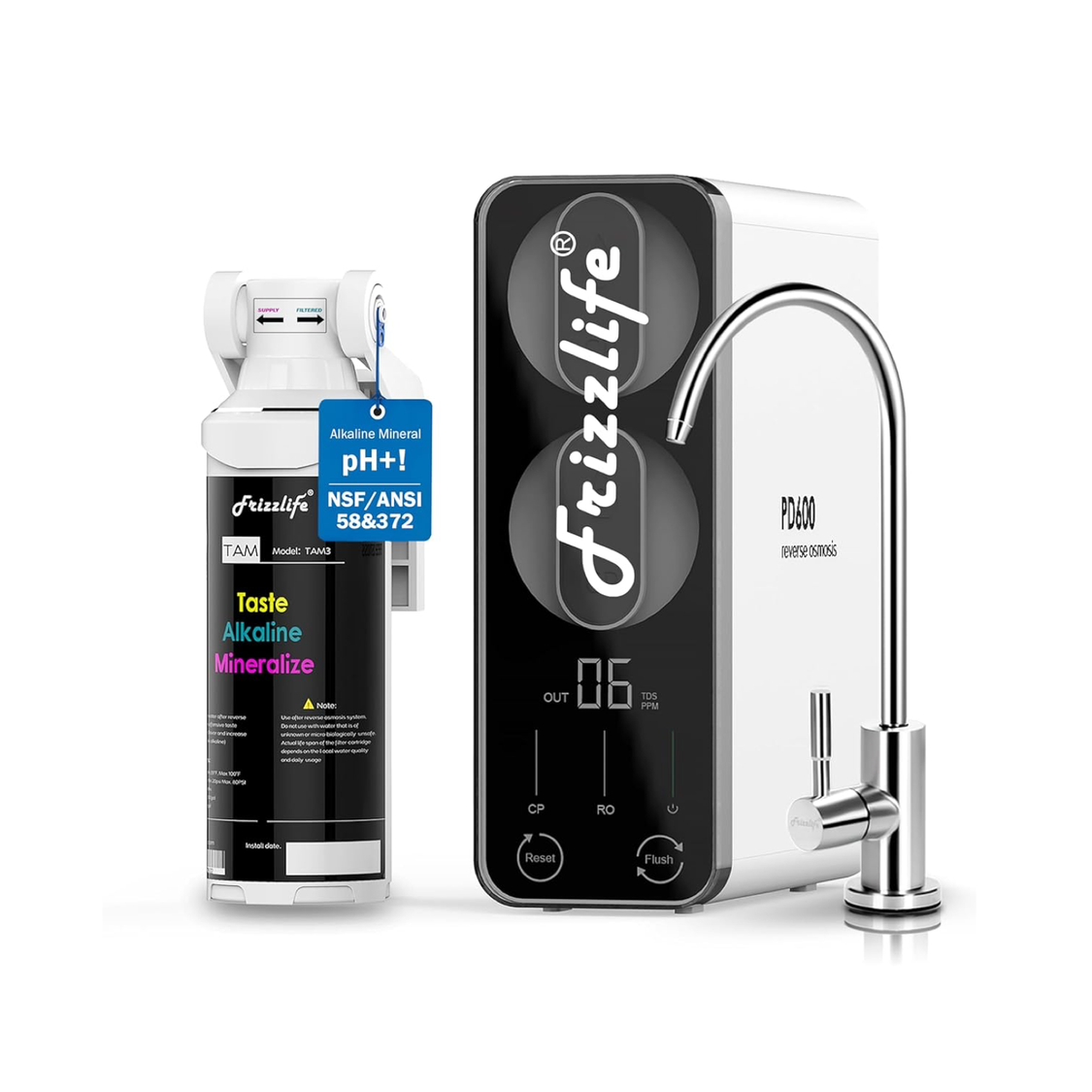 Reverse Osmosis Option
Frizzlife PD600-TAM3
For readers considering a move from carbon filtration to reverse osmosis when broader dissolved-solids reduction is part of the treatment goal.
View PD600-TAM3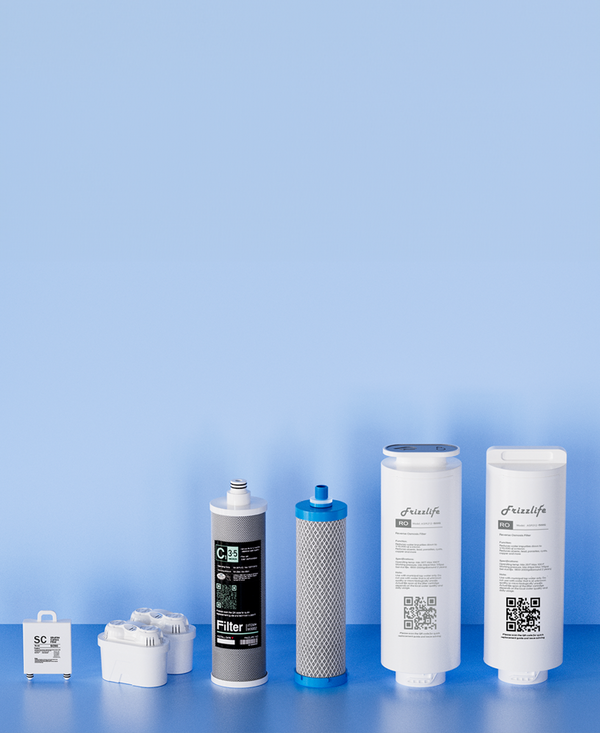 Filter Maintenance
Replacement Filters
Already own a Frizzlife filtration system? Find compatible replacement filters and keep routine filter maintenance on schedule.
Find Replacement FiltersIs the Frizzlife MK99 Right for Your Water?
When MK99 is a practical fit for municipal tap water
The Frizzlife MK99 can be a practical fit when all of the following are true:
-
The home receives microbiologically treated municipal water.
-
The primary concerns include chlorine taste, odor, lead, or particulates covered by the model’s documented claims.
-
The household wants to keep naturally occurring dissolved minerals.
-
A direct connection to the existing kitchen faucet is preferred.
-
The plumbing and operating conditions fall within the model’s specifications.
-
The owner is willing to replace and flush the cartridge regularly.
It may also appeal to renters or homeowners who want to avoid drilling a countertop hole, provided plumbing modifications are permitted and the existing connections are compatible.
When well water, microbiological risks, hardness, or specific contaminants require another treatment approach
The MK99 should not be treated as a universal water-purification system.
For private well water, obtain a laboratory test before choosing treatment. Depending on the results, a well may require sediment removal, iron or manganese treatment, softening, nitrate reduction, or disinfection. Carbon filtration may be one component of that plan, but it is not a substitute for source testing or pathogen control.
Likewise:
-
Microbiological risk: Use an appropriate disinfection strategy and follow public-health guidance.
-
Severe hardness: Consider a dedicated softening system; standard carbon filtration does not remove hardness minerals.
-
High TDS or dissolved salts: Consider treatment designed for dissolved-ion reduction.
-
Known PFAS or another specific contaminant: Require current, model-specific performance documentation for that exact substance.
-
Boil-water advisory: Follow local instructions; do not assume the MK99 makes the water safe.